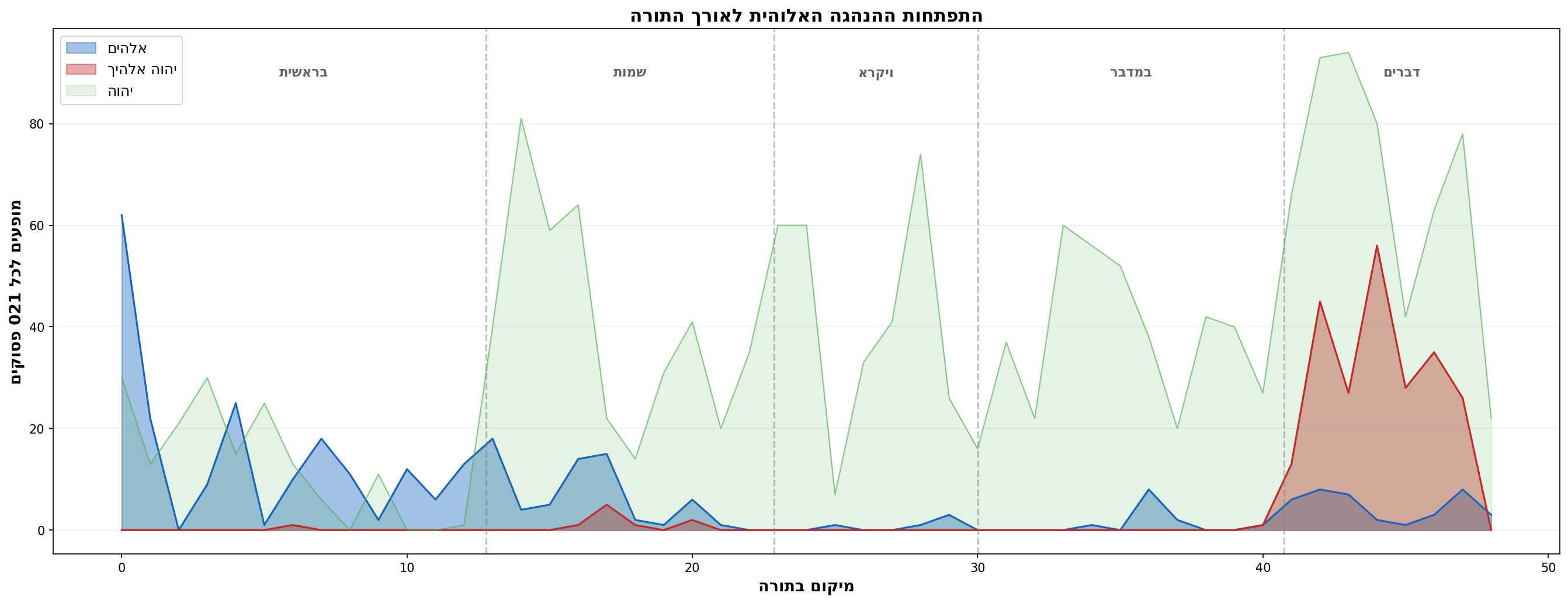
 Graph 2: Frequency of the three divine names across the Torah. Elohim (blue) dominates Genesis, YHVH (green) rises linearly, "the Lord your God" (red) appears only in Deuteronomy.
Part 2: The Bird That Was Not Cut — The Science Within the Song
By Eran Eliyahu Tobul and Yehonatan Tobul
When the children of Israel stand on the far side of the sea — Egypt behind them, desert before them, a new life they had never known — a mouth opens and a single word comes forth:
"I will sing to the Lord, for He has triumphed gloriously (אשירה ליהוה כי גאה גאה / ashirah la-Hashem ki ga'oh ga'ah)." (Exodus 15:1)
Five letters. א-ש-י-ר-ה (aleph-shin-yod-resh-heh). A single word that opens the first song in the Torah.
And not just any five letters. Five very specific letters. For when we examine the behavior of all twenty-two letters across the 5,846 verses of the Torah — we discover that precisely these five letters produce the three strongest tensions in the entire text.
In 2026 we published a statistical analysis of letter frequencies in the Torah, in windows of 100 verses, across all five books. The result: out of 231 possible pairs of 22 letters, three pairs stand out in sharp opposition — each time one letter of the pair rises, the other falls. Systematically. Across the entire text. In a manner not found in any random shuffling:
| Pair | Correlation (r) | Shuffles (0/500) | Meaning |
|---|---|---|---|
| א ↔ ש (aleph ↔ shin) | −0.567 | 0/500 | אש (esh) — fire |
| י ↔ ה (yod ↔ heh) | −0.535 | 0/500 | יה (Yah) — God's Name |
| ש ↔ ר (shin ↔ resh) | −0.502 | 0/500 | שר (shar) — song, root |
0 out of 500 shuffles — meaning that in no random ordering of the Torah's verses did a similar pattern occur. The probability: p < 0.002. This is not chance. This is not literary style. This is architecture embedded in the text itself.
But the finding is not confined to the Torah. We ran the same analysis on the three divisions of the Tanakh — Torah (5,846 verses), Prophets/Nevi'im (9,294), Writings/Ketuvim (8,064) — and found that the pattern changes sharply:
| Pair | Torah | Nevi'im (Prophets) | Ketuvim (Writings) |
|---|---|---|---|
| א ↔ ש (aleph ↔ shin) | −0.567 | +0.138 | −0.132 |
| י ↔ ה (yod ↔ heh) | −0.545 | −0.295 | −0.203 |
| ש ↔ ר (shin ↔ resh) | −0.502 | −0.061 | +0.165 |
Two of the three pairs — א↔ש (aleph↔shin) and ש↔ר (shin↔resh) — reverse or vanish outside the Torah. In the Prophets, aleph and shin actually move together (+0.138). In the Writings, shin and resh move together (+0.165). Only י↔ה (yod↔heh) is preserved throughout the Tanakh — but weakens: from −0.545 in the Torah to −0.295 in the Prophets and −0.203 in the Writings.
And the foundational letters confirm this: in the Torah they behave as nearly independent of one another (r = +0.014). In the rest of the Tanakh — they move together (r = +0.124). Nine times more correlated. As if the Torah operates a system that deliberately separates components — and no such system is found in any other part of the Tanakh.
But the rest of the Tanakh is not "without structure." It has a different structure: in the Prophets and Writings, the strongest pairs revolve around פ (peh) — ה↔פ (heh↔peh) (−0.614), ט↔פ (tet↔peh) (+0.550), פ↔ק (peh↔qof) (+0.523). The Torah revolves around ש (shin) (fire, name). The rest of the Tanakh revolves around פ (peh) (mouth, speech). Two texts. Two architectures.
And the question the data raises is not "what does this prove" — but: why does the Torah specifically build a consistent opposition between א (aleph) and ש (shin) and between ש (shin) and ר (resh), while the rest of the Tanakh almost never does?
Anyone attempting to answer this question must contend with an additional fact: precisely in the Name יהוה (YHVH) — which appears 1,821 times — the opposed י (yod) and ה (heh) dwell together. The Name is not merely an exception. It is a unique linguistic nexus where what the Torah almost always separates — unites. And the pattern of divine names sharpens this further: אלהים (Elohim) dominates Genesis, יהוה (YHVH) rises in a nearly linear fashion across the five books, and "יהוה אלהיך (YHVH Elohekha / the Lord your God)" — the combination of both — erupts only in Deuteronomy. A pattern spanning 5,846 verses — without faltering.
Graph 2: Frequency of the three divine names across the Torah. Elohim (blue) dominates Genesis, YHVH (green) rises linearly, "the Lord your God" (red) appears only in Deuteronomy.
And what are the five letters of the three pairs? א, ש, י, ר, ה (aleph, shin, yod, resh, heh).
אשירה (Ashirah).
And how many animals in the Covenant Between the Pieces? Five. Heifer (עגלה / eglah), goat (עז / ez), ram (איל / ayil), turtledove (תור / tor), young pigeon (גוזל / gozal). Five animals — five letters. Three beasts were cut — "each piece opposite its counterpart (איש בתרו לקראת רעהו / ish bitro likrat re'ehu)" — three pairs of halves facing halves, exactly like the three opposed pairs. And two birds — two outcomes: the young pigeon was cut and died, the turtledove remained alive. Death and life. The same structure: 3 + 2.
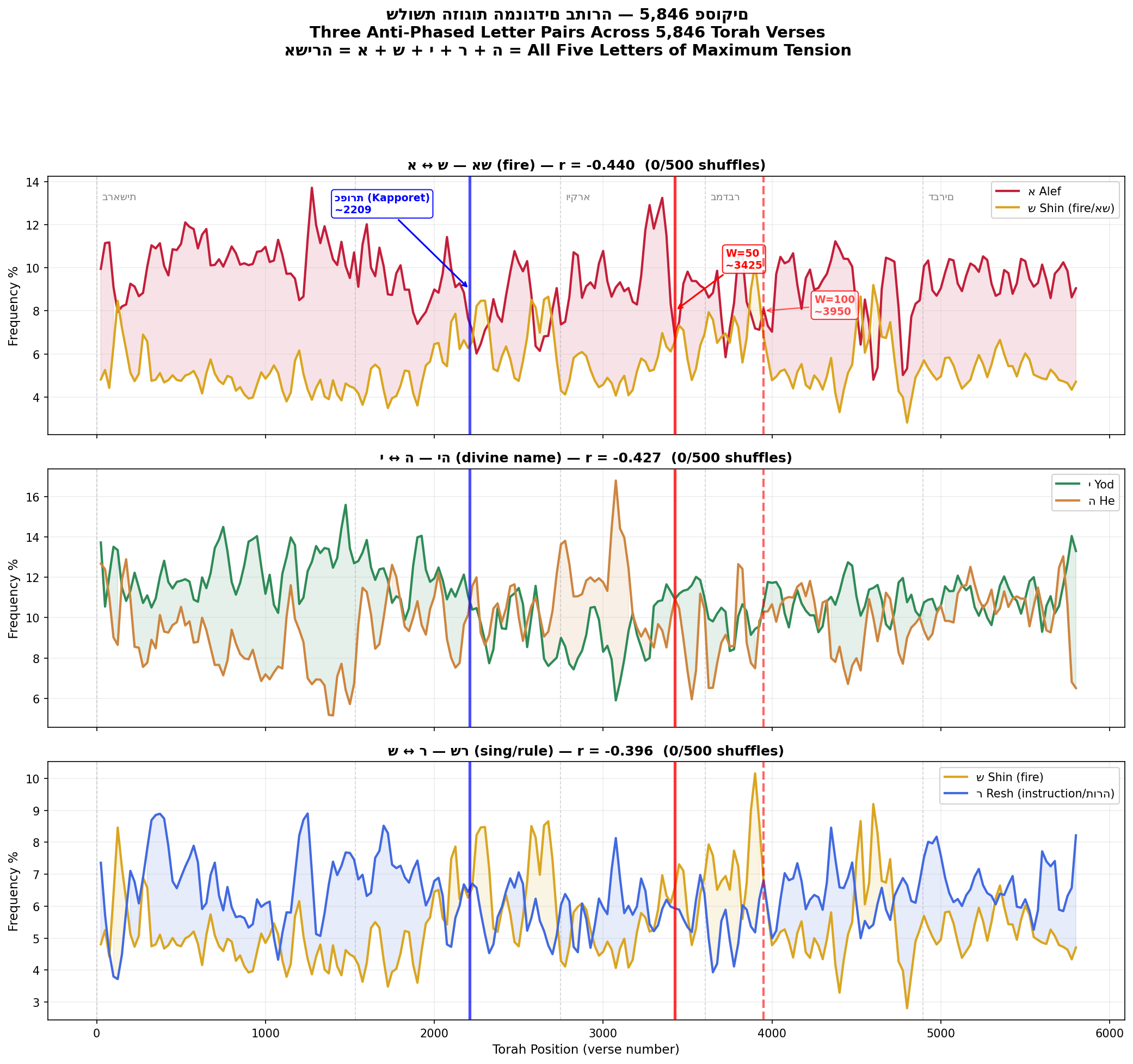 Graph 1: Frequency of the five letters across 5,846 verses of the Torah. Each pair is opposed: when one rises — the other falls. 0/500 shuffles for all three pairs.
And the next graph presents the strength of the opposition across the entire Tanakh — 23,204 verses in a single line. The further the line drops below zero — the stronger the opposition. The red line = the end of the Torah:
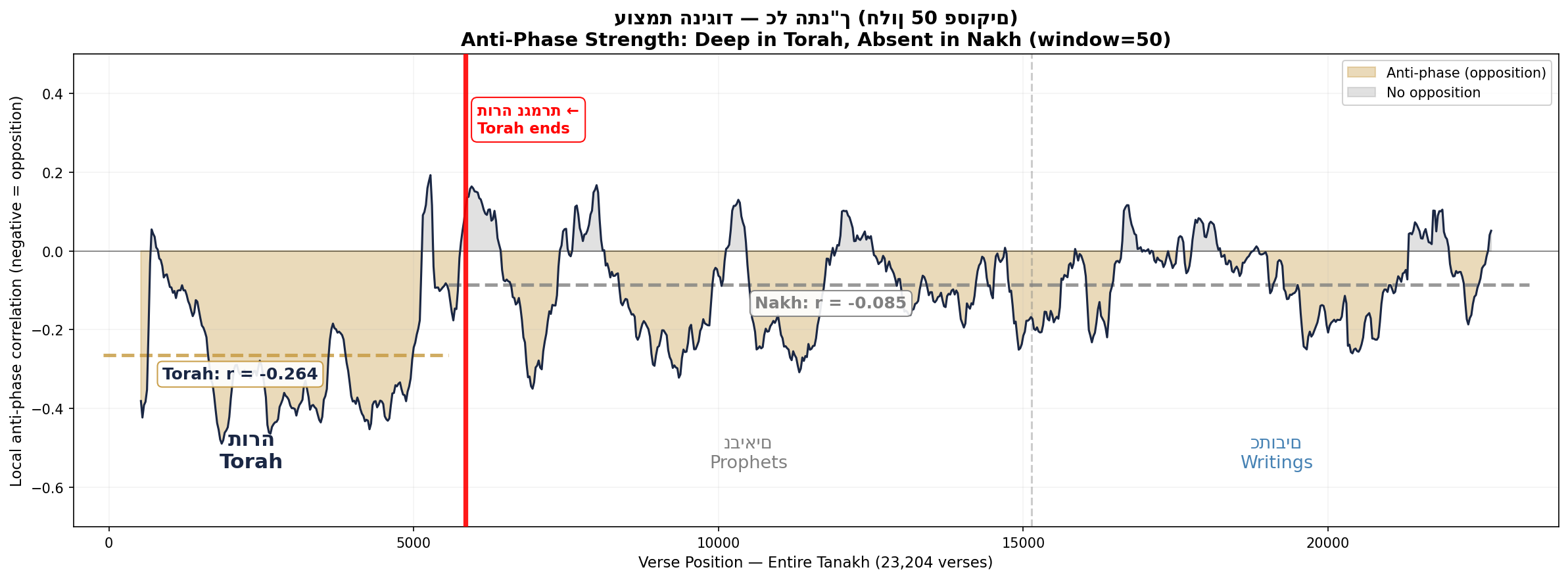 Graph 2: Opposition strength between the three pairs across the entire Tanakh. Gold = opposition active. Gray = no opposition. The red line = end of the Torah. Average in the Torah: r = −0.264. Average in the rest of the Tanakh: r = −0.085.
In the Torah — the line sinks deep below zero. Almost continuously. The opposition is alive and breathing. The moment the Torah ends — the line rises and oscillates around zero. The opposition vanishes. Not gradually — all at once.
| Pair | Torah | Nevi'im (Prophets) | Ketuvim (Writings) | What happens at the red line |
|---|---|---|---|---|
| א ↔ ש (aleph ↔ shin) | −0.563 | +0.142 | −0.136 | Reverses |
| י ↔ ה (yod ↔ heh) | −0.551 | −0.301 | −0.198 | Weakens gradually |
| ש ↔ ר (shin ↔ resh) | −0.503 | −0.040 | +0.188 | Vanishes → reverses |
And something remarkable: when we check where the three pairs come closest to convergence — at two different resolutions (windows of 50 and 100 verses) — the peaks fall on the same places: the vessels of the Tabernacle (the Kapporet, the Menorah, "And they shall make Me a sanctuary"), the separation of the Levites, and the festivals. Where holiness is most dense — there the oppositions converge.
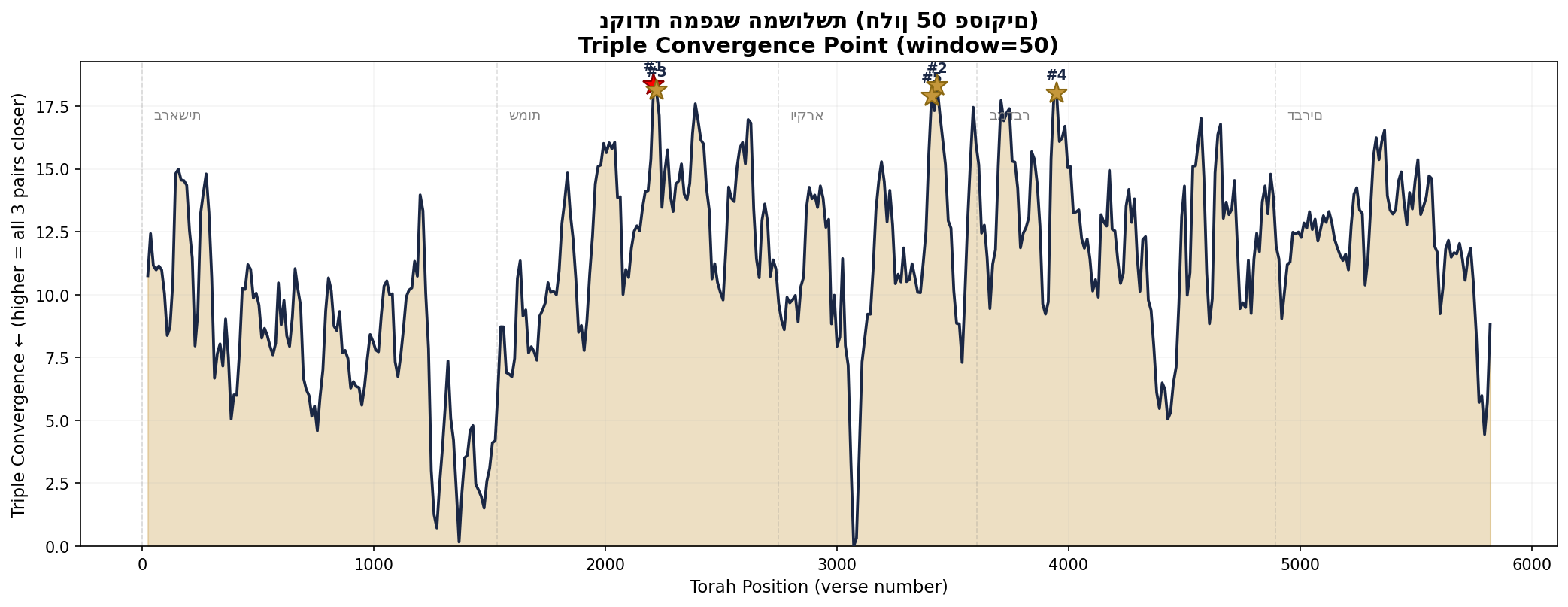 Graph 3: Convergence points of all three pairs (two resolutions). The peaks — Tabernacle, Levites, festivals — are stable across window sizes.
And there is one more place in the Torah where precisely these five letters appear — and only they:
"I will be what I will be (אהיה אשר אהיה / Ehyeh Asher Ehyeh)." (Exodus 3:14)
א-ה-י-ה (aleph-heh-yod-heh). א-ש-ר (aleph-shin-resh). א-ה-י-ה (aleph-heh-yod-heh).
The unique letters: א, ה, י, ש, ר (aleph, heh, yod, shin, resh). Five. The same five.
God says to Moses at the burning bush: אהיה אשר אהיה (Ehyeh Asher Ehyeh) — and the first word Moses speaks after crossing the sea: אשירה (Ashirah).
The same letters. The same tensions. The Name that was given = the song that was sung.
And in the bush itself — "and the bush burned with fire (והסנה בוער באש / ve-ha-sneh bo'er ba-esh)" — א-ש (aleph-shin / esh / fire). The first and strongest opposed pair (r = −0.567), burning before Moses. And Moses — מ-ש-ה (mem-shin-heh / Moshe) — carries within him the ש (shin) (fire) and the ה (heh) (direction). The bush burns and is not consumed — because in Moses, fire and water (מ / mem) dwell together. He is the vessel that holds opposites without their destroying one another.
And the word אשר (asher) itself — the central connecting word of the Torah, appearing 1,938 times — is built from א+ש+ר (aleph+shin+resh): precisely the three letters of the two opposed pairs that share ש (shin) (א↔ש, ש↔ר). The word that connects sentences in the Torah — is built from letters that repel one another. Connection is born from opposition.
And therefore 'אהיה אשר אהיה (Ehyeh Asher Ehyeh)' is not merely a name. It is a structure: אהיה (Ehyeh) = א+ה+י+ה = the third pair (י↔ה / yod↔heh) + א (aleph). אשר (Asher) = א+ש+ר = the other two pairs. אהיה (Ehyeh) connects אשר (Asher) — being connects opposites. And אשר+יה (asher + Yah) = אשירה (Ashirah) — when the connecting word meets the Name of God, song is born.
And here we return to the covenant.
"And he placed each piece toward its counterpart (ויתן איש בתרו לקראת רעהו / va-yiten ish bitro likrat re'ehu)." (Genesis 15:10)
Each half is placed opposite its other — toward its counterpart. Not in place of its counterpart. Not with its counterpart. Toward it — like two forces facing one another. Two halves with tension between them. Distance. And longing.
Like א (aleph) toward ש (shin). Like י (yod) toward ה (heh). Like ש (shin) toward ר (resh).
The opposed pairs in the Torah are not war — they are covenant. Each letter runs in the opposite direction — and this is what creates the tension that holds the text together, like two halves of an animal holding open the passage between them — the path through which the fire passes.
"A smoking furnace and a flaming torch that passed between the pieces (ותנור עשן ולפיד אש אשר עבר בין הגזרים / ve-tannur ashan ve-lappid esh asher avar bein ha-gezarim)." (Genesis 15:17)
Fire (אש / esh — א-ש / aleph-shin) passes between the pieces. Between the opposites. The covenant is forged within the tension — not in its resolution. Because the tension is the covenant.
And there is one place where the two strongest pairs sit in plain sight, within two words every child knows:
איש (ish / man) = א-י-ש (aleph-yod-shin). אשה (ishah / woman) = א-ש-ה (aleph-shin-heh).
Both contain א-ש (aleph-shin) — אש (esh / fire). Pair 1 (r = −0.567). The fire within each one. And what separates them? י (yod) versus ה (heh) — Pair 2 (r = −0.545). The two letters that repel each other throughout the Torah — and precisely here are divided: one in איש (ish / man), one in אשה (ishah / woman).
And already in the Gemara (Sotah 17a): "Man (איש / ish) and woman (אשה / ishah) — if they merit, the Divine Presence (שכינה / Shekhinah) dwells between them. If they do not merit — fire (אש / esh) consumes them." Remove the י (yod) from איש (ish) and the ה (heh) from אשה (ishah) — and what remains is אש (esh / fire) and אש (esh / fire). The union of י+ה = the Divine Presence (שכינה / Shekhinah). Separation = conflagration. The Gemara knew that י (yod) and ה (heh) are what transforms fire into life. Our data show: י (yod) and ה (heh) indeed repel each other (r = −0.545) — and precisely in God's Name and in the union of man and woman they unite.
And what of Pair 3 — ש↔ר (shin↔resh) (r = −0.502)? ר (resh) appears neither in איש (ish) nor in אשה (ishah). But it is written: "And they shall become one flesh (והיו לבשר אחד / ve-hayu le-vasar echad)" (Genesis 2:24). בשר (basar / flesh) = ב-ש-ר (bet-shin-resh). Shin and resh are opposed — but when man and woman unite, flesh (בשר / basar) is created = ש+ר (shin+resh) together. The third pair is revealed only in the result of the union.
| Pair | What It Is | Where It Appears |
|---|---|---|
| א↔ש (aleph↔shin) | אש (esh / fire) — what is within each one | א-ש in איש (ish) and אשה (ishah) |
| י↔ה (yod↔heh) | יה (Yah) — what separates and unites | י (yod) in ish, ה (heh) in ishah |
| ש↔ר (shin↔resh) | שר (shar) — what is created in union | ש-ר in "one flesh" (בשר אחד / basar echad) |
And if we take the letters of איש (ish) + אשה (ishah) = א, י, ש, ה (aleph, yod, shin, heh). One letter is missing to complete אשירה (Ashirah): ר (resh). And ר (resh) = what is born when they unite. Man + woman + union = א-ש-י-ר-ה (Ashirah).
משה (Moshe) = מ-ש-ה (mem-shin-heh). Three letters. Three elements:
| Letter | Element | Source |
|---|---|---|
| מ (mem) | Water (מים / mayim) | "For I drew him from the water (כי מן המים משיתהו / ki min ha-mayim meshitihu)" (Exodus 2:10) |
| ש (shin) | Fire (אש / esh) | "And the bush burned with fire (והסנה בוער באש / ve-ha-sneh bo'er ba-esh)" (Exodus 3:2) |
| ה (heh) | Direction | The ה (heh) of תורה (Torah), of צפרה (Tzipporah), of אברהם (Avraham) |
Moses = water + fire + heh. Opposites in one body. And this explains why he receives the Torah — for only one who holds opposites within can hold a text built upon opposites.
And there is something more: within מ-שה (Moshe) hides שה (seh / lamb) — a perfect lamb. The Passover offering. Moses is the lamb that came from the water. A shepherd carrying the flock within himself.
And מ-ה (mem-heh) (skipping the ש / shin) = מה (mah / what) — "And we, what are we (ונחנו מה / ve-nachnu mah)" (Exodus 16:7). Absolute humility. A question without an answer. The empty vessel that can contain everything.
In Part One we showed that יתרו (Yitro) + צפרה (Tzipporah) = תורה (Torah) + צפר (tzippor) + י (yod) (991 = 991). Now we can go a step further.
From the letters of the three people — יתרו (Yitro) (י-ת-ר-ו / yod-tav-resh-vav) + צפרה (Tzipporah) (צ-פ-ר-ה / tzadi-peh-resh-heh) + משה (Moshe) (מ-ש-ה / mem-shin-heh) — we can build:
ש (shin) (from Moshe) + י (yod) (from Yitro) + ר (resh) (from Tzipporah or Yitro) + ה (heh) (from Tzipporah or Moshe) = שירה (shirah / song).
The three of them together = song.
But אשירה (Ashirah) requires one more letter: א (aleph). And א (aleph) is not found in any of the three. The א (aleph) — Aleph — is the Creator. The One. The One above.
| Word | Letters | Who Sings | Gematria |
|---|---|---|---|
| שיר (shir / song) | ש+י+ר | Moshe+Yitro+Tzipporah | 510 |
| שירה (shirah / song) | ש+י+ר+ה | The three of them (with heh) | 515 |
| אשירה (Ashirah / I will sing) | א+ש+י+ר+ה | The three + the Creator | 516 |
The difference between שירה (shirah) and אשירה (Ashirah) = 1 = א (aleph) = Aleph = One — the Creator Himself.
The three human beings can produce song (שירה / shirah). But for אשירה (Ashirah / I will sing) — one needs the One. The One who passes between the pieces. The א (aleph) inside א-ש (aleph-shin / fire).
And therefore the verse says: "אשירה ליהוה (Ashirah la-Hashem / I will sing to the Lord)" — the א (aleph / the Creator) + שירה (shirah / the song of the three) = directed to יהוה (YHVH) = י (yod) (Jethro) + ה (heh) (Zipporah) + ו (vav) (Jethro) + ה (heh) (Moses). The song goes to the Name they themselves carry.
Among these three people the four letters of God's Name are distributed:
| Letter of the Name | Who Carries It | How |
|---|---|---|
| י (yod) | Jethro (יתרו) | י-תרו — the first letter of his name |
| ה (heh) first | Zipporah (צפרה) | צפר-ה — the heh that completes תור (tor) → תורה (Torah) |
| ו (vav) | Jethro → Moses | Passes between them (יתרו → יתר / Yitro → Yeter) |
| ה (heh) second | Moses (משה) | מש-ה — the heh of the receiver |
Three people. One Name. י-ה-ו-ה (Y-H-V-H).
And perhaps this is why — "meshulleshet (משולשת / threefold)." Not merely "three years old." Three who create a single wholeness. Just as the heifer, the goat, and the ram — all are threefold. Because three is the number at which opposites become whole.
And the word itself hints: מ-ש-ולשת (m-sh-ulleshet) — opens with the letters of משה (Moshe). מש (msh) = Moshe. שלש (shalosh) = three. משולשת (meshulleshet) = Moses who made three (שילש / shillesh). The one who carries water and fire and direction — is the one who makes three. He is the one who turns two-in-opposition into three-in-wholeness.
And as if that were not enough — here is a partial list of what can be built only from the 11 letters of the three of them (י-ת-ר-ו-צ-פ-ר-ה-מ-ש-ה / yod-tav-resh-vav-tzadi-peh-resh-heh-mem-shin-heh):
| Word | Meaning | Contributor |
|---|---|---|
| יהוה (YHVH) | God's Name | י+ו from Yitro, ה+ה from Tzipporah+Moshe |
| תורה (Torah) | Torah | ת+ו+ר from Yitro, ה from Tzipporah/Moshe |
| תור (tor) | Turtledove/Torah root | Yitro |
| פרה (parah) | Red Heifer | Tzipporah |
| צפר (tzippor) | Bird | Tzipporah |
| צור (tzur) | Flint/rock | צ+ר from Tzipporah, ו from Yitro |
| שרפ (saraf) | Fiery serpent | ש from Moshe, ר+פ from Tzipporah |
| פרש (parash) | Interpretation (saraf reversed) | פ+ר from Tzipporah, ש from Moshe |
| שפר (shofar) | Shofar/Shifrah | ש from Moshe, פ+ר from Tzipporah |
| מצר (metzar) | Egypt/distress | מ from Moshe, צ+ר from Tzipporah |
| שרה (Sarah) | Sarah our mother | ש from Moshe, ר+ה from Tzipporah |
| שיר (shir) | Song | ש from Moshe, י from Yitro, ר from Tzipporah |
| רפ (ref) | Healing | Tzipporah |
| צר (tzar) | Distress/oppressor | Tzipporah |
Three people. 11 letters. And within them: God's Name, Torah, heifer, bird, flint, fiery serpent, shofar, Egypt, Sarah, song, healing — and the entire story.
In Part One we saw that the Midianites are called "צוררים (tzorerim / harassers)" — "for they are harassers (צוררים / tzorerim) to you" (Numbers 25:18). צר (tzar) = pressure, constriction, distress.
And the name צפרה (Tzipporah) = צ-פ-ר-ה (tzadi-peh-resh-heh). The letter פ (peh) enters within צר (tzar) and breaks it open:
צר (tzar) → צ-פ-ר = צפר (tzippor) = bird. Pressure becomes flight.
And פ (peh) = mouth. Speech. Fertility. And also: פרה (parah) = what is fruitful, what spreads.
And therefore when Zipporah takes the צור (tzur) — an instrument bearing the name of harassers (צוררים / tzorerim) — she transforms it into an instrument of liberation: "And she cut (ותכרות / va-tikhrot)... and He released him (וירף ממנו / va-yeref mimenu)" (Exodus 4:25–26). And וירף (va-yeref) = רפ (ref) = healing = the reversal of צר (tzar). She whose name carries the breaking of צר (tzar) — is the one who brings רפ (ref / healing).
צר (tzar) → צפר (tzippor) → וירף (va-yeref). Pressure → bird → healing.
And after seeing the science — we return to Jethro. To his three names. And now we see an order we did not see before:
| Name | What It Holds | State of Torah |
|---|---|---|
| רעואל (Re'uel) | ר+ו (resh+vav) imprisoned within רע+אל (ra+El) | Torah hidden in darkness |
| יתרו (Yitro) | ר+ו in reverse order (ר-ו instead of ו-ר) | Torah seeking a recipient |
| יתר (Yeter) (without vav) | ר (resh) without ו (vav) | ו (vav) passed to Moses (the staff) |
| יתרו (Yitro) (again) | ר+ו returned | He sent Moses away = reconnection |
| חובב (Chovav) | Without ר, without ו | Torah went out into the world. What remains: debt + affection |
In רעואל (Re'uel) — the ר (resh) and ו (vav) are imprisoned in darkness. In יתרו (Yitro) — they are outside, searching. In חובב (Chovav) — they are already in the world. They are in the Torah. And what remains in Jethro = חוב (chov / debt) (he deserves it) + חיבה (chibbah / affection) (he is loved).
And this is not a metaphor. The ר (resh) in Jethro is the ר (resh) of תורה (Torah), of הוראה (hora'ah / teaching), of מורה (moreh / teacher). When it departs from him — it goes to its place: into a Torah scroll named after him.
And now the circle closes:
At the bush: God says אהיה אשר אהיה (Ehyeh Asher Ehyeh) = א, ש, י, ר, ה. At the sea: Moses says אשירה (Ashirah) = א, ש, י, ר, ה. In the graph: these five letters = the three greatest tensions in the Torah.
God gave Moses the letters. Moses returned them as song. And the entire Torah — from Genesis to "before the eyes of all Israel" — is built upon the tensions between those same five letters. Aleph against shin. Yod against heh. Shin against resh. Opposition that creates wholeness.
And "each piece toward its counterpart (ויתן איש בתרו לקראת רעהו / va-yiten ish bitro likrat re'ehu)" — is the same principle. Half against half. Tension that holds a covenant. Fire that passes between the pieces (אש שעוברת בין הגזרים / esh she-overet bein ha-gezarim) = א-ש (aleph-shin) passing between the opposites.
The bird that was not cut — the תור (tor / turtledove) — carries within her ת-ו-ר (tav-vav-resh). And תור (tor) + ה (heh) = תורה (Torah). And the Torah is built upon אשירה (Ashirah). And אשירה (Ashirah) = the five letters of tension. A complete circle. From the covenant — through the bush — through the sea — to the graph that shows this is not imagination.
For the slaughtered bird does not sing — but the Torah sings. And now we have a framework that unifies all the findings.
The song is not merely a response to a miracle — it is testimony that the Torah is built upon the same tension that created the covenant in the first place.
← Back to Part 1: The Bird That Was Not Cut
Part 2 of "The Bird That Was Not Cut" — an essay from the book "Bound by Design." Data: 5,846 verses, 306,269 letters, 500 shuffles, p < 0.002. Root search tool: boundbydesign.org/search_roots.html The full book: **boundbydesign.org