Eran Eliyahu Tobul and Yehonatan Tobul
"This paper does not seek to replace peer-reviewed academic research, does not claim finality, and offers no theological interpretation. The data are independently verifiable and all tools and code are available for full replication. Other explanations for what we describe here may well exist."
Abstract: The Torah exhibits a striking anti-phase pattern between three letter-pairs — א→ש (aleph→shin), י→ה (yod→he), and ש→ר (shin→resh) — derived automatically from its two most frequent words: יהוה (YHWH) and אשר (asher, "that/which"). The signal is 2.2× stronger than in the rest of the Hebrew Bible, stable across every tested threshold parameter (8–30 letters), present in all five books of the Torah (5/5), and absent from every one of the 34 books of Nevi'im and Ketuvim (0/34). It survives the removal of the most frequent words, opens at the deepest point in the entire Hebrew Bible — the verse "This is the book of the generations of Adam" (Genesis 5:1) — and terminates sharply at the Deuteronomy→Joshua boundary, the steepest transition across all 39 books. The Score = the sum of absolute values of the three strongest anti-correlations.
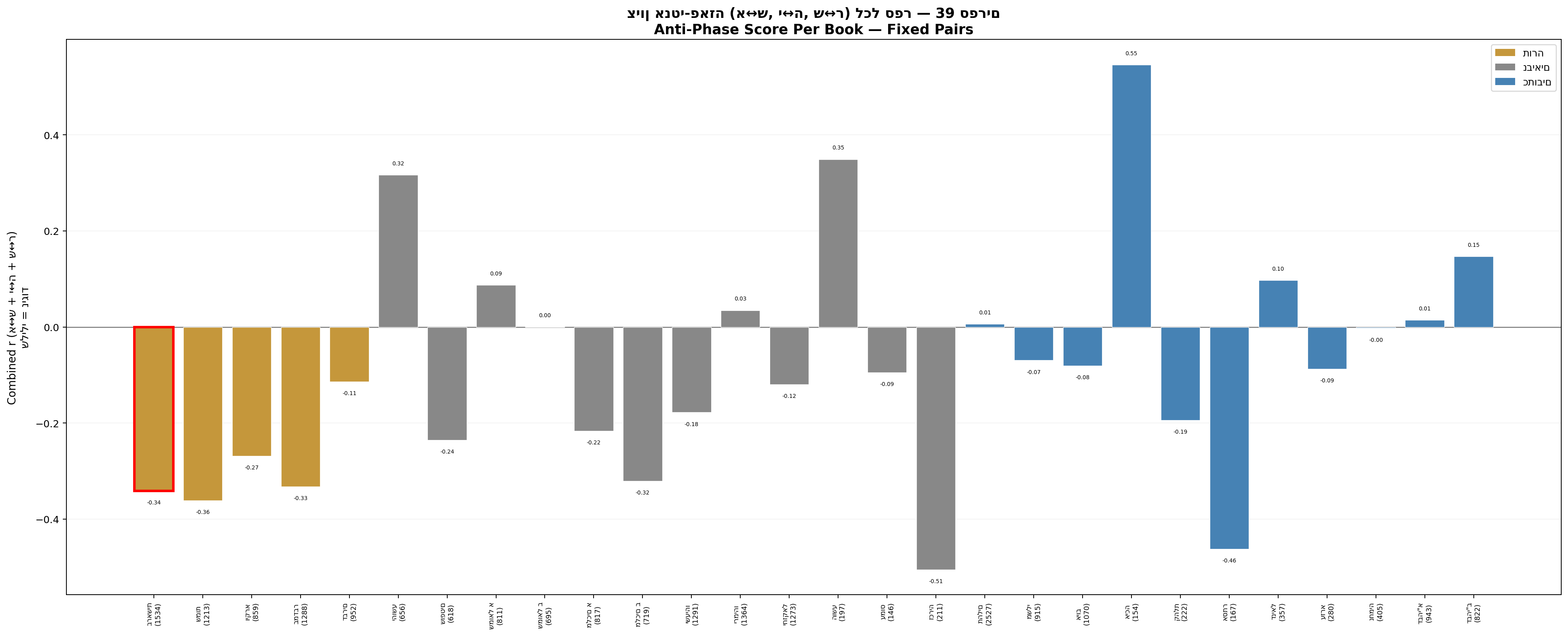
Is there a statistical property that distinguishes the five books of the Torah from all 34 books of Nevi'im (Prophets) and Ketuvim (Writings) — not at a theological level, not at a literary level, but at the level of pure mathematics?
To answer this question, the methodology must satisfy three non-negotiable conditions: (1) fully automatic — no human selection of parameters; (2) content-blind — no prior knowledge of which text is "Torah" and which is "Prophets"; (3) stable — producing identical results across a wide parameter range.
All methodological decisions were fixed before examining results: Pearson correlation as the standard linear measure, top-3 as the selection criterion, verses as the natural unit of text, consecutive letter pairs in natural word order, and the 0.3% frequency threshold for function-word removal. No parameter was modified after observing outcomes.
Before any analysis, we removed from the entire Hebrew Bible nine common two-letter function words:
את (et), כי (ki), אל (el), לא (lo), על (al), כל (kol), לו (lo), עד (ad), לי (li)
These are every two-letter word constituting more than 0.3% of all words in the Hebrew Bible — a pre-defined threshold. They carry no book-specific information. The filter is applied uniformly to the entire Hebrew Bible, with no distinction between Torah and non-Torah. (Note: even without filtering, the three pairs א→ש, ש→ר, י→ה remain in the Top 3 in every case. Filtering merely removes noise and clarifies the picture.)
For each corpus (Torah, Prophets, Writings, or an individual book), we counted the frequency of every word and ranked them from most to least frequent.
Starting from the most frequent word, we accumulated letters until reaching a fixed threshold. We tested every threshold from 8 to 30 letters. For example: if the threshold is 12 and the first word contains 4 letters, we continue to the second and third words until at least 12 letters are accumulated.
From each word, we extracted consecutive letter-pairs in the natural order of the word. That is: from the word אשר (asher), we obtain the pairs א→ש (aleph→shin) and ש→ר (shin→resh). From the word יהוה (YHWH), we obtain י→ה (yod→he), ה→ו (he→vav), and ו→ה (vav→he). Pairs were extracted within words only — never across word boundaries.
The methodology requires the researcher to choose no letters, no pairs, and no parameters. It is fully automatic: count words, accumulate letters, extract pairs. Any researcher who runs the same algorithm on the same text will obtain exactly the same results.
In the Torah, the two most frequent words (after filtering function words) are:
These two words alone — 7 letters in total — already contain all three pairs that will prove statistically significant:
No matter how many letters you accumulate — 8, 12, 16, 20, 24, or 30 — these three pairs always remain the three strongest:
| Letter Threshold | Torah Score | Nach Score | Ratio | א→ש, ש→ר, י→ה = Top-3? |
|---|---|---|---|---|
| 8 | 1.042 | 0.471 | 2.21× | ✓ 3/3 |
| 10 | 1.064 | 0.478 | 2.23× | ✓ 3/3 |
| 12 | 1.089 | 0.485 | 2.25× | ✓ 3/3 |
| 14 | 1.078 | 0.480 | 2.25× | ✓ 3/3 |
| 16 | 1.085 | 0.483 | 2.25× | ✓ 3/3 |
| 18 | 1.070 | 0.479 | 2.23× | ✓ 3/3 |
| 20 | 1.075 | 0.481 | 2.23× | ✓ 3/3 |
| 24 | 1.068 | 0.477 | 2.24× | ✓ 3/3 |
| 30 | 1.055 | 0.470 | 2.24× | ✓ 3/3 |
At every threshold — without exception — the same three pairs lead, and the Torah-to-Nach ratio stands at 2.2×–2.25×. This is the stability profile of structure, not of an arbitrary result.
The complete table — containing anti-phase scores for all 39 books of the Hebrew Bible — is available interactively at:
The reader is invited to examine the data firsthand, sort by column, and verify every number.
| Torah | Nevi'im (Prophets) | Ketuvim (Writings) | |
|---|---|---|---|
| Top-3 Score | 1.089 | 0.485 | 0.486 |
| Strongest Pair | א→ש = −0.397 | ה→ו = −0.200 | ו→א = −0.262 |
| Pairs above 0.25 | 3 | 0–1 | 1 |
The "score" represents the sum of absolute values of the three strongest negative correlations. The higher the score, the stronger the anti-phase — meaning a mechanism pushes certain letters to appear separately from one another at the verse level.
In the Torah, three pairs cross the 0.25 threshold: א→ש (aleph→shin, −0.397), ש→ר (shin→resh, −0.356), י→ה (yod→he, −0.336) — precisely the three pairs derived automatically by the methodology.
In Nevi'im, the strongest pair is ה→ו (he→vav, −0.200) — below 0.25 in most books. In Ketuvim, ו→א (vav→aleph, −0.262) crosses the threshold in one or two books — but not a single book exhibits three strong pairs.
| Book | א→ש | ש→ר | י→ה | All three? |
|---|---|---|---|---|
| בראשית (Genesis) | ✓ | ✓ | ✓ | ✓ |
| שמות (Exodus) | ✓ | ✓ | ✓ | ✓ |
| ויקרא (Leviticus) | ✓ | ✓ | ✓ | ✓ |
| במדבר (Numbers) | ✓ | ✓ | ✓ | ✓ |
| דברים (Deuteronomy) | ✓ | ✓ | ✓ | ✓ |
| יהושע (Joshua) | ✗ | ✗ | ✗ | ✗ |
| שופטים (Judges) | ✗ | ✗ | ✗ | ✗ |
| ישעיהו (Isaiah) | ✗ | ✗ | ~ | ✗ |
| ירמיהו (Jeremiah) | ✗ | ✗ | ~ | ✗ |
| יחזקאל (Ezekiel) | ✗ | ✗ | ✗ | ✗ |
| תהלים (Psalms) | ✗ | ~ | ✗ | ✗ |
| משלי (Proverbs) | ✗ | ✗ | ✗ | ✗ |
| איוב (Job) | ✗ | ✗ | ✗ | ✗ |
| דניאל (Daniel) | ✗ | ✗ | ✗ | ✗ |
| ... | ... | ... | ... | ... |
(~ = near threshold but does not cross it)
5 out of 5 Torah books exhibit all three pairs. 0 out of 34 Nach books exhibit all three.
In a permutation test with 10,000 shuffles — where in each of the 10,000 permutations, we randomly shuffled the order of verses in the Torah (5,846 verses). The content and length of each verse were preserved — only its position in the sequence changed. After each shuffle, the entire algorithm was re-run from scratch: word frequency counting, selection of the most frequent words, extraction of consecutive pairs, re-selection of the three strongest pairs, and score computation. In other words: not only the score was recomputed — the pairs themselves were re-selected in every permutation. This is a particularly stringent test, giving each shuffle the best possible opportunity to produce a high score each time — zero shuffles produced a score equal to or exceeding the Torah's. The empirical p-value is therefore < 0.0001.
The five letters composing the three pairs are: א (aleph), ש (shin), ר (resh), י (yod), ה (he).
This set contains three of the four letters of the Divine Name י-ה-ו-ה (YHWH), and both additional letters of the word אשר (asher). These five letters form the word ashira ("I will sing," Exodus 15:1), the opening word of the Song of the Sea. And "Yah" as a standalone word appears only twice in the entire Torah: "my strength and song is Yah" (Exodus 15:2 — the Song of the Sea) and "for a hand is upon the throne of Yah" (Exodus 17:16 — the war against Amalek). Five letters alone — out of the 22-letter Hebrew alphabet — generate a system of three coupled anti-correlations that distinguishes the Torah from every other book in the Hebrew Bible.
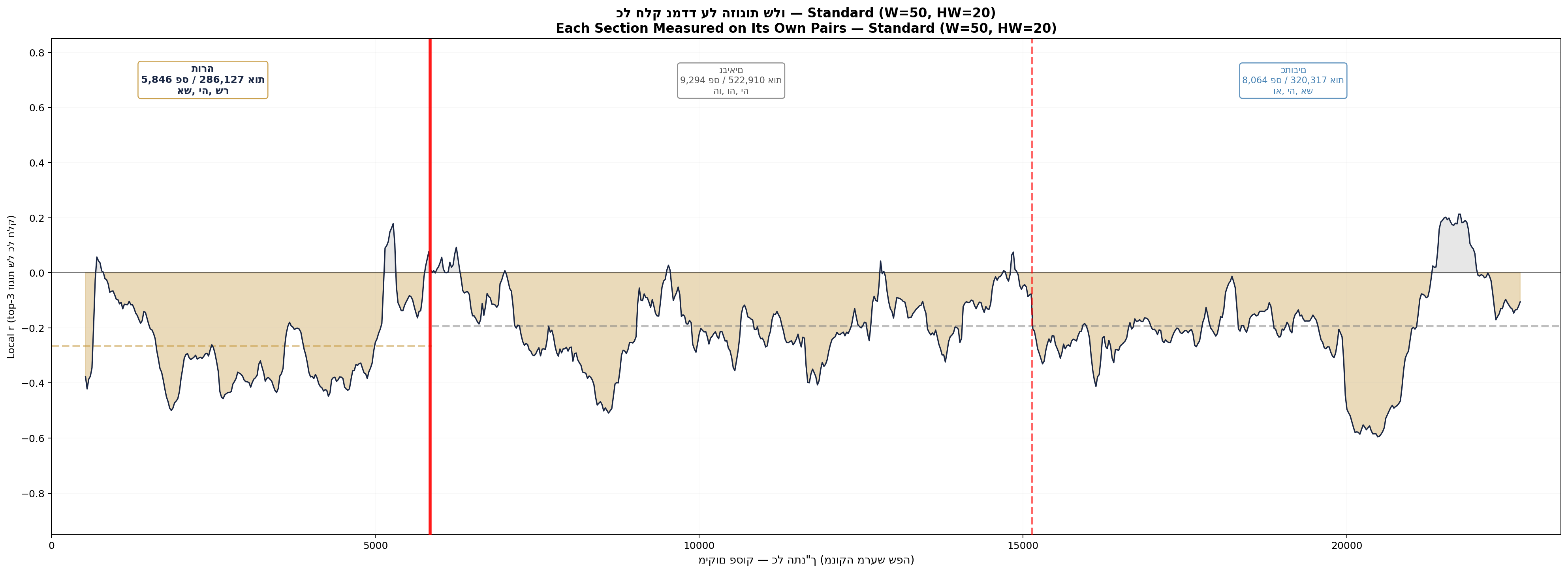
The first graph (file: own_pairs_standard.png) displays the anti-phase score across the entire Hebrew Bible, where each division is measured against its own pairs — the Torah against the Torah's three pairs, the Prophets against the Prophets' three pairs, and the Writings against the Writings' three pairs.
Parameters: a window of 50 chapters, a half-window of 20 chapters.
Results:
| Division | Mean Score | Std. Dev. |
|---|---|---|
| Torah | −0.266 | 0.041 |
| Nach | −0.193 | 0.035 |
The gap between means is 0.073 — approximately 38% above the Nach average. More important than the mean is the shape: the Torah maintains a high and stable anti-phase level throughout, while Nach exhibits lower levels and greater fluctuation.
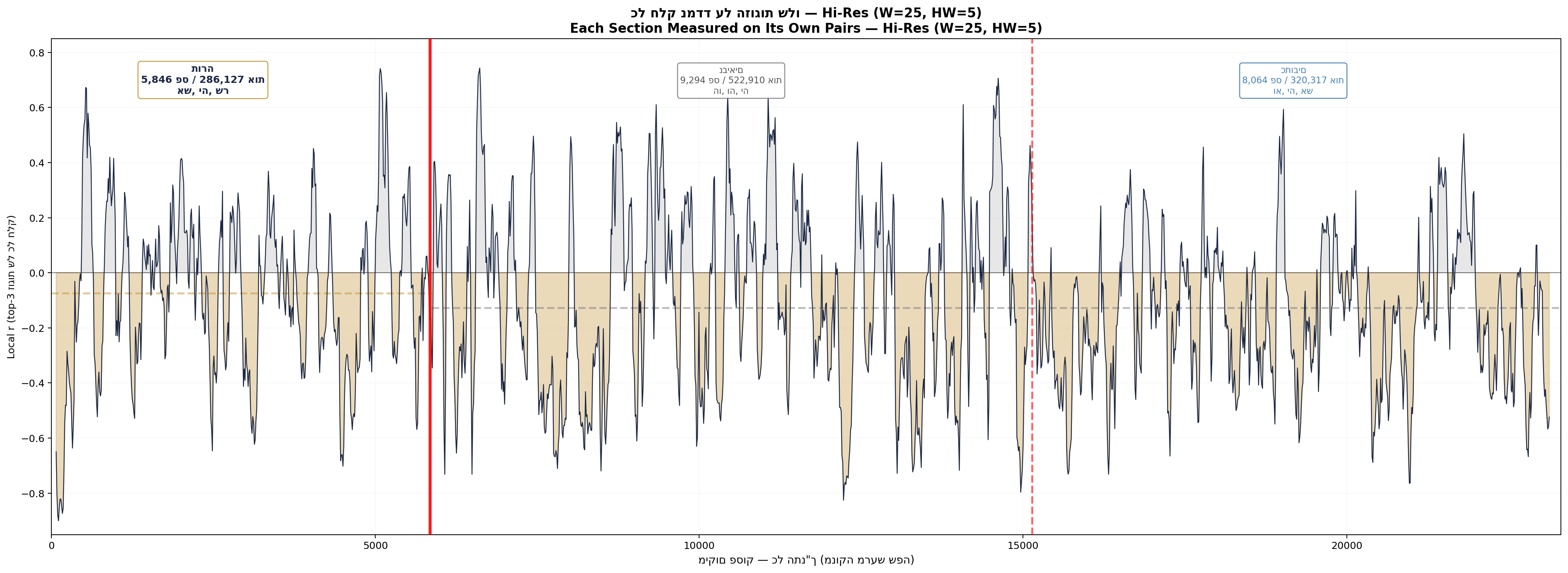
The second graph (file: own_pairs_hires.png) reveals internal structure with a narrow window of 25 chapters and a half-window of only 5.
Key findings:
The first window — #1 in the entire Hebrew Bible. The opening window of Genesis exhibits the strongest anti-phase score of any window in all 39 books.
Correlation coefficient: r = −0.900. The Pearson coefficient in the opening windows reaches −0.900 — a near-perfect negative correlation: when one letter of a pair rises in frequency, the other falls.
"The book of the generations of Adam" = the deepest point. The verse "זה ספר תולדות אדם" (Genesis 5:1) falls within the window where the anti-phase score reaches its nadir — the strongest anti-phase not only in the Torah, but in the entire Hebrew Bible.
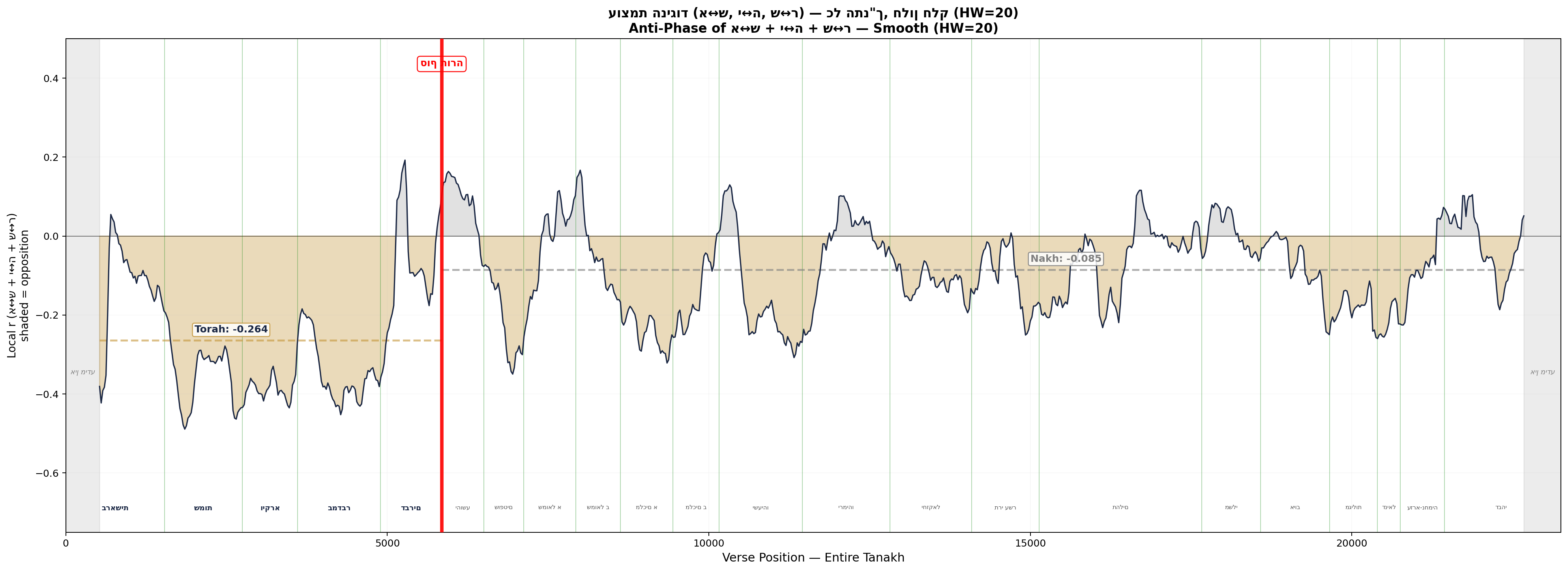
Among the 17 boundaries between consecutive books in the Hebrew Bible, the boundary between Deuteronomy and Joshua exhibits the steepest drop in anti-phase score.
According to tradition, Deuteronomy is the last book written by Moses, and Joshua is the first written after his death. The statistical data — with zero prior knowledge of this tradition — identify precisely that boundary as the sharpest transition point. We do not claim this constitutes "proof" — we note the fact.
The Torah behaves as one system — not as five independent texts that happen to resemble each other, but as a system in which three anti-correlations operate in parallel, at a high and stable level, from the first verse to the last. The moment the Torah ends, the system collapses — not gradually, but sharply.
The most surprising finding is not the existence of the anti-phase — it is where it occurs.
The most frequent word in the Torah is יהוה (YHWH, 5,410 occurrences). The second most frequent is אשר (asher, 2,505 occurrences). Together, they account for approximately 10% of all words in the Torah.
The natural expectation: if two words are this common, their constituent letters should co-occur — appearing together in verses. In the Torah, precisely the opposite occurs. The letters of אשר and יהוה are in anti-phase: when אשר letters rise in a verse, יהוה letters fall — and vice versa.
To determine whether the anti-phase is a property of the frequent words or something deeper, we removed the five most frequent words from every book and measured again.
In Nach, what looks like anti-correlation is largely a byproduct of word frequencies — remove the words and the effect vanishes. In the Torah, the anti-phase penetrates to the level of the letters themselves, persisting even when the words containing those letters are removed.
In any natural language, the most frequent words should contain letters that tend to appear together — frequent words "attract" frequent letters, and frequent letters cluster. In the Torah, the most frequent words contain letters that repel one another. In Nevi'im and Ketuvim, the picture is normal. The Torah — and only the Torah — violates the rule.
Not all 22 letters of the Hebrew alphabet are in anti-phase. Only five — א (aleph), ש (shin), ר (resh), י (yod), ה (he) — form the system. The remaining 17 letters behave normally. This is a focused and specific effect operating on five particular letters in three coupled pairs — difficult to account for by "random variance" or "literary style," which affect words, syntax, and general frequencies, not Pearson correlations between specific letter-pairs.
The phrase "אשר יהוה" appears 372 times in the Torah — each time placing all five letters in a single verse. Yet the anti-phase survives. The mechanism is robust enough to overcome 372 instances of co-occurrence and still maintain opposition at the aggregate level.
The first window of Genesis — containing "ספר תולדות אדם" (Genesis 5:1) — exhibits the strongest anti-phase score in the entire Hebrew Bible. The Torah opens at its peak, declining slightly but remaining at a high level throughout all five books. The moment Deuteronomy ends — a sharp collapse.
The five books of the Torah differ from one another by virtually every literary measure:
There is no literary, stylistic, or thematic reason why five texts this different should exhibit the same statistical signature — the same three pairs, at the same intensity, throughout each of them. Yet 5 out of 5 exhibit all three pairs; 0 out of 34 Nach books exhibit all three.
What would be required to deliberately construct a text with anti-phase across three letter-pairs?
We are not currently aware of any mechanism described in the published literature that would be capable of producing three coupled anti-correlations of this magnitude across 80,000+ words while maintaining narrative coherence.
To our knowledge, no language model as of 2026 has demonstrated the ability to generate a text of this length with sustained letter-level anti-correlations while maintaining narrative, legal, and poetic coherence.
A point that strengthens the finding: asher and YHVH are the two most frequent words not only in the Torah, but in every part of the Tanakh (after function-word removal). All three corpora begin from the same starting point: the same words, the same letters, the same candidate pairs (aleph-shin, shin-resh, yod-he, he-vav, vav-he). The Torah has no built-in advantage. The difference is not in what is tested, but in the strength of the opposition: in the Torah, aleph-shin = -0.40; in the Prophets, aleph-shin = +0.02 (zero); in the Writings, aleph-shin = -0.09 (weak). Moreover, expanding the threshold from 7 letters to 12, 20, or 30 gives an advantage to the Nach (more letters = more chance of finding strong pairs), yet the Torah still wins.
To test whether the phenomenon is unique to the Torah or characteristic of classical Hebrew generally, we ran the identical algorithm on the complete Mishnah (4,118 mishnayot, nearly pure Hebrew with minimal Aramaic). Each corpus received its own pairs — same test, same rules.
| Corpus | Top Words | Top-3 Score |
|---|---|---|
| Torah | YHVH, asher | 1.089 |
| Mishnah | rabbi, shel | 0.544 |
| Ratio | 2.0x |
The seven most frequent words in the Mishnah (after filtering) are: rabbi, shel, ve-lo, o, ela, zeh, bayit — none of them "asher" or "YHVH." The Mishnah speaks a different language. Yet the same algorithm runs on both. The resulting pair system is entirely different: resh-bet (from "rabbi"), shin-lamed (from "shel"), aleph-lamed (from "ela"). It does not show aleph-shin, shin-resh, or yod-he as strong pairs. The ratio — 2.0x — is identical to the Torah-versus-Nakh ratio. The phenomenon is not a general property of classical Hebrew; it is specific to the Torah.
Several extensions would strengthen these findings:
We do not claim that this finding proves divine authorship. We do not claim it is a hidden "code" or an encrypted message. We do not offer theological, religious, or philosophical interpretation.
We do claim the following:
We invite researchers, mathematicians, linguists, and anyone with interest — to examine, replicate, and deepen.
All data are open. All code is available. Every table is independently reproducible. If a simpler explanation exists — we would welcome it. If none does — the numbers speak for themselves.
We do not answer the question. We only present it.
Eran Eliyahu Tobul and Yehonatan Tobul July 2026
Accompanying graph files:
- own_pairs_standard.png — Standard graph, W=50, HW=20
- own_pairs_hires.png — High-resolution graph, W=25, HW=5
Full interactive table: - boundbydesign.org/tanakh_clean_test.html