
The Earth That Heard
The Hidden Thread — From Genesis to Joshua
Eran Eliyahu Tobul
About This Essay
What lies before you is a midrashic-scientific essay. It reads the Torah and the Book of Joshua as a single image — continuous, whole, deliberate — and traces threads that pass from verse to verse, from root to root, from Genesis to Mount Ebal.
It shows; it does not prove. It lays out a picture — and the reader will draw their own conclusions. At the end of this essay we test whether the density of connections described here could arise from a random set of verses.
The text says exactly what it says — and we read it at face value before we interpret. Every verse is quoted in full, every parallel is marked, every chain is visible. The full scientific work — morphological analysis, statistics, comparative genomics — is found in the main book.
Three weighty claims run through this essay. For each, three layers are presented: Text — what the verses say; Reading — what emerges from comparing verses; Implication — what the complete picture points toward. The layers are marked in their places.
See: Tobul 2026, The Road and the Place, boundbydesign.org
A Note on Hebrew Sound and Letters
Many connections in this essay depend on Hebrew consonantal roots, sound patterns, or letter sequences that are invisible in English translation. Where such a connection is central to the argument, the Hebrew word is given in transliteration and in Hebrew script — for example: tevel (תבל), Tuval (תובל), Hevel (הבל) — shared core: B-L (ב-ל). This is not a claim of formal etymology; it is an observation about textual resonance within a single literary work. The reader need not accept every such connection to follow the essay's main argument.
Reader's Guide
The Thesis
The earth that received the blood of Abel is the place where the altar was built. From Genesis to Joshua, a single thread runs: a reshit (firstfruit) that was stolen — returns. A bekhor (firstborn) that was flawed — is rectified. A brother who was murdered — becomes part of every sacrifice that will ever be offered there.
Four Central Chains
The essay traces chains that recur throughout the entire Torah. Four are central:
Adamah/Dam      Abel's blood → altar of earth → Korah → Ebal → reshit returns
Bekhor/Reshit   Reshit stolen → Cain → Esau → Nadav & Avihu → the priest eats by right
Shadai/Sadeh    The field of the murder → El Shadai → scent of the field → blessings of the breasts → Ebal
Kum/Makom       "And Cain rose" → "And Korah took" → "Cursed is he who does not raise" → "and he set it up there"
Additional chains join along the way. All are detailed in Chapter XXVIII, after the reader has followed them.
Table of Contents
- About This Essay
- Reader's Guide
Act I — The Wound - I. Silence in the Field - II. Before the Field — What Happened in Creation - II-B. The Donkey — Matter, Sin-Offering, and Ownership - III. The Tainted Firstborn - IV. The Earth Opened Its Mouth — And What Was Built from It - V. Abel on the Altar — His Blood Mingled with the Blood of the Sacrifice - V-B. Tzillah and the Roasted Offering — The Stolen Offering and Passover - V-C. The Opening in the Earth — Two Openings - VI. El Shadai — God of the Field
Act II — The Rectification - VII. Esau — The Firstborn Who Failed - VIII. Dinah at Shechem — A Return to Eden - IX. Judah and Tamar — Descent and Ascent - X. Joseph — The Rectified Serpent - XI. Tzipporah and Moses - XII. Sinai — And Aaron Who Stood in Silence - XIII. Korah — The Earth Opens Its Mouth Again - XIV. The Red Heifer - XV. Shiluach HaKen — Sending Away the Mother Bird - XVI. Ki Tavo
Act III — The Place - XVII. The Altar on Ebal — The Stones Remember - XVII-B. The Sanctuary of the Lord — The First Consecration - XVII-C. "And Abraham Rose Early in the Morning" — The Binding and Shechem - XVIII. "The Place That He Will Choose" — Twenty-One Times - XVIII-B. "Sevenfold Shall Cain Be Avenged" — Seven Altars - XIX. Nitzavim — The Rising to Build - XX. Moses Gazes — The Last Jericho - XX-B. The Garden - XXI. "From There, the Shepherd, the Stone of Israel" - XXII. Joshua — The Book of Fulfillment - XXIII. Jericho and Rahab — The Reiakh That Opened - XXIV. The Javelin and the King of Ai — From the Carcass to the Altar - XXV. The Sanctuary of the Lord at Shechem — The Elah, and the Circle Closed - XXVI. Two Tribes — Nearly a War of Annihilation - XXVII. The Gibeonites — The Prophecy of Nitzavim - XXVII-B. The Mountain of the Curse — The Place That Survived - XXVII-C. The Law of Balance — Who Is the Writer?
The Chains and the Test - XXVIII. The Chains - XXIX. The Number — A Connection-Density Test - XXX. Closing — The Words of the Text
Act I — The Wound
From Genesis to the Flood: the murder, the earth, the horror, and the erasure.
I. Silence in the Field
Abel lies in the field.
No movement. No breath. The body that had been a shepherd — the hands that held a lamb, the face that saw open skies above a flock — all of it lies upon the face of the earth, and blood flows into her.
Cain stands. Perhaps still stands. The text does not say what he did next. Only silence. And then:
"קול דמי אחיך צועקים אלי מן האדמה." (בראשית ד:י)
"The voice of your brother's blood cries out to Me from the earth." (Genesis 4:10)
The blood cries "to Me from the earth" — God hears. But He hears from within the earth. Because the earth heard first. The blood entered her, and she — from whom all life had come — could not leave the image of God cast down like that. She opened her mouth. She covered him.
But why in a field? Classical midrashic reading proceeds from the premise that no word in the Torah is superfluous. The verse states explicitly:
"ויאמר קין אל הבל אחיו, ויהי בהיותם בשדה, ויקם קין אל הבל אחיו ויהרגהו." (בראשית ד:ח)
"And Cain spoke to Abel his brother, and it was when they were in the field, that Cain rose up against Abel his brother and killed him." (Genesis 4:8)
"And it was when they were in the field." What were they doing in the field? Here begins the possibility this essay seeks to examine: perhaps they came to sacrifice. Perhaps Abel came to prepare an altar, to set up stones, to bring an offering. Because one moment earlier, the Lord had accepted his gift — but the offering had not yet gone up.
Read again:
"וישע ה' אל הבל ואל מנחתו." (בראשית ד:ד)
"And the Lord turned to Abel and to his offering." (Genesis 4:4)
Va-yisha — He turned. He looked. He inclined toward him. It does not say va-ya'al ("and it went up"), as is written of every offering that ascends. It does not say "and the Lord smelled the pleasing aroma," as is written of Noah:
"וירח יהוה את ריח הניחוח." (בראשית ח:כא)
"And the Lord smelled the pleasing aroma." (Genesis 8:21)
With Abel — there is no aroma. No fire. No altar. There is only va-yisha — a gaze, not an offering. Abel was accepted but never sacrificed.
And then Abel went out to the field. To build. To raise stones. To bring up the sacrifice that had already been accepted but had not yet ascended.
Implication: Abel never sacrificed. He was only accepted. He came to sacrifice — and was slaughtered upon the site of the altar he came to build.
The first blood spilled upon that earth was not the blood of a sacrifice. It was Abel's blood. The blood of the altar's builder. The first altar in the world was built upon the blood of its builder.
This is the first claim of this essay — the text allows a surprising possibility: Abel's offering was accepted but the act of sacrifice never took place:
Text: "And the Lord turned to Abel and to his offering" — turned, not went up, not smelled.
Reading: The distinction between turned (a gaze) and "the Lord smelled the pleasing aroma" (with Noah). Abel came to sacrifice — and was murdered before the offering could ascend.
Implication: The first altar was built upon the blood of its builder.
And the Lord did something He had not done before and would not do again: He set a marker. Not words — a place. Here, in this earth, in this exact spot where the first man died on account of a sacrifice — here would be the memorial. Forever.
Abel is buried beneath the altar.
Implication: Every sacrifice that would ever ascend upon stones — its blood is mingled with the blood of Abel. The pleasing aroma that rises — is the scent of Abel and the scent of the sacrifice together, for they are in the same place, in the same earth. And the priest who eats by right — is Cain rectified, Cain who at last eats the firstfruit not by theft but by gift.
But all of this — the priest, the altar, the sacrifice, the aroma — all of it comes later. First there is only a field, and blood, and silence.
And a brother who killed a brother.
And there is one more thing to notice. The text does not say "and he killed him in the field." It says "and it was when they were in the field" — both of them were there. Both went out. Cain did not chase Abel to the field — they came together. Together they walked. And perhaps, one moment before, there was still a possibility that it would end differently. That two brothers would build an altar together. That Cain would bring the firstfruit this time, and Abel would offer his firstlings, and a pleasing aroma would rise from both of them. But that moment never came. The rising served destruction.
II. Before the Field — What Happened in Creation
To understand why the first blood was spilled, we must return to the beginning. Not the beginning of the story — the beginning of the world.
Two Layers
In Genesis 1, a single name operates: Elohim. Order, law, separation. Light from darkness. Waters from waters. Dry land from seas. Each day is an act of distinction — "and God separated." A world built as a system.
And then — after the sixth day, after the seventh was separated from the six days of making, after the unity of one from seven — only then:
"אלה תולדות השמים והארץ בהבראם — ביום עשות יהוה אלהים ארץ ושמים." (בראשית ב:ד)
"These are the generations of the heavens and the earth when they were created — on the day that the Lord God made earth and heaven." (Genesis 2:4)
The Lord God. A new name. Not "God" alone — the Lord God. Suddenly there is speech. Relation. Command. God built the structure in six days, and only when the seventh was separated did the Lord enter the structure and speak.
Two layers. Not two gods — two modes. As a building is both architecture and home. God is the architecture. The Lord is the one who dwells within and speaks. And "the Lord is God" — both together — is the rectified reality that existed in the Garden.
And at the precise moment the Lord enters, something appears that had not existed before:
"וכל שיח השדה טרם יהיה בארץ וכל עשב השדה טרם יצמח — כי לא המטיר יהוה אלהים על הארץ ואדם אין לעבד את האדמה." (בראשית ב:ה)
"And every shrub of the field was not yet in the earth, and every herb of the field had not yet sprouted — for the Lord God had not caused it to rain upon the earth, and there was no man to work the ground." (Genesis 2:5)
The field. Not plants, not herbs — the field itself. The space where creation meets blessing. Without the Lord there is no rain. Without man there is no labor. The field demands partnership.
The Sequence: Behemah, Adamah, Adam — in the Verses
Look at the order in Genesis 1:
"תוצא הארץ נפש חיה למינה בהמה ורמש וחית ארץ למינה." (בראשית א:כד)
"Let the earth bring forth living creatures after their kind: cattle, and creeping things, and beasts of the earth." (Genesis 1:24)
The earth brings forth cattle and beasts. Eretz = dry dust, dry land. And then, in the very next verse, the first appearance of the word adamah in the entire Torah:
"ויעש אלהים את חית הארץ למינה ואת הבהמה למינה ואת כל רמש האדמה למינו." (בראשית א:כה)
"And God made the beasts of the earth after their kind, and the cattle after their kind, and every creeping thing of the ground after its kind." (Genesis 1:25)
Remes ha-adamah — not "creeping things of the earth (eretz)." The adamah. She is alive. Creeping things reside within her as an integral part of her being. Eretz = dead dust. Adamah = living matter, fertile, with life inside her.
And how did eretz become adamah?
"ואד יעלה מן הארץ והשקה את כל פני האדמה." (בראשית ב:ו)
"And a mist rose from the earth and watered the whole face of the ground." (Genesis 2:6)
An ed (mist) rises from the eretz and waters — and then there is adamah. Without the mist, without the moisture — there is no adamah. Only eretz. Dead dust.
Behemah = Bah + Mah
In the letter-midrash framework used in the main book — not as an etymological claim but as a structural reading — one can read:
| Word | First pair | Second pair |
|---|---|---|
| בהמה (behemah) | בה (bah — "within her") | מה (mah — "the element of water") |
| אדמה (adamah) | אד (ed — "what rose") | מה (mah — "the element of water") |
Mah = water in singular. Mayim is always plural — in singular: mah, one unit. The same mah that was gathered "to one place" (Genesis 1:9).
Behemah = within her (bah) resides the singular water (mah). The behemah holds within her two forces — dust (from the earth, the first week, Elohim) and water (from the Lord, the second account) — together, in peace.
Adamah = ed (what rose from the water) + mah (the element of water). The ed that was concentrated within the bah — rose, watered, and created adamah.
And note: ב (bet) is one letter above א (alef). ה (heh) is one letter above ד (dalet). Behemah is one degree above adamah. What was within her (ed) exited her and formed what is beneath her.
And from the adamah — adam: "And the Lord God formed man, dust from the ground" (Genesis 2:7).
The Pure Earth
And there is something that anyone who knows cows understands: a tomato seed inside cow dung will grow a tomato plant. The place of seeding = inside the animal's product. And with a pure (tahor) animal — the regulation is perfect. The fruit that grows from within her is safe to eat.
The earth of Eden = pure earth. "Of every tree of the garden you may freely eat" — you could eat everything because the earth was pure. Where did this earth come from? From the pure behemah. And therefore the Red Heifer = a return to the source: a pure animal that restores the earth to its original state. The heifer's ash + living water = dust (Elohim) + water (the Lord) = creation anew.
The red fruit is a product of the earth. The blood of the earth. And whoever stole the fruit — stole the blood of the earth.
This is why "cursed is the ground because of you" (Genesis 3:17) — is not an arbitrary curse. The earth felt the theft. Someone took from her. And the curse did not stop there. Adam was cursed: "By the sweat of your brow you shall eat bread" (Genesis 3:19). The earth was cursed: "In sorrow you shall eat of it all the days of your life" (Genesis 3:17). Thorns and thistles. Hard labor. Sweat.
And Cain? Cain made it sevenfold worse. He did not merely steal from the earth — he spilled human blood upon her. "Cursed are you from the ground, which opened her mouth to receive your brother's blood from your hand" (Genesis 4:11). The earth opened her mouth.
The Tree of Knowledge = the Vine
What was the fruit? The Torah does not say "apple." It gives no name. But it provides clues.
Text: "And the woman saw that the tree was good for food and that it was a delight to the eyes" (Genesis 3:6). Fruit from a tree, without a name.
Reading: The Sages did not leave the question open. An explicit Tannaitic dispute (Babylonian Talmud, Berakhot 40a; Sanhedrin 70a): "The Tree of Knowledge — it was a vine, says Rabbi Meir; it was wheat, says Rabbi Yehudah; it was a fig, says Rabbi Nehemiah." Rashi on Genesis 2:9 cites the debate. Three opinions, three fruits.
Implication: This essay follows the vine — and not because of Rabbi Yehudah alone. Because of what the Torah itself says:
Enav (grape) — from the root of inui (affliction). Gefen (vine) — "and you shall be struck." Yayin (wine) — "the blood of grapes" (Deuteronomy 32:14). And there is one verse in the Torah that uses the word "slaughter" for something that is not meat:
"וישחט את הענבים אל כוס פרעה." (בראשית מ:יא)
"And I pressed them into Pharaoh's cup." (Genesis 40:11)
The only slaughter in the Torah that is not of an animal — is of grapes. Of the vine. And there is a second verse that links wine to blood beyond dispute:
"כיבס ביין לבושו ובדם ענבים סותו." (בראשית מט:יא)
"He washes his garment in wine, and his robe in the blood of grapes." (Genesis 49:11)
Wine = the blood of grapes. Explicit.
Letter-midrash: "Sotho" (סותו) is a rare biblical word meaning garment/robe (root s-w-t; BDB). It is not, etymologically, "kesuto" (כסותו, "his covering") minus the letter kaf. But visually — sotho = kesuto without kaf. And in the essay's letter-key, kaf is the letter of covering. Cain is not described as covering the blood. The earth itself performs the act of receiving and covering that the human is not described as doing: "which opened its mouth to receive your brother's blood" (4:11). The blood is exposed, crying out — not covered. The letter missing from "sotho" is the echo of the act that was not performed. And only when Judah says "recognize, please" — the covering begins to come undone. And only when the blood is properly absorbed into the earth — "and his robe in the blood of grapes" — the garment is purified.
And there is a further layer. In the genome of the grapevine, a transposon called Gret1 is active — a mobile element that inserted into the promoter region of VvMYBA1, disrupting the expression of the gene responsible for color production. The red fruit is the original state — the default of the vine. White grapes are the disruption: the mobile element disrupted the regulation, broke the capacity for pigmentation. It did not add — it disrupted. Like the stranger that invaded the Garden of Eden: he did not introduce something new into the world — he disrupted a system that had been whole.
Four Heads — The Four Roots of the Vine
Written: "And a river went out of Eden to water the garden; and from thence it parted, and became four heads." (Genesis 2:10)
One river, four heads. And the vine — four roots:
| Root | Meanings | "Branches" |
|---|---|---|
| gafan (גפנ) | vine (the tree), negef (plague), guf (to strike) | 3 |
| eshkol (אשכל) | cluster (the fruit structure), sekhel (wisdom/bereavement), mashkelah (sword) | 3 |
| enav (ענב) | grape (the fruit), av (cloud, thickness), avita (you grew thick — Deut 32:15) | 3 |
| yayin (יין) | wine (the drink) | 1 |
Reading: Four roots. Each of the first three has three meanings. "And in the vine were three branches" (Genesis 40:10). Three branches = three meanings. And all four converge in only two verses in the entire Torah — the dream of Pharaoh's cupbearer and the Song of Ha'azinu:
"And in the vine were three branches... its clusters ripened into grapes" (Genesis 40:10)
"For from the vine of Sodom is their vine, and from the fields of Gomorrah; their grapes are grapes of poison, clusters of bitterness" (Deuteronomy 32:32)
Implication: The river goes out of Eden — eden (עדנ) — and from there it divides into four. Just as the four vine-roots split from a single tree. And if the vine is the Tree of Knowledge, then the Tree of Knowledge stands at the center of the garden and draws through each root from a different channel:
- gafan — the channel of plague, the body, the striking. Injury.
- eshkol — the channel of intellect, bereavement, the sword. Discernment.
- enav — the channel of cloud, thickness, covering. Concealment.
- yayin — one channel. The blood of grapes. The drink that reveals truth.
And there is another junction: Shekhem (שכמ) — one name, four meanings: a person (Shechem son of Hamor), a place (the city of Shechem), a verb (vayashkem — to rise early), a body part (shekhem — shoulder). Like the four rivers — four channels from a single junction.
"Let the waters be gathered under the heavens unto one place" (Genesis 1:9) — and shekhem after removing the seven letters (אמתניהו) = shekh (שכ) = mishkan (tabernacle). The place to which everything converges.
The Nazirite — One Who Returns to the State Before the Fruit
And if the vine is the Tree of Knowledge, consider the Nazirite:
"מיין ושכר יזיר, חומץ יין וחומץ שכר לא ישתה, וכל משרת ענבים לא ישתה, וענבים לחים ויבשים לא יאכל. כל ימי נזרו מכל אשר יעשה מגפן היין מחרצנים ועד זג לא יאכל." (במדבר ו:ג–ד)
"He shall abstain from wine and strong drink; he shall drink no vinegar of wine or vinegar of strong drink, nor shall he drink any grape juice, nor eat fresh or dried grapes. All the days of his naziritehood, of all that is made from the grapevine, from the seeds to the skin, he shall not eat." (Numbers 6:3–4)
From the seeds to the skin. Everything. Peel, raisin, juice, vinegar. Zero vine. The Nazirite abstains from every product of the Tree of Knowledge — as if the fruit had never been eaten. He returns to the state before the sin.
And the Nazirite also does not touch the dead (6:6) — because death entered through the fruit. No vine = no death.
And what happens at the end of the naziriteship?
"וגלח הנזיר פתח אהל מועד את ראש נזרו ולקח את שער ראש נזרו ונתן על האש אשר תחת זבח השלמים." (במדבר ו:יח)
"And the Nazirite shall shave the head of his consecration at the entrance of the Tent of Meeting, and shall take the hair of the head of his consecration and put it on the fire which is under the peace-offering." (Numbers 6:18)
Hair upon the altar. Human hair — on the fire — like the wool of a lamb. The person himself becomes a sacrifice, without dying. And hair — covering. "And they knew that they were naked" = the covering was exposed. The Nazirite grows hair = restores the covering. And at the end, he places it on the altar = returns the covering to the site of the first consecration.
The Mobile Element — A Stranger That Invaded
The fruit introduced something into the human being that had not been there before. The text tells this in the language of nakedness: "And the eyes of both of them were opened, and they knew that they were naked" (Genesis 3:7) — they suddenly see something they had not seen. Something changed from within.
And arumim (naked) — from the root er. The opening of the gate of nakedness. The same root that recurs throughout the Torah: Er and Onan (Genesis 38), ervah (nakedness, Leviticus 18), na'ar — "for the inclination of the human heart is evil from his youth (ne'urav)" (Genesis 8:21), "he'erah bah" (Leviticus 20:18). Eating fruit = uncovering nakedness = the same root, the same dimension.
For what is in the fruit? "Fruit tree with its seed (zar'o) in it" (Genesis 1:29). Seed (zera). And within seed — zar (stranger) + ayin. The stranger is found within the seed of the fruit. And ra (evil) = the same letters as er, reversed. The fruit → the seed → the stranger → evil. All in the same root, all in the same place.
And what changed — passed to the next generation.
Of Seth it is written: "and he begot in his likeness, after his image" (Genesis 5:3). Of Cain — it is not written. Not "in his likeness." Not "after his image." Cain was born after the fruit. The stranger was already inside.
And there is a modern analogy for this pattern: in the bovine genome resides a mobile element with a well-documented history of horizontal transfer among distantly related animal lineages, including squamates and mammals — BovB (Walsh et al., PNAS 2013; Ivancevic et al., Genome Biology 2018). A transposon that jumped from species to species. In the essay's imagery: snake DNA inside a cow. Science does not prove the midrash — it creates an unexpected parallel to a structure the midrash already identified: what enters from outside remains inside and is passed on.
The serpent in the Garden of Eden → a mobile element → passes through the fruit → enters the human being → passes to the firstborn.
The Flaming Sword That Turns
And what does God do after the expulsion?
"וישם מקדם לגן עדן את הכרובים ואת להט החרב המתהפכת לשמור את דרך עץ החיים." (בראשית ג:כד)
"And He placed at the east of the Garden of Eden the cherubim and the flaming sword that turns every way, to guard the way to the Tree of Life." (Genesis 3:24)
Kherev (sword) = khet-resh + bet. The letters of khamor (donkey). And "turns every way" (mit'hapekhet) — it works in both directions. A staff that strikes, a sword that kills, a flame that burns. Three degrees.
And that same sword returns with Balaam: he strikes the she-donkey with a staff (three times), threatens with a sword — and the angel of the Lord stands with his sword drawn. Three degrees — like "the flaming sword that turns." Whoever returns to meddle with donkeys — the sword turns upon him.
II-B. The Donkey — Matter, Sin-Offering, and Ownership
"The Serpent Beguiled Me"
"ותאמר האשה: הנחש השיאני ואוכל." (בראשית ג:יג)
"And the woman said: The serpent beguiled me, and I ate." (Genesis 3:13)
Hishi'ani ("beguiled me"). The plain meaning: he deceived me. But at the letter level, the spelling hishi'ani also invites an association with nesi'ah — to carry, to lift, to transport.
Khamor (חמור, donkey) = khomer (חומר, matter). The same consonantal frame: Kh-M-R. The donkey is materiality — the body, the burden, the weight, the substance used to build — and the load that weighs down. "Let the work be heavier" (Exodus 5:9) — weight = matter = donkey.
The Torah does not say in the plain text that the serpent carried the woman to a donkey. That cannot be read into the narrative. But at the midrashic level, an axis emerges that is hard to ignore. "The serpent beguiled me" opens the axis. And further on — the Torah itself pairs "donkey" with "crouches," and "sin-offering" with "crouches." As though the donkey and the sin-offering are the same thing.
The Riding — Who Rides Whom
The Torah describes four states of riding upon a donkey. And the danger depends on who rides and who is ridden:
"ויקח משה את אשתו ואת בניו וירכיבם על החמור וישב ארצה מצרים." (שמות ד:כ)
"And Moses took his wife and his sons, and mounted them upon the donkey, and returned to the land of Egypt." (Exodus 4:20)
Tzipporah — a female upon a male. And Moses walks — he does not ride.
"וירכב על אתונו" — Balaam (Numbers 22:22)
"And he rode upon his she-donkey."
Anatomical parallel: The text sets up two inverted images: Tzipporah, a female, upon a male donkey; Balaam, a male, upon a female donkey. The text does not describe sexual contact. The reading here examines the anatomical and symbolic inversion alone.
Balaam — a male upon a female. And indeed — immediately after: "And the she-donkey saw the angel of the Lord" (22:23). The donkey sees — Balaam does not. Because the rider is blind, and the ridden one sees.
Reading: The Torah says explicitly: "And a woman shall not stand before a beast to mate with it; it is perversion (tevel)" (Leviticus 18:23). And also: "You shall not lie carnally with any beast to defile yourself with it" (Leviticus 18:23). Two directions — woman to beast, and man to beast. And the name of the transgression?
Tevel = Tuval = Hevel
Tevel. The name of the transgression is: tevel (perversion). "And a woman shall not stand before a beast to mate with it (le-rav'ah), tevel it is" (Leviticus 18:23). And "a woman who approaches any beast to mate with it — you shall kill the woman and the beast; they shall surely die, their blood is upon them (demeihem bam)" (Leviticus 20:16). And Tuval-Cain — son of Tzillah — is named after Tuval. Tevel (תבל) = Tuval (תובל) = Tav + B-L (ב-ל) = Hevel (הבל). Shared consonantal core: B-L.
The name of the transgression contains the name of the victim. "Their blood is upon them" (demeihem bam) — the blood of Abel — bal — is inside the tevel. The transgression bears the name of the blood that was spilled because of it.
"At the Door Sin Crouches" — The Donkey at the Door
"הלוא אם תיטיב שאת — ואם לא תיטיב לפתח חטאת רובץ ואליך תשוקתו." (בראשית ד:ז)
"Surely, if you do well, you will be uplifted; and if you do not do well, at the opening sin crouches, and its desire is toward you." (Genesis 4:7)
Khatat — not merely sin. Khatat = a consequence of sin. What was born from the sin. And the donkey — at the midrashic level — is that consequence: what was created from the mixing in the Garden.
Crouches (rovetz) — and later: "Issachar is a heavy-boned donkey, crouching (rovetz)" (49:14). The same rovetz. The Torah pairs "donkey" with "crouches" — just as it pairs "sin-offering" with "crouches."
Se'et (uplifted) = bearing a burden. If you do well — the material will bear the load, will work with you. If not — it will crouch at the opening. It will not bear — it will crouch.
"Upon the Third and Fourth Generations"
"פוקד עוון אבות על בנים ועל בני בנים, על שלשים ועל רבעים." (שמות לד:ז)
"Visiting the iniquity of fathers upon sons and upon sons' sons, upon the third and upon the fourth generation." (Exodus 34:7)
Revi'im ("fourth generation"). The root rava = mating with a beast (revi'ah). And arba (four) = rava + alef. The curse is visited "upon the fourth generation" — but if you read the root: upon the generation of the mating. The defect of the revi'ah persists for four generations.
And "four" (arba) — without the alef — is rava. The number itself bears the name of the transgression.
Acquisition — From Eve to Jacob
"קניתי איש את יהוה." (בראשית ד:א)
"I have acquired a man with the Lord." (Genesis 4:1)
Kaniti ("I have acquired"). Eve thinks she has acquired. But k-n = kinyan (acquisition) = donkey. What was acquired — was acquired through the donkey. And therefore Cain = flawed acquisition.
And hundreds of years later — Hamor buys Shechem:
"ויקן את חלקת השדה... מיד בני חמור אבי שכם." (בראשית לג:יט)
"And he bought the parcel of the field… from the sons of Hamor, the father of Shechem." (Genesis 33:19)
Hamor acquired the place. The flawed acquisition — which began in the Garden — gave the donkey ownership of Shechem. And Shechem son of Hamor = prince of the land — because his father bought it.
And Jacob buys it back — with silver, not by theft:
"ויקן... במאה קשיטה." (בראשית לג:יט)
"And he bought it… for a hundred kesitah." (Genesis 33:19)
And Joseph is buried there:
"ואת עצמות יוסף אשר העלו בני ישראל ממצרים קברו בשכם, בחלקת השדה אשר קנה יעקב מאת בני חמור." (יהושע כד:לב)
"And the bones of Joseph, which the children of Israel brought up from Egypt, they buried in Shechem, in the parcel of the field which Jacob bought from the sons of Hamor." (Joshua 24:32)
Kanah → Cain → Hamor → Shechem → Jacob buys back → Joseph buried. The acquisition returns.
The Stations of the Donkey — The Donkey Ascends
| Station | Donkey | What happens |
|---|---|---|
| Garden of Eden | "The serpent beguiled me" | Mixing — the donkey enters the story |
| Cain | "At the opening sin crouches" | The material crouches at the door |
| Abraham | "Stay here with the donkey" | Materiality remains below, spirituality ascends |
| Sinai | "Your enemy's donkey crouching under its burden… you shall surely help him" (Ex 23:5) | Even an enemy's donkey — you help it bear |
| Moses and Tzipporah | "And he mounted them upon the donkey" | Tzipporah upon the donkey → the inn → the Lord sought to kill → Tzipporah cuts the foreskin = repair |
| Joseph | "Ten donkeys laden" | The donkey serves — bears good |
| Moses and Korah | "I have not taken one donkey from them" | Liberation from materiality |
| Issachar | "A heavy-boned donkey, crouching" | Bears the yoke of Torah, receives reward |
| Balaam's she-donkey | "And she crouched under Balaam" | The material sees the angel — the man does not |
And note the she-donkey: "Am I not your she-donkey upon which you have ridden all your life to this day? Have I been in the habit of doing this to you? And he said: No" (Numbers 22:30). The she-donkey says: I am yours from always — from the beginning. Aton (she-donkey) = eitan (enduring) = etnan (a harlot's hire). The same consonantal pattern under the essay's reduction method. And therefore: "You shall not bring the hire of a harlot (etnan) or the price of a dog into the house of the Lord your God" (Deuteronomy 23:19). The etnan shall not enter the house of the Lord. Because the aton — what lies between man and donkey — does not belong in the sanctuary.
The Letters Khet-Resh — The Donkey Everywhere
And the consonantal frame kh-r — two letters of khamor (donkey) — appears in 403 verses in the Torah (above the 200 threshold, and therefore not counted in T1). Kherev (sword), kherpah (shame), kharash (plow), kherem (ban), bakhar (choose), makhar (tomorrow), shakhar (dawn). Wherever kh-r appears — an echo of the donkey.
And especially: kherev (sword) = kh-r + bet. The weapon of death that appears in the Garden of Eden — "the flaming sword that turns" (Genesis 3:24) — bears the donkey's letters. The sword guards the Tree of Life — so that the donkey shall not approach again.
And Balaam: "If only I had a sword in my hand, I would kill you" (Numbers 22:29) — he wants a sword against his donkey. And immediately: "And the Lord opened Balaam's eyes… his sword drawn in his hand" (22:31) — the same sword, reversed. Whoever meddles with donkeys — the sword turns upon him.
And with Dinah: "And two of the sons of Jacob, Simeon and Levi, Dinah's brothers, each took his sword" (Genesis 34:25) — they killed Shechem son of Hamor by the sword. And Jacob: "which I took from the hand of the Amorite with my sword and my bow" (48:22) — he took Shechem from Hamor by the sword.
Kherev = kh-r = khamor. Wherever the sword appears — the donkey is not far.
Who Rides Whom
The message of the entire chain is not: donkey = impurity. Rather: donkey = matter. And the question that runs throughout the entire Torah is: who rides whom? And note: Shechem (שכם) = shikhmah (שכמה) = shoulder. Whoever is mounted — is mounted upon the shoulder. And "she placed it upon her shoulder (shikhmah)" (Genesis 21:14). The place where one is mounted is called Shechem.
When matter directs man — a fall. When man sanctifies matter — the donkey bears. And in the extreme case — with Balaam — the man who ought to see does not see, and the matter beneath him sees the angel of the Lord.
Matter need not be erased. It must learn to bear instead of to crouch. "If you do well — se'et (you shall be uplifted/you shall bear)."
And there is a further layer. In Noah's ark, regarding the animals — the pure and the impure — the text says specifically "man and his wife" (ish ve-ishto, Genesis 7:2). Not "male and female" as with the other creatures — man and his wife. The Sages themselves asked: "Does a behemah have ishut (conjugal bond)?" (Sanhedrin 108b) — and connected this language to purity from the transgression. And what does science say? In domesticated donkeys, strong pair-bonds with a specific companion are documented. Separation from such a bond can cause severe distress, cessation of eating, and may even lead, through hyperlipaemia, to a fatal condition. And therefore "at the door sin crouches" — the donkey does not move. He crouches. Like a donkey waiting for a bonded companion who was taken from him.
And even the word sin (khet) — khet-tet-alef — in the letter-key of the book, hints: khet = donkey, tet (incline, lean — a root of a single letter), alef = human. A donkey that inclines toward a human. That is the entire sin.
And the donkey has a grievance. He did not choose any of this. The donkey has no knowledge — "the serpent beguiled me" = someone encouraged this, not the donkey. And in the end, his bonded companion was taken or his firstborn's neck was broken — "the firstling of a donkey you shall redeem with a lamb; and if you do not redeem it, you shall break its neck" (Exodus 13:13). A memorial of the she-donkey whose neck was broken, or of the firstborn that was taken.
Implication: What we call the evil inclination (yetzer ha-ra) is not an evil force created to destroy. It is a wounded donkey — an animal that lost its bonded companion, that was not consulted, that was not guided. It crouches at the door because it is waiting. "And its desire is toward you" — the donkey yearns for you not out of malice but out of hurt. And "if you do well — se'et (you shall bear)" — if you repair what you have done, it will bear you instead of crouching upon you.
III. The Tainted Firstborn
"I Have Acquired a Man with the Lord"
Eve gives birth to Cain and says:
"קניתי איש את יהוה." (בראשית ד:א)
"I have acquired a man with the Lord." (Genesis 4:1)
She thinks she has acquired. That the son is hers. But the name she gave him is proof that he is not: Cain (Heb. Qayin, קין) — from the root k-n-h, acquisition. What was acquired, what was taken. From the moment the firstfruit was stolen from the Tree of Knowledge, the firstborn of Adam and Eve no longer belongs to them. He belongs to the one from whom they stole.
And this is not Cain alone. Every firstborn in the world, from that moment, belongs to the Lord:
"קדש לי כל בכור, פטר כל רחם בבני ישראל, באדם ובבהמה — לי הוא." (שמות יג:ב)
"Sanctify to Me every firstborn, the first issue of every womb among the children of Israel, of man and of beast — it is Mine." (Exodus 13:2)
The birthright was stolen? The birthright returns. Every first issue of the womb — belongs to God. And if it is not returned willingly — the plague of the firstborn. Pharaoh holds firstborns that are not his, and the Lord takes them out. Because they are His from the start. "My son, My firstborn, is Israel" (Exodus 4:22) — the Lord tells Moses from the beginning what the end will be.
Cain (קין) → Kohen (כהן), Abel → Levi
Now look at the letters.
Text: "And Cain rose up against Abel his brother and killed him" (Genesis 4:8). Two brothers: Cain — firstborn, a tiller of the ground; Abel — the younger, a shepherd of flocks.
Reading: The letters tell a story of rectification — and this parallel is well known: the Arizal (Sha'ar HaGilgulim, Introduction 36) and the Zohar (Bereshit 36b) see in Cain a soul that reincarnates and arrives at the priesthood. Not a modern invention — an ancient root.
Implication: Three substitutions, exact symmetry:
Cain — ק (Kuf), י (Yod), ן (Nun). Kohen — כ (Kaf), ה (Heh), ן (Nun).
Kuf→Kaf — in modern Israeli Hebrew these sound nearly identical; in ancient Hebrew they were distinct consonants (Qof uvular, Kaf velar). Yod→Heh — an exchange among the letters Y-H. Nun remains. This is a written/sonic wordplay, not a proven phonological symmetry in biblical Hebrew. But the overlap in spelling is striking: Cain became Kohen.
Hevel (Abel) — ה (Heh), ב (Bet), ל (Lamed). Levi — ל (Lamed), ו (Vav), י (Yod).
The same pattern, reversed direction: Bet→Vav — the same sound, different form (like Kuf→Kaf). Heh→Yod — an exchange among the letters Y-H, but reversed from Cain! In Cain: Yod became Heh. In Abel: Heh became Yod. Lamed remains, but shifts position — because in Abel everything is inverted: the last letter becomes the first.
The symmetry: In both — two substitutions, one in voice (different form), one among the Y-H letters, and one that remains. In Cain Y→H, in Abel H→Y. The same substitution, opposite direction. Two brothers who transform together, each the mirror of the other.
Cain became Kohen — the firstborn who stole the firstfruit is rectified into the priest who eats by right. Abel became Levi — the murdered one who never sacrificed becomes the minister of the holy, who assists the priest.
And Seth? Eve said: "God has set for me another son in place of Abel" (Genesis 4:25). In place of Abel. Abel transmigrates into Seth. From Seth comes Israel. And from Israel come — Levi and Kohen. Two brothers who work together. The elder serves the younger. The elder brings offerings by right, not by theft. The younger lives.
| Genesis | Rectification | Role |
|---|---|---|
| Cain (tainted firstborn) | Kohen | Eats firstfruit by right |
| Abel (murdered) | Levi | Assists the Kohen, serves |
| Seth (in place of Abel) | Israel | Brings firstfruit, begets the way |
Why the Offering Was Rejected
Cain brought an offering. "And Cain brought from the fruit of the ground" (Genesis 4:3) — from the fruit. Not "from the first." Not "from the choicest." Simply — from the fruit. Abel, by contrast:
"והבל הביא גם הוא מבכורות צאנו ומחלביהן." (בראשית ד:ד)
"And Abel, he also brought from the firstlings of his flock and from their fat." (Genesis 4:4)
Firstlings. The fat. The first, and the best of the first.
"And the Lord turned to Abel and to his offering, and to Cain and to his offering He did not turn." The Lord inclined toward Abel. He did not incline toward Cain.
Cain's sin is not the type of offering. It is the withholding of the firstfruit. To keep the first for yourself — that is exactly what Adam did in the Garden of Eden: he took a fruit that was not his. Cain continues the same sin, this time not by theft but by withholding. He did not bring the first. He kept it for himself.
And what did Cain fail to understand? A simple thing. If you bring the Lord the firstfruits — what will He do with them? Eat alone? That is not His way. In the original design: "Thank you, come let us eat together." El Shadai ate with Abraham — "and they ate" (Genesis 18:8). The Lord does not eat alone. If you bring Him firstfruit — He returns it, with blessing, and you eat together. That is the entire point of sacrifice: not deprivation but partnership. Not withholding but invitation.
"Why Has Your Face Fallen"
Before the murder, the Lord asks:
"למה חרה לך ולמה נפלו פניך? הלוא אם תיטיב שאת, ואם לא תיטיב לפתח חטאת רובץ." (בראשית ד:ו–ז)
"Why are you angry, and why has your face fallen? Surely, if you do well, you will be uplifted; and if you do not do well, at the door sin crouches." (Genesis 4:6–7)
The Lord saw the problem before the murder. The face had already fallen — the image had already changed.
But this verse says something more: "At the opening, sin crouches, and its desire is toward you." La-petakh = the opening. Khatat rovetz = sin crouches, lies in wait. Like a body lying in a grave. The opening of the grave is open — and sin waits there.
And "desire" (teshukato) — not appetite. Desire. Eve had appetite (ta'avah) for the fruit: "that it was a delight to the eyes" (3:6). The earth has desire — stronger, a pull that cannot be resisted. The earth hungers for blood. She hungers for the firstfruit that was taken from her.
What Cain Said to Abel
"ויאמר קין אל הבל אחיו." (בראשית ד:ח)
"And Cain said to Abel his brother." (Genesis 4:8)
The Masoretic text does not say what he said. But the Samaritan Pentateuch, the Septuagint (LXX), the Peshitta, and the Vulgate all supply a version: "Let us go to the field." If so — Cain invited Abel to the field. But even reading the Masoretic silence, he heard the Lord's warning — "at the opening sin crouches" — and turned the warning into a plan. Cain is a tiller of the ground. The earth is hard on him — thorns and thistles. He feels that she wants him back, wants his blood. He thinks: if I return to her other blood — the blood of the one whose firstfruit was accepted — she will be appeased.
"And Cain said to Abel his brother" — he persuaded him to go out to the field. "And it was when they were in the field" — they came together. Premeditated murder. With intent.
And Cain Rose — And the Parallel
"ויקם קין אל הבל אחיו ויהרגהו." (בראשית ד:ח)
"And Cain rose up against Abel his brother and killed him." (Genesis 4:8)
And the earth indeed took. "Which opened her mouth to receive your brother's blood from your hand" (4:11). Cain partially succeeded — the earth opened her mouth and took the blood. But instead of blessing — a double curse. "Cursed is the ground because of you" — the curse escalated. Because the earth does not want human blood. She wants the blood of her own firstfruit — animal blood. Cain erred in the type of blood, not in the direction. And therefore only with Noah, when the blood of a behemah rose upon an altar — "I will not again curse the ground."
And note the parallel: "At the opening sin crouches" = "opened her mouth to receive." Two openings. The warning said: the opening is open. And after the murder: the mouth opened. The same opening.
"And he rose" — va-yakam: rising to destroy. The root k-u-m recurs throughout all of Scripture: "And Korah took" — taking. "Cursed is he who does not raise up" — whoever does not raise up returns to Cain. Rising can build or destroy. Cain chose to destroy.
And note: the text says "And Cain rose el (toward) Abel his brother" — not al (upon), but el (toward). Direction, not position. A rising toward Abel, as if Cain rose toward the place where Abel stood. The rising became a place. Va-yakam = makom (place). We shall return to this.
Seven Generations of Cain — Adah, Tzillah, and the First Tent
And there is something else revealed when you read the genealogy: in the line of Seth, it is written "and he begot sons and daughters" — fertility, continuity, life. In the line of Cain — that formula is absent. (Daughters do exist — Naamah daughter of Tzillah and Lamech is named explicitly — but the formula "and he begot sons and daughters" that appears in every generation of Seth's line is missing from Cain's.)
And why is the formula absent from Cain's line? Because the earth is cursed. The female is the quality of reception — she is earth, she gives birth, she receives seed and brings forth life. Cursed earth does not produce daughters. And if something does come forth — "thorns and thistles shall it bring forth for you" (Genesis 3:18) — conflicts, not daughters. And therefore Cain's line yearns for the line of Seth, where it is written "in his likeness, after his image" (Genesis 5:3) — daughters who bear the full image of God. They look good, as they say.
And if the distinction were easy to miss, the text adds a verse:
"ויהי כי החל האדם לרוב על פני האדמה, ובנות יולדו להם." (בראשית ו:א)
"And it came to pass when mankind began to multiply on the face of the earth, and daughters were born to them." (Genesis 6:1)
"And daughters were born to them." Why mention it? Do we not see sons and daughters in every generation? Rather: only these produce daughters. Seth's line — "man" who multiplied on the face of "the earth (adamah)" — fertile earth, not cursed, producing females. Because female = earth = fertility = the one who receives seed and brings forth life.
And in Cain's line? Cursed earth. Does not produce females. Thorns and thistles — not daughters. And therefore the very next verse: "And the sons of God saw the daughters of man" — they see them because they have none of their own. Two consecutive verses: to man were born daughters, and the sons of God seize them. Cause and effect.
But before we reach the sons of God and the daughters of man — we must read what is written in chapter 4. For there the story begins from which everything follows.
Adah and Tzillah — Who Are They?
"ויקח למך לו שתי נשים, שם האחת עדה ושם השנית צלה." (בראשית ד:יט)
"And Lamech took for himself two wives; the name of the first was Adah, and the name of the second, Tzillah." (Genesis 4:19)
Text: Lamech — sixth from Cain (seventh if counting from Adam), takes two wives. The Torah gives names only when names matter — and these are the first names of women after Eve.
Implication: The essay proposes: Cain was born with a twin sister — she is Tzillah. Abel was born with a twin sister — she is Adah. This identification does not arise from the plain text — it is a midrashic proposal. Both are daughters of Adam and Eve. Daughters of man — literally.
And note the names: Adah — a sonic echo of ed (testimony); lexicographically, ʿAdah is usually linked to ʿadi (ornament), so the connection to ʿed (witness) is a midrashic sound-play, not an etymology. And Tzillah — from tzel, shadow, the hidden side, she who stands in shadow. And if we read further: Tzillah = tzelem without the mem. Because "in the image (tzelem) of God He created him" (Genesis 1:27) — and Tzillah is she who carries the image from the dark side. The sister in the shadow.
Why? Because Cain and Abel were not alone. Who married them? The Sages say: twins — according to Bereishit Rabbah (22:2-3), one twin was born with Cain and two with Abel (hence Cain's jealousy). But the text itself suffices: "Male and female He created them" (Genesis 1:27), "and he begot sons and daughters" (Genesis 5:4) — Adam fathered sons and daughters. Two daughters of Adam. Adah and Tzillah.
Adah — The Testimony That Was Not Heard
Abel was a shepherd. A shepherd dwells in tents. Abel lived in a tent — the first tent in the world. And his twin, Adah, was with him.
"ויהי בהיותם בשדה, ויקם קין אל הבל אחיו ויהרגהו." (בראשית ד:ח)
"And it was when they were in the field, that Cain rose up against Abel his brother and killed him." (Genesis 4:8)
In the field. The text says: "and it was when they were in the field" — and mentions no tent, no witnesses. "And Cain rose up against Abel his brother and killed him" — and no one saw.
Implication: If we read the name — Adah = edut (testimony). The name suggests: she could have been the witness. But the text emphasizes the opposite — there are no witnesses, only "the voice of your brother's blood cries out to Me from the earth." The earth heard, not a person. And according to this reading, Adah received her name after — in memory of testimony that was never heard.
And now what happened to her? Cain murdered her husband. She is a widow. There are no children. According to the law that would come later — "her brother-in-law shall come to her and take her as wife" (Deuteronomy 25:5) — the brother must take the murdered man's wife and raise up offspring for him.
But who is the brother? Cain. The murderer. The Lord, who cursed Cain, would not have punished the murdered man's wife as well. He would not have given the victim's wife to the murderer himself — abomination. All the more so — not to the murderer's son. "They shall be burned with fire" (Leviticus 20:14) — is written of those who exploit such proximity.
And therefore — seven generations. Adah waits. The earth is cursed, Cain's line is corrupted, no one is worthy. Two hundred years? A trifle — they live nine hundred years there. Adah lives. Adah remembers. Adah waits.
Lamech — He Who Cleared the Way
"ויאמר למך לנשיו עדה וצלה שמען קולי, נשי למך האזנה אמרתי, כי איש הרגתי לפצעי וילד לחבורתי." (בראשית ד:כג)
"And Lamech said to his wives: Adah and Tzillah, hear my voice; wives of Lamech, give ear to my speech: for I have slain a man for my wound, and a young man for my bruise." (Genesis 4:23)
Text: Lamech killed a man. Killed a youth.
Reading: "A man I have slain for my wound" — Cain. The man who wounded the world. Lamech killed Cain himself. The identification of the man as Cain appears in Tanhuma (Bereshit 11), where the child is Tubal-Cain; Bereishit Rabbah 23:4 presents Lamech's claim as "but I who did not kill." The identification is not unanimous — not the plain meaning.
And Lamech already takes both — Adah, the widow of Abel, and Tzillah, the twin of Cain. The order in the text: first the wives and children (4:19–22), then the killing speech (4:23). But either way — the horror is complete.
The Complete Horror
And now lay out what Lamech does — layer upon layer:
| Layer | Transgression |
|---|---|
| 1 | Tzillah is his great-grandmother. Cain's twin = mother of Cain's line. Lamech is sixth generation from Cain — he lies with the mother of the line. Incest forbidden to the bottom of all generations. |
| 2 | Two sisters. Adah and Tzillah — daughters of Adam and Eve, twins of Cain and Abel. "You shall not take a woman and her sister" (Leviticus 18:18). |
| 3 | The murdered man's wife. Lamech marries Adah — the wife of Abel, whom Cain murdered. |
| 4 | The murderer's wife. Lamech marries Tzillah — the wife of Cain, whom Lamech himself killed. |
| 5 | A killer marries his victim's wife. He killed Cain and took his wife. |
Five layers of "all flesh had corrupted its way." And this is not mere transgression — it is compelled transgression. Because there is no other way. No other redeemer. No clean levir. The entire line is contaminated. Lamech is the least bad option. And the least bad option — is sleeping with his great-grandmother and her sister after murdering his great-grandfather.
And now you understand the Flood. "For all flesh had corrupted its way upon the earth" (Genesis 6:12) — this is not a general statement. It is a precise description of what happened. Everything is mixed — murder, incest, abduction, grandmother, sisters, killer upon killer.
The Children — Names in Memory of the Dead
And from this horror — an act of love. Adah, who waited seven generations, raises up a name for her husband:
"ותלד עדה את יבל, הוא היה אבי יושב אהל ומקנה." (בראשית ד:כ)
"And Adah bore Yaval; he was the father of those who dwell in tents and have livestock." (Genesis 4:20)
Yaval. Y + val. Hevel (Abel). She hides her husband's name within the son's name — and adds yod, a letter of the Lord's name, at the beginning. As if crying out: the Lord + Abel.
And his role? "The father of those who dwell in tents and have livestock." Exactly his father — Abel, shepherd of flocks, dweller in tents. The firstborn son returns to the trade of the murdered father. Not coincidence — memorial.
"ושם אחיו יובל, הוא היה אבי כל תופש כינור ועוגב." (בראשית ד:כא)
"And the name of his brother was Yuval; he was the father of all who play the lyre and the pipe." (Genesis 4:21)
Yuval. Y + u + val. Again Abel — this time with yod and vav. She hides another letter of the Lord's name. Two sons, two names, the letters Y-H-V-H scattered within them. Adah cries out in terror — but sanctifies her cry with the name of God.
And from Tzillah's side:
"וצלה גם היא ילדה את תובל קין." (בראשית ד:כב)
"And Tzillah, she also bore Tuval-Cain." (Genesis 4:22)
Tuval-Cain. Named for the murderer. Tzillah, whose husband Lamech killed (Cain), names her son after her dead. She too did not hold back — she too raises up a name.
"ואחות תובל קין — נעמה." (בראשית ד:כב)
"And the sister of Tuval-Cain — Na'amah." (Genesis 4:22)
Na'amah. The only name that does not commemorate the dead. The only name that is a blessing — pleasantness. And according to R. Abba bar Kahana (Bereishit Rabbah 23:3), Na'amah is Noah's wife — and survived the Flood. (There is a dissenting view in the same midrash. The essay follows the reading where Na'amah = Noah's wife.)
"And a Youth for My Bruise" — Connection, Not Wound
"כי איש הרגתי לפצעי וילד לחבורתי." (בראשית ד:כג)
"For I have slain a man for my wound, and a youth for my bruise." (Genesis 4:23)
"My bruise" (khaburati) — not a blow. Connection (khibur). I am connected to the dead man through the child. Lamech says to Adah: I killed the man (Cain), and the first child (Yaval) — he is my bond to your dead husband. I am not the redeemer you wanted. I am the redeemer who remained.
The Flood = the End of Abel's Line
Mabul (Flood). M + bul. Bul = bal = Hevel (Abel). The end of the line. The Flood is the end of Abel's lineage — the line that began with murder and ended with compelled abomination. Yaval, Yuval, Tuval — all val. All Abel. And the Flood erases them all.
All except one: Na'amah. Daughter of Tzillah. She survived the Flood. She continued the line of women that passes from Eve — through Tzillah — through Na'amah — to a new humanity.
"And They Took for Themselves" — The Same Root
And immediately after the story of Lamech and his wives:
"ויראו בני האלהים את בנות האדם כי טובות הנה, ויקחו להם נשים מכל אשר בחרו." (בראשית ו:ב)
"And the sons of God saw the daughters of man, that they were fair, and they took for themselves wives from whomever they chose." (Genesis 6:2)
"And they took for themselves." Exactly the same root: "And Lamech took for himself two wives" (4:19). The same action. The same taking. Lamech — the first example. "The sons of God" — the continuation. Taking of daughters of man, daughters of Adam in the literal sense — abduction.
And immediately after the taking of the daughters of man — the Flood.
The Tent, the Testimony, and "You Shall Not Murder"
And now the corner that closes everything.
Yaval — "the father of those who dwell in tents and have livestock." The firstborn of Adah establishes the tent. This is the first tent in the Torah mentioned as a dwelling — because his father Abel was the first to dwell in a tent. A shepherd dwells in tents.
And what happened in that tent? Adah was inside when Cain murdered Abel in the field, before the tent. Adah — testimony (edut). That tent — is the tent of testimony.
And in the Torah:
"ויתן אל משה... שני לוחות העדות, לוחות אבן כתובים באצבע אלהים." (שמות לא:יח)
"And He gave to Moses… two tablets of the Testimony, tablets of stone, written with the finger of God." (Exodus 31:18)
The tablets are called "the Testimony." The ark in which they were placed — "the Ark of the Testimony." The entire Tabernacle — "the Tabernacle of the Testimony." And the tent — "the Tent of Meeting," whose origin is the tent of the Testimony.
And what is written on the tablets? The Ten Commandments. And among them:
"לא תרצח." (שמות כ:יג)
"You shall not murder." (Exodus 20:13)
Adah → edut (testimony) → the Tablets of the Testimony → "You shall not murder."
The name of Abel's wife is the reason the tablets are called Testimony. She was the first witness to the first murder. Her tent — the tent in which she saw her husband's death — became through her son Yaval the Tent of Meeting. And the testimony inside the Ark, the commandment engraved in stone — "You shall not murder" — was born from the murder she witnessed.
The Other Way — Spilling
But the earth did not want this blood. And there is another way.
After the Flood, the Lord says to Noah:
"שופך דם האדם באדם דמו ישפך, כי בצלם אלהים עשה את האדם." (בראשית ט:ו)
"Whoever sheds the blood of man, by man shall his blood be shed, for in the image of God He made man." (Genesis 9:6)
"Yishafekh" — not merely "shall be spilled." Shafakh = the reverse of kafash (filth, contamination). When blood is spilled upon the earth as a legitimate sacrifice — it is pouring that purifies. When blood is spilled in murder — it is contamination that defiles. The same letters, opposite direction.
And the easy way? To do well. "Surely, if you do well, you will be uplifted" (Genesis 4:7) — the Lord told Cain before the murder. Do well — bring the firstfruit, share, eat together. Not deprivation but partnership. Not murder but sacrifice. Not human blood but animal blood. The way was there — Cain did not take it.
And Noah took it. "And Noah built an altar to the Lord, and took of every clean behemah… and offered burnt offerings on the altar" (Genesis 8:20). Animal blood on an altar of earth. The earth heard — and the Lord answered: "I will not again curse the ground."
Adah + Yaval = Ebal
And one more thing — hiding within the verse itself:
"ותלד עדה את יבל." (בראשית ד:כ)
"And Adah bore Yaval." (Genesis 4:20)
Adah + Yaval = Ayin.Dalet.Heh.Yod.Bet.Lamed.
Within those letters: Ayin.Yod.Bet.Lamed — Ebal.
The place where the altar will be raised is hidden in the name of the mother and the name of the son. Adah — the witness to the first murder — bore Yaval — the father of those who dwell in tents — and within their names is encoded the name of the mountain upon which the Torah will be written in stone.
There is no earlier occurrence. This is the first encoding of Ebal in the Torah — not as a place name, but as letters concealed within a birth.
The Flood — the Lord and God Strike Together
The Flood is described with two names: the Lord and God. Each strikes. But — they strike together. Because the fundamental balance upon which creation rested had been violated: the union of the Lord God. This is the state of regulation. The state of peace. "The Lord is God" — the rectified reality that existed in the Garden.
When the sons of God (Cain's line) took the daughters of man (Seth's line) — the lines mixed. The separation that God built in the six days — was broken. And so both strike. Not the Lord alone, not God alone — together. Because together they were harmed.
And only Noah, who offered sacrifice after the Flood — "and the Lord smelled the pleasing aroma" (Genesis 8:21) — closed the curse: "I will not again curse the ground because of man."
III-B. Cain, the Altar, and the City of Refuge
Tent and City — Two Brothers, Two Structures
Text: "And Abel was a keeper of sheep, and Cain was a tiller of the ground" (Genesis 4:2).
Reading: Keeping sheep = a transient life, moving from place to place. Tilling the ground = permanent settlement. And indeed: Cain builds the first city (4:17). Abel's way of life as a shepherd receives its explicit formulation in Cain's line: "Jabal — he was the father of those who dwell in tents and have livestock" (4:20).
Implication: Two kinds of dwelling, two kinds of faith. The tent = minimal security, just fabric and wind, acknowledging that everything is temporary. The city = permanence, control, "I have acquired." Cain wants to own — the land, the firstfruit, reality itself. Abel lives within it without grasping. And from Cain's descendants came the one who sat in the tent — in the tent of the offering.
The Altar That Absorbs — "From My Altar You Shall Take Him"
Text: "And Cain rose up against Abel his brother, and slew him" (4:8). The first murder in the Torah.
Reading: Cain brought an offering, it was rejected, he rose and killed. But — did Cain know what death was? There had been no human death in the world. No person had died before Abel. Cain saw his brother bring firstborn offerings and be accepted; he had not brought firstfruit; he was angry — but the act of "killing" he had never witnessed. If no animal had died before his eyes (since meat was not yet permitted), how would he know that a blow could kill?
Implication: Cain may have been deliberate in the act of striking, yet inadvertent regarding the ultimate meaning of death — a person who strikes with intent in a world where he has never yet seen a human die.
And here is the key:
"And if a man acts presumptuously against his neighbor to slay him with guile — from My altar you shall take him to die" (Exodus 21:14).
"From My altar you shall take him" — the verse assumes that the killer may flee to the altar and seek refuge there. The Sages and Maimonides ruled that the altar has a limited absorbing power for the inadvertent killer. If the essay's reading places Abel's murder in the vicinity of the first offering and the first altar — Cain brought an offering, it was rejected, Abel stood there with accepted firstborn, and Cain rose against him — a surprising axis emerges: the first murder, the altar, and the refuge are linked from the very beginning of the story.
And for the unintentional killer — "I will appoint for you a place to which he may flee" (Exodus 21:13). A city of refuge. The one who strikes with an axe — "and the iron slips from the wood" (Deuteronomy 19:5) — wood again. The tree that started everything appears again at the moment the inadvertent killing is defined.
The City of Refuge — Shechem
Text: "And Cain went out from the presence of the Lord, and dwelt in the land of Nod, east of Eden" (4:16). Cain goes eastward — like Adam who was driven "east of the Garden of Eden." The direction recurs.
Reading: "The land of Nod" = the land of wandering. Root n-w-d. Exactly the expression of the sentence: "a fugitive and a wanderer you shall be on the earth" (4:12). He does not merely go into exile — he wanders. And "wanderer" = exile. City of refuge.
When is the inadvertent killer released from the city of refuge?
"And he shall dwell therein until the death of the High Priest who was anointed with the holy oil" (Numbers 35:25).
Upon the death of the High Priest. But in Cain's time — there is no High Priest. No priesthood. No one whose death would release him. Generations later, the law would establish that the exile is released upon the High Priest's death; the Mishnah further states that one whose sentence was finalized when there was no High Priest never goes free (Makkot 2:7). In Cain's world there is no High Priest yet. In a retroactive reading of the refuge law, his exile becomes an exile with no release date. "A fugitive and a wanderer" = forever.
And the mark of Cain — "And the Lord set a mark upon Cain" (4:15) — functions as a portable refuge. Before there is a city of refuge, there is a mark that prevents anyone who encounters the killer from killing him. A protective sign that halts blood vengeance.
And where is the city of refuge? No need to guess. In Joshua 20:7, when the cities of refuge are designated — Shechem is one of the three cities of refuge west of the Jordan. Shechem itself. The city where the story began — Abraham built an altar, Jacob purchased a plot, Joseph was buried — is also the city to which the inadvertent killer flees. The curse and the refuge share the same sacred space.
And the six cities of refuge in the Torah (Numbers 35), implemented in Joshua — are a repair of the land of Nod. Cain wandered without borders, without a High Priest, without release. The cities of refuge = a system that closes what Cain opened.
IV. The Earth Opened Its Mouth — And What Was Built from It
"Va-yakam" = Makom = "The Place That He Will Choose"
"And Cain rose up against Abel his brother" — the rising became a place. The root k-u-m, which carried destruction, was planted in the earth and became a fixed point. The place where Cain rose upon Abel — is the Place (ha-makom).
And look at what Moses commands, years later:
"והקמת לך אבנים גדולות ושדת אותם בשיד." (דברים כז:ב)
"And you shall set up (ve-hakemota) great stones and coat them with plaster." (Deuteronomy 27:2)
Ve-hakemota. The same root. The same rising. But this time — not rising against a brother but raising up stones. Where you shall raise them — in the same place where Cain rose — you shall raise stones. The place where murder rose is the place where the Torah will rise.
Why Only One Place
Because Abel was murdered, and there are no witnesses. No person saw. Only the Lord heard — through the earth. "They cry out to Me from the earth." And He did not say "I saw you murder" — He said: the earth gave you away. He cries out to Me from her. He hears through the earth. Just so, plainly.
And there is an explicit parallel in the Torah — the eglah arufah (the heifer whose neck is broken):
"כי ימצא חלל באדמה אשר יהוה אלהיך נותן לך לרשתה, נופל בשדה, לא נודע מי הכהו." (דברים כא:א)
"If a corpse is found in the earth that the Lord your God gives you to possess, lying in the field, and it is not known who struck him." (Deuteronomy 21:1)
A corpse in the earth. Lying in the field. Not known who struck him. Three words that are Abel: earth, field, unknown. And what is done? A heifer's neck is broken in a wadi — animal blood against innocent blood that was never resolved. Exactly like Abel: a corpse in the earth, lying in the field, and only the Lord knows who struck him.
And already with Noah, the Lord said:
"ואך את דמכם לנפשותיכם אדרוש, מיד כל חיה אדרשנו, ומיד האדם מיד איש אחיו אדרוש את נפש האדם." (בראשית ט:ה)
"And surely your blood of your lives I will require; at the hand of every beast I will require it; and at the hand of man, at the hand of every man's brother, I will require the life of man." (Genesis 9:5)
"At the hand of every man's brother" — a direct allusion to Cain and Abel. I will require the blood. From the hand of his brother.
The altar — upon the earth that heard. There alone. Any other place = the earth heard nothing there, there is no witness, the process does not work.
The Lord, too, has only one firstfruit. One place. One altar. Every other altar — erases the testimony.
Why Animal Sacrifice Works
After the murder, after the Flood, Noah exits the ark and offers:
"ויבן נח מזבח ליהוה ויקח מכל הבהמה הטהורה ומכל העוף הטהור ויעל עולות במזבח. וירח יהוה את ריח הניחוח, ויאמר יהוה אל לבו: לא אוסיף לקלל עוד את האדמה בעבור האדם." (בראשית ח:כ–כא)
"And Noah built an altar to the Lord, and took of every clean behemah and of every clean bird, and offered burnt offerings on the altar. And the Lord smelled the pleasing aroma, and the Lord said in His heart: I will not again curse the ground because of man." (Genesis 8:20–21)
A pleasing aroma — and the Lord promises: I will not curse the earth again. The sacrifice closed the curse. But why? Why does animal blood on stones bring peace?
Because the behemah is the firstfruit of the earth. In the sequence of creation, the behemah precedes man. Man was formed from the earth. The fruit is a product of the earth. Animal blood upon an altar = returning the firstfruit to the earth. It rectifies what was stolen in the Garden of Eden — the red fruit, the blood of the earth that was taken.
Noah returns the firstfruit — and the Lord accepts.
And this sequence explains why the Red Heifer is the perfect rectification: cow = behemah = the firstfruit of the earth. Red = adamah = the color of blood, the color of the fruit, the color of the soil. Red Heifer = the firstfruit of the earth in the color of blood. Death entered through a red fruit of the earth — and the rectification returns through a red animal of the earth.
V. Abel on the Altar — His Blood Mingled with the Blood of the Sacrifice
The Sacrifice That Was Never Completed
Abel was a shepherd — a dweller in tents, as his son Yaval would be called "the father of those who dwell in tents and have livestock." He lived on the mountain with his flock, his tent, his Adah. The offering was local — simple stones from the mountain where he lived. "And the Lord turned to Abel and to his offering" — the Lord accepted. But Abel was murdered before he could bring the offering up. There was no fire. No aroma. There was only va-yisha — a gaze, not a sacrifice. Abel was accepted but never sacrificed.
And his blood was spilled on that same mountain where he prepared the stones. In the same earth that received his gift — she also received his blood. And perhaps — if this reading is correct — those same stones are still there.
The Lord Made Abel Part of Every Sacrifice
From that moment, every sacrifice that ascends upon stones in that place — Abel's blood is mingled with it. The blood that was spilled was absorbed into the earth, and upon that earth the altar was built. The pleasing aroma that rises — is the scent of Abel and the scent of the sacrifice together. They were never separated.
And when the priest eats from the sacrifice — what happens?
The priest = Cain rectified. He eats the firstfruit by right, not by theft. The sacrifice = Abel's blood mingled with the blood of the animal. The eating = Cain eats with Abel, by right, together.
This is the second claim of this essay — "Abel's blood is in every sacrifice":
Text: "The voice of your brother's blood cries out to Me from the earth" — the blood is in the earth, the altar is upon the earth.
Reading: If the altar stands upon the earth that heard, Abel's blood is mingled with every sacrifice that ascends there.
Implication: The priest (Cain rectified) eating by right = closing the circle. Cain eats with Abel, not in his place.
This is what Cain failed to understand at the start. He thought that whoever brings the firstfruit — loses it. That whoever gives — loses. But the design from the beginning was different: if you bring the Lord the firstfruit, He returns it. And the priest eats. And Abel, who never saw his offering ascend — ascends, at last, in every sacrifice that rises there. Forever.
This is the perfect process. Cain gives by right, Abel is present in the sacrifice, the Lord smells a pleasing aroma. Three partners — as it was meant to be from the beginning.
V-B. Tzillah and the Roasted Offering — The Stolen Offering and Passover
The Offering That Was Taken
Abel brought from the firstlings of his flock. The Lord accepted — va-yisha. But the offering had not yet ascended. And then Cain killed Abel.
Implication: If we read the eating of the stolen firstfruit as a continuation of Cain's sin, the name Tzillah creates an additional hint: Tzillah / Tzeli (roast). What at the beginning of the story is called a firstfruit taken without permission — returns at the Exodus as tzeli esh (fire-roasted), a commanded offering: a sacrifice eaten by right.
And the Lord knew:
"וישם יהוה לקין אות לבלתי הכות אותו כל מוצאו." (בראשית ד:טו)
"And the Lord set a sign (ot) for Cain, lest anyone finding him should strike him." (Genesis 4:15)
Ot (sign). A mark on Cain. The Lord passed over him — did not kill him despite the murder.
Passover = Rectification of the Stolen Offering
And thousands of years later:
"ואכלו את הבשר בלילה הזה צלי אש ומצות על מרורים יאכלוהו." (שמות יב:ח)
"And they shall eat the flesh on that night, roasted with fire (tzeli esh), and unleavened bread; with bitter herbs they shall eat it." (Exodus 12:8)
"אל תאכלו ממנו נא ובשל מבושל במים כי אם צלי אש ראשו על כרעיו ועל קרבו." (שמות יב:ט)
"Do not eat of it raw, nor boiled in water, but roasted with fire (tzeli esh) — its head with its legs and its entrails." (Exodus 12:9)
Tzeli esh — the same axis returns, but this time as a commandment. And whole — "its head with its legs and its entrails" — not stolen but given, not taken but commanded.
"והיה הדם לכם לאות... ופסחתי עליכם." (שמות יב:יג)
"And the blood shall be for you a sign (ot)… and I will pass over you." (Exodus 12:13)
Ot — just like "And the Lord set for Cain an ot." And I will pass over — just as the Lord passed over Cain. The same mechanism: sign + blood + protection.
And over whom did He truly pass? Not over Cain — over Adah. Cain is a premeditated murderer ("and Cain rose" = premeditated). By law — "from My altar you shall take him to die." But if the Lord kills Cain — Adah remains a widow without possibility of levirate marriage, without a brother's line through which Abel's name could be raised. The Lord passed over Cain so that Adah could wait. Seven generations of genealogical distance — until Lamech, the seventh generation, would take her. And her children — Yaval, Yuval — would be named after the dead. "I will pass over you" = mercy for the widow.
And "in haste" — like Cain who fled. And "unleavened bread" — the bread of affliction, like "by the sweat of your brow you shall eat bread." And "bitter herbs" — mar — a root shared with Moriah and Moreh (a sonic echo, not a proven etymological link).
And note what the Lord placed on Cain's forehead: ot (sign). And what does Israel place on the doorpost: blood that is an ot. Two letters — ed (witness) — in blood. Because "And the Lord set for Cain an ot" = He placed a witness (ed) on his forehead. Just as "this pillar is a witness (edah)" (Genesis 31:48). Ot = ed = Adah = matzevah (pillar) = mezuzah. They all say: there is a witness — and "they shall not die."
And there is one verse in the Torah — and only one — that contains both testimony (edut) and sign (ot) and "and they shall not die":
"השב את מטה אהרן לפני העדות למשמרת לאות לבני מרי ותכל תלונותם מעלי ולא ימותו." (במדבר יז:כה)
"Put back the staff of Aaron before the Testimony, for safekeeping, as a sign for the rebellious, so that their complaints against Me shall cease — and they shall not die." (Numbers 17:25)
Testimony + sign + protection from death. Exactly like Cain. Exactly like Passover. And Aaron's staff — is the proof that the priesthood was given by right, not taken by theft. The rectification of Cain, who took the firstfruit.
And the root tzl = one occurrence in the entire Torah. Tzillah = 3 occurrences (Cain's wife). Tzeli = 2 occurrences (Passover only). Remove AMTN+YHV: Tzillah → tzl. Tzeli → tzl. The same root. The same story. From the stolen offering — to the roast eaten by right.
V-C. The Opening in the Earth — Two Openings
"At the Opening Sin Crouches"
The Lord warned Cain:
"הלוא אם תיטיב שאת, ואם לא תיטיב לפתח חטאת רובץ ואליך תשוקתו ואתה תמשל בו." (בראשית ד:ז)
"Surely, if you do well, you will be uplifted; and if you do not do well, at the opening sin crouches, and its desire is toward you, but you may rule over it." (Genesis 4:7)
La-petakh — the opening. Which opening? The opening of the earth. The place where Abel will die. The place where blood will flow into the earth. "Sin crouches" — lying at the opening, like a body crouching in a grave, waiting for it to open.
And there is a second opening in the Torah:
"ואם עולה קרבנו... תמים יקריבנו אל פתח אהל מועד יקריב אתו לרצונו לפני יהוה." (ויקרא א:ג)
"And if his offering is a burnt offering… he shall offer it unblemished at the entrance of the Tent of Meeting, he shall offer it of his own will before the Lord." (Leviticus 1:3)
The entrance of the Tent of Meeting. Two openings. Two parallel systems of atonement — one for the earth and one for man.
Two Systems: The Opening of the Tent and the Opening of the Earth
Reading: The system of Leviticus = the opening of the Tent. Atonement for man. Sin-offering, burnt-offering, guilt-offering — rituals that purify man from his impurity, that shift guilt from his shoulders. The entire book of Leviticus deals with this: "and it shall be forgiven him" (Leviticus 4:26), "and the priest shall atone for him from his sin" (Leviticus 4:35). This system operates at the opening of the Tent.
But there is a second system that runs from Genesis through Exodus to Deuteronomy — a system that atones for the earth herself. The earth that was cursed in the Garden of Eden: "cursed is the ground because of you" (Genesis 3:17). The earth that opened her mouth and received blood: "which opened her mouth to receive your brother's blood" (Genesis 4:11). The earth that cries out: "the voice of your brother's blood cries out to Me from the earth" (Genesis 4:10). This system operates at the opening of the earth — at the place where the blood was spilled.
The opening of the Tent = atonement for man. The opening of the earth = atonement for the land.
The Altar of Earth Precedes the Tabernacle
And look at the order. Immediately after the Ten Commandments:
"מזבח אדמה תעשה לי וזבחת עליו את עולותיך ואת שלמיך את צאנך ואת בקרך, בכל המקום אשר אזכיר את שמי אבוא אליך וברכתיך." (שמות כ:כא)
"An altar of earth you shall make for Me, and you shall sacrifice upon it your burnt offerings and your peace offerings, your sheep and your cattle; in every place where I cause My name to be mentioned, I will come to you and bless you." (Exodus 20:24)
An altar of earth — the first commandment after the giving of the Torah. And only five chapters later, in the portion of Terumah:
"ועשו לי מקדש ושכנתי בתוכם." (שמות כה:ח)
"And they shall make Me a sanctuary, that I may dwell among them." (Exodus 25:8)
Reading: The altar of earth precedes the Tabernacle. The order is not accidental. The opening of the earth — the repair of the land, the return of blood to the earth that heard — comes before the opening of the Tent. Because the curse upon the earth preceded every sin of man: "cursed is the ground because of you" (Genesis 3:17) was spoken before Cain was born, before blood was spilled. First you repair the ground — then you repair the man who stands upon it.
Bronze in the Wilderness — But Not at Ebal
And in the Tabernacle, in the wilderness — what encloses everything?
"ועשית את המזבח עצי שטים... וצפית אתו נחשת." (שמות כז:א–ב)
"And you shall make the altar of acacia wood… and you shall overlay it with bronze (nekhoshet)." (Exodus 27:1–2)
"וקלעים לחצר... ואדניהם נחשת." (שמות כז:ט–י)
"And hangings for the courtyard… and their bases of bronze." (Exodus 27:9–10)
"וכל יתדת המשכן וכל יתדת החצר נחשת." (שמות כז:יט)
"And all the pegs of the Tabernacle and all the pegs of the courtyard — bronze." (Exodus 27:19)
Nekhoshet (bronze) — n-kh-sh-t. The same letters as nakhash (serpent) with the addition of tav. In the wilderness, bronze encloses everything: altar, bases, pegs, courtyard. Why?
Implication: Because the wilderness is the land of the serpent. "Who led you through the great and terrible wilderness, of fiery serpents and scorpions and thirst where there was no water" (Deuteronomy 8:15). The wilderness = territory of impurity. A place where the serpent reigns. And therefore bronze — a material that contains the serpent's name within it — is needed to contain him. Like the bronze serpent that Moses made: "And Moses made a serpent of bronze" (Numbers 21:9) — a serpent of bronze, the venom swallowed within the material, contained.
Bronze does not sanctify — it contains. It is a wall between the impurity of the wilderness and the holiness of the Tabernacle. The entire system of the opening of the Tent is wrapped in bronze because the wilderness wants to enter, and a wall of containment is needed.
And at Ebal?
"מזבח אבנים שלמות אשר לא הניף עליהן ברזל." (דברים כז:ו)
"An altar of whole stones, upon which no iron has been lifted." (Deuteronomy 27:6)
Whole stones. No iron. And no bronze. There is no serpent-barrier here, no wall of containment. Why?
Implication: If this reading is correct, Ebal is not atonement from the earth — Ebal is atonement of the earth. The altar stands on the earth that heard, in the earth that opened her mouth, within the earth that needs repair. There is no "inside" and "outside" here — the altar is the earth. Whole stones, that came from the mountain itself, uncut, unworked — part of the earth. No bronze is needed because there is nothing to contain: we are not defending against the earth, but standing within her, with her, for her.
The opening of the Tent = bronze = defense from the serpent. The opening of the earth = whole stones = return to the source.
V-D. The Shofar of the Jubilee — The Release of Abel
The Shofar in the Torah — Only at the Jubilee
"Then you shall sound the shofar of alarm on the tenth day of the seventh month; on the Day of Atonement you shall sound the shofar throughout all your land." (Leviticus 25:9)
In the Torah, the word shofar appears in one context of a fixed commandment: the Jubilee year. Not on Rosh Hashanah. On Rosh Hashanah, the text says "a day of teruah" (Numbers 29:1) and "a memorial of teruah" (Leviticus 23:24) — teruah, not shofar. And not on every Yom Kippur — only in the fiftieth year. Once every fifty years. One shofar.
Jubilee = Abel
And who is Yuval?
"And his brother's name was Yuval; he was the father of all who play the lyre and pipe." (Genesis 4:21)
Yuval son of Adah. Seventh generation from Cain (counting Cain as generation 1). His name = Yuval = Y + uval = Abel with the letters of Y-H-W. Adah named her son after the dead.
And the Jubilee year = the year of Abel. The shofar of the Jubilee = the shofar of Abel.
The Two Lines — From Adam to the Ark
                          Adam + Eve
                    ┌────────┼────────┐
                  Cain       Seth      Abel ✝
                + Tzillah   + ?      + Adah
                  │          │
              Enoch ✝      Enosh
          (built, never      │
           dedicated)      Kenan
                  │          │
                Irad      Mahalalel
           (blood avenger)   │
                  │        Yered
             Mehuyael        │
                  │       Enoch ✝
            Methushael    (365, taken)
           (asked death)     │
                  │      Methuselah
              Lamech I    (sent death)
          (killed Cain        │
           + Enoch)       Lamech II
            │    │          (777)
            │  + Adah ←── "shall
            │  + Tzillah   comfort us"
            │    │            │
    ┌───┬───┼───┐           Noah
 Yaval Yuval Tuval Naamah ──┤
  (bel) (bel) Cain   ╰─────╯
    │    │                   │
 holding shofar          ╔══╧═══╗
                         ║ THE  ║
      Jubilee            ║ ARK  ║
        │                ║Noah  ║
      Yaval              ║Naamah║
                         ║Shem  ║
                         ║Ham   ║
                         ║Yaphet║
                         ╚══════╝
Yaval and Yuval — Two Faces of Release
"And Adah bore Yaval; he was the father of those who dwell in tents and have livestock." (Genesis 4:20) "And his brother's name was Yuval; he was the father of all who play the lyre and pipe." (Genesis 4:21)
Two sons. Two names. Two kinds of release:
Yaval = "father of tent-dweller and livestock" — return to one's holding, to property, to land. And in the Jubilee: "it shall remain in the hand of the buyer until the Jubilee, and in the Jubilee it shall be released, and he shall return to his holding" (Leviticus 25:28). Yaval = the return of the land.
Yuval = "father of all who play lyre and pipe" — sound, song, shofar. The proclamation of freedom. Yuval = the return of liberty.
Adah named her two sons after the two faces of the redemption she awaits: Yaval = holding (the property that was taken), Yuval = freedom (the liberty that was taken). Two sons = two faces of the Jubilee year. And both = val = vel = Abel.
Abel Has No Blood Avenger — The Complication
Abel was murdered. But who has the right to avenge? He has no children. There is no blood avenger. There is no levirate for Adah — because there is no living brother to raise seed (Seth is not yet born). The blood cries from the earth — because there is no human to avenge.
Only Adam the father could — but Adam does not kill his son. God places a mark on Cain — protection. "Whoever kills Cain, sevenfold shall it be avenged" (4:15). God himself is the blood avenger — but not yet. Sevenfold. Seven generations.
And so Adah waits. Seven generations. Until Lamech takes her. Until her sons — Yaval and Yuval — are named after Abel. Until the redemption begins.
Seven Sevens — The Concentration beside the Shofar
"You shall count seven sabbaths of years, seven years seven times, and there shall be for you the days of seven sabbaths of years — forty-nine years." (Leviticus 25:8)
Six seven-roots in verse 8: sheva, shabbetot, sheva, sheva, sheva, shabbetot. And one shevi'i (seventh) in verse 9. Total: seven sevens across two verses. Exactly seven.
The concentration of the root sh-b-ʿ in verse 8 alone: 100 times the Torah average. Across all 5,846 verses of the Torah, only one pair of consecutive verses has a higher concentration — Pharaoh's dream (Genesis 41:26–27, 8 sevens). The shofar verses are second.
And immediately after seven sevens: "Then you shall sound the shofar... on the Day of Atonement." The only commandment in the entire Torah for sounding the shofar on Yom Kippur.
Two Lamechs — A Double Mirror
Written: Two Lamechs in Genesis. In the same era. Both connected to the Flood.
| Lamech I (Cain's line) | Lamech II (Seth's line) | |
|---|---|---|
| Father | Methushael — "asked" for death | Methushelah — "sent" death |
| Deed | "I have killed a man for my wound" — killer | "This one shall comfort us from the ground which the LORD has cursed" — comforter |
| Sevens | "sevenfold... seventy-seven" | lived 777 years |
| Children | Yaval, Yuval, Tuval-Cain, Naamah | Noah |
| Gender | brings a female (Naamah) to the ark | brings a male (Noah) to the ark |
| Repair | Yuval = shofar = atonement | Noah = sacrifice = removal of the curse |
| End | erased in the Flood | erased in the Flood |
Two mirrors of the same repair. Lamech I begets Yuval (shofar, atonement, Yom Kippur). Lamech II begets Noah (sacrifice, "pleasing aroma," removal of the curse). Both repair the same thing: the blood of Abel that the earth swallowed. And both are erased — because their repair is not yet complete. The Flood = m + bul = m + bel — the end of Abel. The total erasure.
Naamah — From Adam to the Ark
Written: "And Tzillah also bore Tuval-Cain... and the sister of Tuval-Cain was Naamah" (4:22). Naamah is the daughter of Tzillah. She is the first female in the Torah who is born and named.
Eve — not born, created. Adah and Tzillah — wives, not said to have been born to a named father. "Daughters" in Genesis 5 — without names. Naamah — the first.
And who is her mother? Tzillah. And who is Tzillah? As the essay proposed in the chapter "Seven Generations of Cain" — Tzillah is a daughter of Adam directly. Cain's original wife. By this reading:
Adam + Eve
  → Tzillah (their daughter — Cain's wife)
    → Naamah (daughter of Tzillah and Lamech)
      → the Ark (wife of Noah)
Two generations. Adam → Tzillah → Naamah. A granddaughter of Adam. A line of females — from the Garden to the Ark. From the first man to the new world. Lamech I brings the female — Naamah. Lamech II brings the male — Noah. The female of Cain's line is saved through the male of Seth's line. The two lines merge in the Ark.
I Killed a Man — and a Child
"For I have killed a man for my wound, and a child for my bruise." (Genesis 4:23)
Written: Lamech killed two — a man and a child. The text does not say who they are.
Reading: The essay proposes: the man — Cain. The child — Enoch his son. The identification of the man as Cain appears in Tanhuma (Bereshit 11), where the child is Tubal-Cain. In Rashi on 4:23, also Tubal-Cain. The identification of the child as Enoch is the essay's own proposal, not an existing midrash — the essay chooses it because it fits the city-of-refuge structure (Enoch built the city; Irad his son = the blood avenger). But if accepted, note the language: "a man I killed for my wound" — Cain wounded him first. "And a child for my bruise" — Enoch bruised him. It sounds like a fight: Cain wounds Lamech, Lamech kills Cain in response. Enoch (the son) comes to avenge his father, bruises Lamech — and Lamech kills him too. Two killings, two injuries, two directions.
And then Irad remains — son of Enoch, grandson of Cain — as the next blood avenger in line. And from here, an entire narrative opens.
Two Enochs — Both Built and Did Not Dedicate
Enoch I (son of Cain): "And he was building a city, and he called the name of the city after his son — Enoch" (4:17). He built a city — he dedicated a house. The root ḥ-n-k = ḥanukah, dedication.
Enoch II (son of Yered, Seth's line): "And Enoch walked with God... 365 years... and he was no more, for God took him" (5:22–24). He lived 365 years — the days of a solar year, one complete cycle — and was taken. Before his time. While others live 900.
And in the Torah — the curse:
"What man has built a new house and not dedicated it — let him go home, lest he die in battle and another man dedicate it." (Deuteronomy 20:5)
Built and did not dedicate — lest he die — and another man dedicate it. Enoch I built a city and did not dedicate — because Lamech killed him. Enoch II walked with God and did not dedicate — because God took him. Two Enochs, both built, neither dedicated. One killed by man, one taken by God.
And the Congregation Rescued — Adah and Tzillah as Protectors
If Lamech killed Cain (the man) and Enoch (the child) — who is the blood avenger? Irad. Son of Enoch. Grandson of Cain. He inherited the city his father built.
And in the Torah, one verse describes what happens when the blood avenger pursues the killer:
"And the congregation shall rescue the manslayer from the hand of the blood avenger, and the congregation shall return him to his city of refuge." (Numbers 35:25)
| Word in the verse | Name in Genesis 4 |
|---|---|
| the congregation (ha-edah) | Adah — Lamech's wife, Abel's widow |
| and rescued (ve-hitzilu) | Tzillah — Lamech's wife (tzel = shadow = rescue) |
| the manslayer | Lamech — "I have killed a man... and a child" |
| blood avenger | Irad — son of Enoch, grandson of Cain |
| his city of refuge | the city Enoch built — "he called it after his son" |
The killer lives inside the memorial of his victim. Until the death of the High Priest. Until the Jubilee. Until the shofar sounds.
Shifrah = Shofar — The Midwife Who Rescues
The root sh-p-r is the root of shofar. Shifrah the midwife (Exodus 1:15) and the shofar of the Jubilee — the same root exactly. And Puah — her companion — bears the name of Pau, the city of Hadar, the last king of Edom (Genesis 36:39). Hadar — the only king who has a wife: Mehetabel. She through whom God made good.
| Midwife | Connection |
|---|---|
| Shifrah = sh-p-r | Shofar = sh-p-r — same root. Rescue |
| Puah = Pau | Pau — city of Hadar, Edom (Genesis 36:39) |
"The king of Egypt said to the Hebrew midwives, of whom the name of one was Shifrah and the name of the other Puah" (Exodus 1:15). Hebrew — not Israelite. Because Esau is also Hebrew — son of Isaac son of Abraham the Hebrew.
Cain's line is repaired through a female — Naamah to the ark. Esau's line is repaired through a female — Mehetabel (the improvement). And her daughters, if this reading is correct — Shifrah and Puah — save the children of Israel. Shifrah = shofar = rescue. Puah = Pau = Edom improved. The Hebrew midwife who saves = the shofar that releases.
Naphtali — A Deer Sent Forth, Words of Shefer
"Naphtali is a deer sent forth, who gives words of shefer." (Genesis 49:21)
Imrei shefer = words of sh-p-r = the sound of the shofar. And ayalah sheluhah = sent forth = release, freedom. The verse says: liberation that emerges from the sound of the shofar. Sheluhah + shefer = freedom + shofar = Jubilee.
And "send" beside "free" — a pattern that recurs in the Torah: "he shall send him free" (Exodus 21:26), "when you send him free" (Deuteronomy 15:13). Sending = freedom. And Naphtali — a deer sent forth — is the bird that is released, the deror proclaimed at the Jubilee.
Shafakh and Shofar — The Blood and the Horn
"And atonement cannot be made for the land for the blood that is shed in it, except by the blood of him who shed it." (Numbers 35:33)
Shufakh (שֻׁפַּךְ) = sh-p-kh. Shofar (שׁוֹפָר) = sh-p-r. Nearly the same root. Kh ↔ R — a known interchange. The blood that was shed (shafakh) in the earth — is redeemed by the shofar (shofar). What was spilled — is repaired by what sounds. And in the same verse: "the land cannot be atoned for" — atonement. Kippur. Yom Kippur. It all closes.
The Day of Atonement — Return to the Garden
"Then you shall sound the shofar of alarm... on the Day of Atonement" (Leviticus 25:9)
"And the LORD spoke to him from above the mercy seat that was on the Ark of the Testimony, from between the two cherubim" (Numbers 7:89)
Written: The High Priest enters the Holy of Holies once a year — on the Day of Atonement. And there — cherubim. God speaks from between the cherubim.
Reading: And where else are there cherubim? "He placed east of the Garden of Eden the cherubim" (Genesis 3:24). The cherubim guard the entrance to the Garden. And the High Priest — on Yom Kippur alone — enters through the cherubim.
And what happened on Yom Kippur? If we count: Creation = Rosh Hashanah (1 Tishrei). The sin — eating the fruit — on the day they were created, or shortly after. "On the day you eat of it you shall surely die" — but they did not die immediately. They received garments of skin — covering — and were expelled. Kippur = kapparah = covering. Yom Kippur is the day one must cover what was exposed.
Implication: The High Priest enters on Yom Kippur through the cherubim — the same cherubim that guard the Garden. He returns, for one moment each year, to the place from which they were expelled. And in the Jubilee year — and only then — he sounds the shofar. The shofar of Abel. The shofar of the ram. A sound that announces: freedom. Return to one's holding. Return to the earth. Return to the Garden.
And "the place which the LORD shall choose" — Shechem. Ebal. The place where blood and earth meet. The place where "he built there an altar" (Genesis 12:7) — Abraham, first. The place where the cherubim guard. The place that has not moved — because the location of the Garden is fixed, and the location of the altar is aligned to it.
Genesis Echoes in the Jubilee Verses
The verses of the Jubilee year (Leviticus 25) are filled with echoes of Genesis — as if the commandments repair what was broken:
| Jubilee verse | What is written | Echo of Genesis |
|---|---|---|
| 11 | "you shall not harvest its nazir-vines" | The land becomes a nazirite. In the Jubilee it abstains from the vine — as the nazirite abstains from the tree of knowledge |
| 12 | "from the field you shall eat" | "in the field" — where Cain killed Abel (4:8) |
| 14 | "do not wrong a man his brother" | "a man his brother" = Cain and Abel. "From the hand of a man his brother I will require the blood" (9:5). And "I have killed a man" — Lamech (4:23) |
| 23 | "you are strangers and sojourners with me" | Cain = the first stranger. "A wanderer and a fugitive shall you be in the earth." Stranger = Gerizim |
| 24 | "you shall grant redemption to the land" | Not to man — to the land. To the earth that opened her mouth |
| 25 | "if your brother grows poor... his redeemer" | Your brother = Abel. Redeemer = blood redeemer |
| 35 | "if your brother grows poor... and he shall live with you" | "Your brother shall live" — Abel lives through the Jubilee |
VI. El Shadai — God of the Field
The First Appearance
Abraham has already passed through Lekh Lekha, has already gone down to Egypt and returned, has already fought the four kings. And then, when he is ninety-nine years old:
"וירא יהוה אל אברם ויאמר אליו: אני אל שדי, התהלך לפני והיה תמים." (בראשית יז:א)
"And the Lord appeared to Abram and said to him: I am El Shadai; walk before Me and be whole." (Genesis 17:1)
El Shadai. A new name. Shadai — sadeh (field) — shad (breast). The God of the field, of the scent, of the blessing that rises from the ground. Not the heavens of Elohim, not the speech of the Lord — the earth. The place where heaven and earth meet and something grows.
And in the Covenant between the Pieces, before El Shadai, there was already a sign:
"ויקח לו את כל אלה ויבתר אותם בתוך... ואת הציפור לא בתר." (בראשית טו:י)
"And he took all of these and divided them in the middle… and the birds he did not divide." (Genesis 15:10)
The bird was not divided. Every animal was halved — the bird survived whole. And the word batar (divide) — unique in the Torah — its letters wandered: Yitro, Tzipporah, Torah. The same letters, the same mystery. We shall return to them.
The Scent of the Field
Isaac blesses Jacob:
"ראה ריח בני כריח שדה אשר ברכו יהוה." (בראשית כז:כז)
"See, the scent of my son is like the scent of a field that the Lord has blessed." (Genesis 27:27)
Scent + field + blessing — all three components of El Shadai in a single verse. Isaac, whose eyes are dim, cannot see — he smells. And that is enough. He smells a field that the Lord has blessed, and he blesses.
Isaac himself — a man of the field. "And Isaac went out to meditate in the field toward evening" (Genesis 24:63). The field is his domain. He does not ascend a mountain or descend to Egypt — he goes out to the field. There he meets Rebekah. There he prays. The field is the place of partnership.
The Three Angels
And even before the blessing — the meal:
"ויקח חמאה וחלב ובן הבקר אשר עשה ויתן לפניהם, והוא עומד עליהם תחת העץ, ויאכלו." (בראשית יח:ח)
"And he took butter and milk and the calf that he had prepared, and set it before them; and he stood by them under the tree, and they ate." (Genesis 18:8)
And they ate. El Shadai eats with Abraham. Not alone. Not from afar. Together, under the tree. This is the foundational image of every sacrifice that would follow: the Lord and man eating together. Sacrifice = a shared meal. Firstfruit returned = an invitation to the table.
And Shadai = shadayim (breasts) = female. The blessing of El Shadai passes through a pure vessel — through the woman who was not contaminated. And therefore when Isaac blesses Jacob, he speaks two blessings: the first — "And may He give you of the dew of heaven and the fatness of the earth" (27:28) — material. The second — "And El Shadai shall bless you and make you fruitful and multiply you… and give you the blessing of Abraham, to you and to your seed" (28:3–4) — seed.
Everyone wanted the first. Esau wept over it. But the great blessing — "and to your seed" — remained with Jacob. Because Jacob goes to Paddan Aram, to the daughters of Laban — not to the daughters of Canaan. And Esau? "And Esau saw that the daughters of Canaan were evil in the eyes of Isaac his father" (28:8). In Esau's blessing there is no "your seed" — because El Shadai does not bestow through a flawed vessel.
Yegar Sahadutha — A Letter-Echo in Laban's Mouth
There is a surprising moment that looks like nothing more than an Aramaic place-name:
"And Laban called it Yegar Sahadutha, and Jacob called it Gilead." (Genesis 31:47)
Laban and Jacob build a cairn on the border between them. Laban names it in Aramaic: "Yegar Sahadutha" = "the cairn of testimony." Jacob names it in Hebrew: "Gilead."
Letter-midrash: Laban knew perfectly well that he was saying "cairn of testimony" in Aramaic. He intended nothing else. But when the same strict strip used in this essay is applied — removing the spirit-letters AMTNYHU (א,ה,ו,י,ת) — "Yegar Sahadutha" → gar + shad. And "Shaddai" itself leaves shad under the same strip. This is not the meaning of the Aramaic word; it is a letter-echo produced mechanically within the essay's system.
And Jacob? He called it Gilead — gal + ed = testimony. Two names for the same place, both saying "testimony" — but in Laban's letters an echo of shad/Shaddai appears that Laban himself never intended.
Act II — The Rectification
From the Patriarchs to the Plains of Moab: the firstborn is rectified, the serpent inverted, the firstfruit returned.
VII. Esau — The Firstborn Who Failed
Red + Firstborn + Scent of the Field
Esau is ruddy (admoni) — red, the color of blood, the color of the fruit, the color of the earth. Firstborn — like Cain. And he bears "the scent of the field" — the scent that Isaac recognized.
Think about it: firstborn. Red. Scent of the field. All three markers in one person. Isaac smelled rectification: a red firstborn who restores the scent of the field. All the components were there — birthright, earth, field, scent.
But Esau did not master his appetite:
"הלעיטני נא מן האדום האדום הזה כי עייף אנכי." (בראשית כה:ל)
"Pour that red, red stuff into me, for I am faint." (Genesis 25:30)
Exactly like Eve: she saw the fruit, she took, she ate. Exactly like Cain: a firstborn who does not guard the firstfruit. He sells the birthright for a stew. The firstfruit is once again sold cheap. "Pour it into me" — not "serve me," not "give me" — pour it into me. Like an animal that cannot master itself. Like one in whom the alien element has taken hold.
And that same red? "The red, the red, this" — twice red. A doubling. Like the doubling of death: death that entered through a red fruit, and death that returns in red blood. Esau, the red firstborn, sells the birthright for red. The fruit returns, the fall returns.
Isaac was not wrong — the scent was there. The man was not.
And Jacob — who wore Esau's garments, who bore the scent of the field on his body, who entered his father in place of the firstborn — he took the blessing. Not by theft: by right. Because the scent belongs to the one who honors the firstfruit, not to the one who sells it for a stew.
The Second Adah — Esau's Wife
And now note the name of the wife:
"ויקח עשו את עדה בת אילון החתי." (בראשית לו:ב)
"And Esau took Adah daughter of Elon the Hittite." (Genesis 36:2)
Adah. Again Adah. The very same name — but now the wife of Esau, a reincarnation of Cain. Esau = ruddy = tiller of the ground = firstborn = the field. All the marks of Cain.
And from the second Adah comes the line:
"ותמנע היתה פילגש לאליפז בן עשו, ותלד לאליפז את עמלק — אלה בני עדה אשת עשו." (בראשית לו:יב)
"And Timna was a concubine of Eliphaz son of Esau, and she bore Amalek to Eliphaz — these are the sons of Adah, Esau's wife." (Genesis 36:12)
Amalek is a concubine's son. Not Adah's son directly. Timna is the mother. But the Torah closes the loop: "These are the sons of Adah." Not the sons of Timna — the sons of Adah. Because the lineage is hers. The line is hers. The name passes through her.
And this is the exact inversion:
| Adah I (Abel's wife) | Adah II (Esau's wife) |
|---|---|
| Her children named for the dead — Yaval, Yuval | Her children carry death — Amalek |
| She hid letters of Y-H-V-H in the names | Amalek = "who chanced upon you on the road" — a cooling of God's name |
| Testimony of murder → "You shall not murder" | Testimony of seed → "You shall blot out the memory of Amalek" |
| Her sons raise up a name for the dead | Her son blots out the name of God |
The same name. The same word. Opposite direction. The first Adah cried out in the names of her children to memorialize Abel — and she connected them to the Lord. The second Adah bore a line whose entire purpose is to blot out — and yet it is still called by her name. Because testimony is testimony — for good and for ill.
The Horite Family — Anah and the Donkeys
And in the same chapter, immediately after Esau and Adah — the family of the Horites, inhabitants of Seir:
"ואלה בני צבעון ואיה וענה, הוא ענה אשר מצא את הימם במדבר ברעותו את החמורים לצבעון אביו." (בראשית לו:כד)
"And these are the sons of Zibeon: Aiah and Anah — the same Anah who found the hot springs in the wilderness while he pastured the donkeys of Zibeon his father." (Genesis 36:24)
Anah herds donkeys — and finds yemim (mixed species; according to Rashi: he mated a donkey with a horse and produced a mule). Mating (revi'ah) — again. And Anah = the same root as "and he lay with her and violated her (va-ye'aneha)" (34:2) — the violation of Dinah.
And Horite (Khori) = kh-r + yod = donkey + the letter of the Lord's name. The family of the donkey — within their very name.
VIII. Dinah at Shechem — A Return to Eden
Jacob's Route — Sukkot, Shechem, Two Mountains
Before the story itself — look at the map.
Jacob crosses the Jordan, wrestles at the Jabbok, and then:
"And Jacob journeyed to Succoth, and built himself a house, and made booths for his livestock — therefore the name of the place is called Succoth." (Genesis 33:17)
Sukkot. Jacob builds sukkot — temporary structures. And then:
"And Jacob came whole to the city of Shechem which is in the land of Canaan... and he bought the parcel of ground... and he erected there an altar, and called it El-Elohe-Israel." (33:18–20)
From Sukkot → Shechem → altar. And what comes after Shechem? The two mountains: Eival and Gerizim.
Now look at Joshua: Crossing the Jordan → Gilgal → wars → the Eival-Gerizim ceremony in the Shechem area (altar, stones, Torah written) → a further covenant at Shechem (Joshua 24). This is not an identical route station-by-station, but the same axis of entry — from east toward the Shechem area. Jacob crosses the Jabbok, reaches Sukkot and Shechem, and builds an altar. Joshua crosses the Jordan, enters the land, and reaches the Shechem-Eival-Gerizim area, where he builds an altar and writes Torah. Jacob = the familial draft. Joshua = the national execution.
And there is more: Jacob purchased "the parcel of ground" in Shechem — with silver, not by the sword. A private purchase. And Joshua set up stones on Eival, in the same Shechem-Eival area that would become the inheritance of Joseph — and where Joseph would be buried (Joshua 24:32). Silver → stones. Private purchase → national covenant.
Taking Without Permission
"וירא אתה שכם בן חמור החוי נשיא הארץ ויקח אתה וישכב אתה ויענה." (בראשית לד:ב)
"And Shechem son of Hamor the Hivite, prince of the land, saw her, and took her, and lay with her, and violated her." (Genesis 34:2)
And took… and lay with her… and violated her (va-ye'aneha). Three actions. And note the root: va-ye'aneha. The very same letters and sound as Anah son of Zibeon — "who found the hot springs in the wilderness while he pastured the donkeys of Zibeon his father" (Genesis 36:24). Rashi: he mated a donkey with a horse — mixing of species. Anah / va-ye'aneha — the same letters. The same violation. The same donkey.
And therefore this is not merely taking — it is a return. Eve was violated in the Garden (in the essay's implied layer). Dinah is violated at Shechem. The essay proposes: Shechem = the area of the Garden. Shechem son of Hamor = son of that same donkey. The violation returns to the same place, from the same source. Shechem son of Hamor carries the donkey's name within the same axis.
Shechem son of Hamor took what was not his — exactly like taking the fruit in the Garden of Eden. Violation of the firstfruit. Theft of the sacred. And the sons of Jacob — Simeon and Levi — killed. Like Cain: murder over the violation of the firstfruit.
But Simeon and Levi did it with justice gone awry. Jacob is furious: "You have troubled me, making me odious among the inhabitants of the land" (Genesis 34:30). The justice was there, but it was crooked. Like Cain who was angry — Simeon and Levi too were angry. And rightly. But their rising, like Cain's rising, destroyed.
"We Cannot Give Our Sister to a Man Who Has a Foreskin"
And look at what the sons of Jacob say before the killing:
"לא נוכל לעשות הדבר הזה לתת את אחותנו לאיש אשר לו ערלה, כי חרפה היא לנו." (בראשית לד:יד)
"We cannot do this thing, to give our sister to a man who has a foreskin, for that is a disgrace to us." (Genesis 34:14)
Foreskin (orlah). And to whom do they say this? To Shechem son of Hamor. Son — of — Hamor (donkey).
And it is noteworthy that in equines there exists a preputial sheath with a double fold (double invagination), an anatomical structure distinct from the prepuce in many other domestic animals.
And the sons of Jacob say to the son of the donkey: no — because you have a foreskin.
And what do they demand? Circumcision — "if you will be as we are, that every male among you be circumcised" (34:15). Remove the foreskin. If the midrashic reading we have described is correct, circumcision is not merely a sign in the flesh — it is the removal of what the donkey symbolizes: unrectified materiality.
Burial of the Foreign Gods Beneath the Elah
And immediately afterward — something happens:
"ויתנו אל יעקב את כל אלהי הנכר אשר בידם ואת הנזמים אשר באזניהם, ויטמן אתם יעקב תחת האלה אשר עם שכם." (בראשית לה:ד)
"And they gave to Jacob all the foreign gods that were in their hands and the rings that were in their ears, and Jacob buried them under the elah (terebinth) tree that was near Shechem." (Genesis 35:4)
Under the elah tree near Shechem. Right there. After the blood, after the violation of the firstfruit, after the killing — they bury the foreign gods. Under a tree. In Shechem.
And notice: elah = tree. And alah — with different vowels — = curse. One word, two faces. The tree from which the curse began (the Tree of Knowledge) meets the tree beneath which impurity is buried. Because other gods — where did they come from? They are the result of a stolen firstfruit. The moment the firstfruit was stolen, a reality was created in which other gods could exist. Their burial under the elah tree at Shechem = returning what was stolen from the tree. A circle beginning to close.
And Shechem — from the root sh-kh-m, shoulder, bearing a burden — is also the place where Abraham received the first promise:
"לזרעך אתן את הארץ הזאת." (בראשית יב:ז)
"To your seed I will give this land." (Genesis 12:7)
First promise = at Shechem. Violation of the firstfruit = at Shechem. Burial of foreign gods = at Shechem. Everything returns to the same place.
And there is a deep insight here: other gods — where did they come from? If the firstfruit had not been stolen, there would be no possibility of other gods. The theft from the Tree of Knowledge did not only introduce death — it created the reality in which other gods can exist. For the moment a person takes a firstfruit that is not his, he acknowledges the existence of an "other" — another source, another power, another god. The theft is the mother of all idolatry. And therefore the burial of the foreign gods beneath the elah tree at Shechem = the annulment of the reality that was created by the theft. Returning what was stolen = annulling the "other."
IX. Judah and Tamar — Descent and Ascent
Three Descents
Joseph is brought down to Egypt — "And Judah said to his brothers: What profit is it if we slay our brother… come, let us sell him" (Genesis 37:26–27). Jacob descends into mourning — "for I shall go down to my son mourning to the grave" (Genesis 37:35). And Judah himself descends:
"ויהי בעת ההיא וירד יהודה מאת אחיו ויט עד איש עדולמי." (בראשית לח:א)
"And it was at that time, and Judah went down from his brothers, and he turned aside to a man of Adullam." (Genesis 38:1)
Three descents. The same root — yarad. The same direction — downward. And the word "va-yet" (and he turned aside) — a root that appears only when creation itself inclines. Moses's staff, Balaam's donkey. Here creation tilts Judah downward.
Tamar — A Tilting Upward
And then:
"ויט אליה אל הדרך." (בראשית לח:טז)
"And he turned aside to her on the road." (Genesis 38:16)
A second va-yet. But this time upward. The first inclination brought him down to the Canaanite — two sons died. The second inclination raises him through Tamar — two sons are born: Peretz and Zerah.
And Tamar — a name to which we shall return. Tamar = tamarim = Jericho, the city of palm trees (tamarim). The name of the woman who saved Judah's lineage is the name of the city that Joshua will open first. Tamar = one who transforms — swaps, reverses, the root of exchanging bitter for sweet.
The Pledge
Reuben tries to guarantee Benjamin: "You may kill my two sons" (Genesis 42:37). That is not surety — it is gambling with others' lives. Judah offers himself:
"אנכי אערבנו מידי תבקשנו." (בראשית מג:ט)
"I myself will be surety for him; from my hand you may require him." (Genesis 43:9)
Not sons — himself. And later, before Joseph:
"ישב נא עבדך תחת הנער עבד לאדני, והנער יעל עם אחיו." (בראשית מד:לג)
"Please let your servant remain instead of the boy as a slave to my lord, and let the boy go up with his brothers." (Genesis 44:33)
"And let the boy go up." The word ya'al — ascent — from Judah's mouth for the first time. He who brought down now lifts up. And immediately after Joshua's death, when Israel asks "who shall go up for us" — the answer: "Judah shall go up" (Judges 1:2). Judah, whose lineage Tamar saved, ascends first.
X. Joseph — The Rectified Serpent
Three and Three and Three
The number three recurs in Joseph's story at a frequency that cannot be ignored: three branches, three baskets, three days, thirty years old, three hundred pieces of silver. Twelve occurrences of three. Each occurrence positions three as a measure of intellect — calculation, discernment, order.
And Joseph says to his brothers:
"כי נחש ינחש איש אשר כמוני." (בראשית מד:טו)
"For a man such as I surely divines." (Genesis 44:15)
Divination (nikhush). The same root — n-kh-sh — as the serpent (nakhash) in the Garden of Eden. But reversed: the first serpent used cunning to tempt; Joseph uses cunning to save. He creates impossible situations — money returned to the sacks, a goblet in Benjamin's sack — not by sorcery, but by a precise use of the power of discernment.
And there is a deeper rectification: where Adam took the first and where Cain withheld the firstfruit — Joseph guarded. He stood before Potiphar's wife and did not take. He mastered the seed, mastered the storehouses, mastered the fields of the entire land.
"הא לכם זרע וזרעתם את האדמה." (בראשית מז:כג)
"Here is seed for you; sow the ground." (Genesis 47:23)
He who mastered the seed returns seed to the earth. He who did not take — gives. The serpent of Joseph is the serpent of the Garden of Eden inverted: instead of tempting and taking — discerning and returning.
The Forbidden Fruit in Potiphar's House
But there is one moment in Joseph's story worth the entire axis. Potiphar's wife:
"ותשא אשת אדניו את עיניה אל יוסף ותאמר שכבה עמי." (בראשית לט:ז)
"And his master's wife lifted her eyes to Joseph and said: Lie with me." (Genesis 39:7)
"She lifted her eyes" — exactly like Eve: "And the woman saw that the tree was good for food and that it was a delight to the eyes" (Genesis 3:6). Eyes. Desire. A fruit that looks good.
And Joseph says:
"הן אדני לא ידע אתי מה בבית וכל אשר יש לו נתן בידי. איננו גדול בבית הזה ממני ולא חשך ממני מאומה כי אם אותך באשר את אשתו." (בראשית לט:ח–ט)
"Behold, my master does not know what is in the house with me, and all that he has he has placed in my hand. He is not greater in this house than I, nor has he kept back anything from me except you, because you are his wife." (Genesis 39:8–9)
"He has not kept back anything from me — except you." Read this alongside the verse from the Garden of Eden:
"מכל עץ הגן אכול תאכל — ומעץ הדעת טוב ורע לא תאכל ממנו." (בראשית ב:טז–יז)
"Of every tree of the garden you may freely eat — but of the Tree of Knowledge of good and evil you shall not eat of it." (Genesis 2:16–17)
The same structure. Everything is permitted — except one thing. All the trees — except one. The entire house — except her. The sole forbidden fruit.
And the sons of God? "And the sons of God saw the daughters of man, that they were fair, and they took for themselves wives from whomever they chose" (Genesis 6:2). They saw. Fair. They took. Eve saw that it was good. She took. The same test, three times in the Torah:
- Eve — saw that it was good → took → fell
- The sons of God — saw that they were fair → took → the Flood
- Joseph — "and she grasped him by his garment" → did not fall
Joseph is the only one who did not take — even when she came to him by force. "And she grasped him" — she seized him. He was a slave. Who would save him? There are no witnesses. Every reason in the world to sin — and he held firm. Like Joshua who held the javelin alone for half a day, one hand, one direction. It takes a great deal of faith for that.
From Joseph to Moses — The Staff That Was a Serpent
And after Joseph? What happens? Moses arrives. And what does the Lord give him?
"ויאמר יהוה אליו מזה בידך ויאמר מטה. ויאמר השליכהו ארצה וישליכהו ארצה ויהי לנחש." (שמות ד:ב–ג)
"And the Lord said to him: What is that in your hand? And he said: A staff. And He said: Cast it to the ground. And he cast it to the ground, and it became a serpent." (Exodus 4:2–3)
The staff becomes a serpent. Joseph mastered the element, mastered the serpent — and now Moses receives that very serpent as a staff in hand. Mastery that passed from Joseph to Moses. Serpent against serpent — the staff in Moses's hand against Pharaoh's serpents. For Pharaoh = a firstborn in a chain of firstborns from Egypt, from Ham, from a line that harbors the proliferating stranger. The divinity of Egypt claims ownership of Israel — and the Lord says: "My son, My firstborn, is Israel" (Exodus 4:22). Mine, not yours.
"From There, the Shepherd, the Stone of Israel"
And Jacob, in his blessing, did not forget:
"משם רועה אבן ישראל." (בראשית מט:כד)
"From there, the shepherd, the stone of Israel." (Genesis 49:24)
Spoken of Joseph, in Jacob's blessing. "From there" — a word that points to a specific place. From where? From Shechem.
Joseph's tomb — is in Shechem. The inheritance of Ephraim and Manasseh — Shechem. Joshua son of Nun — a son of Ephraim, a son of Joseph. The shepherd came from there.
And Moses, when he asked the Lord for a successor, said:
"יפקוד יהוה אלהי הרוחות לכל בשר איש על העדה... ולא תהיה עדת יהוה כצאן אשר אין להם רועה." (במדבר כז:טז–יז)
"Let the Lord, God of the spirits of all flesh, appoint a man over the congregation… that the congregation of the Lord may not be as sheep that have no shepherd." (Numbers 27:16–17)
Shepherd. Flock. Abel was a shepherd of flocks. Joshua = the shepherd, the stone of Israel = a continuation of Abel. And in the place where his blood was spilled — from there came the shepherd who would build the altar.
Jacob did not forget. Did not confuse. He said precisely: from there. From Shechem. From that place.
Joseph — The Abel Who Survived
And Shechem again. Always Shechem.
Jacob sends Joseph: "Go now, see the peace of your brothers" (Genesis 37:14). And Joseph goes — and "a man found him, and behold, he was wandering in the field" (37:15). Again — in the field. Just like "when they were in the field" (4:8). The same place. The same danger.
| Abel | Joseph | |
|---|---|---|
| Brothers | Cain is jealous | The brothers are jealous |
| Place | In the field | Wandering in the field — near Shechem |
| Intent | To kill | "And they conspired against him to kill him" (37:18) |
| Blood spilled | Spilled | Prevented — "Do not shed blood" (37:22) |
| Who intervened | No one | Reuben — a firstborn who rectifies a firstborn |
| Outcome | Dead | Alive — sold, not killed |
Shechem — the same place, the same energy, the opposite outcome. This time someone said "Do not shed blood." The rectification had begun — not yet complete, because they still sold him, still betrayed. But the blood was not spilled into the earth. The earth did not open her mouth this time.
And "from there, the shepherd, the stone of Israel" — from Shechem, from the place where blood was almost spilled again, from there came the shepherd. Joseph is the first reincarnation of Abel — a younger brother, a shepherd of flocks, jealous siblings, a field. But this time — he did not die. This time the bow held firm.
"One Portion Above Your Brothers" — The Power of the Covenant
"ואני נתתי לך שכם אחד על אחיך, אשר לקחתי מיד האמורי בחרבי ובקשתי." (בראשית מח:כב)
"And I have given you one Shechem above your brothers, which I took from the hand of the Amorite with my sword and with my bow." (Genesis 48:22)
Jacob tells Joseph: Shechem — is yours. And why? By my bow. Two brothers — Simeon and Levi — destroyed an entire city. Two. An entire city. Not because they were mighty — because I kept the covenant. His first strength, his firstborn son, was guarded — and therefore supreme power descended upon his sons. He who violated the covenant of circumcision for Dinah — was punished. "For such a thing ought not to be done in Israel" (Genesis 34:7). The bow = the keeping of the covenant. Shechem fell by the power of the bow — not by the power of men.
The Bow — From Noah to Jacob to Joseph
"את קשתי נתתי בענן, והיתה לאות ברית ביני ובין הארץ." (בראשית ט:יג)
"I have set My bow in the cloud, and it shall be a sign of the covenant between Me and the earth." (Genesis 9:13)
The covenant — with the earth. The earth that heard. And the bow — did not remain in the cloud. It passes from hand to hand.
"ותשב באיתן קשתו, ויפוזו זרועי ידיו מידי אביר יעקב — משם רועה אבן ישראל." (בראשית מט:כד)
"But his bow remained in strength, and the arms of his hands were made strong by the hands of the Mighty One of Jacob — from there, the shepherd, the stone of Israel." (Genesis 49:24)
"His bow remained in strength" — the bow held. It did not break. Archers shot at him — his brothers, Potiphar, the prison — and the bow did not move. Because he guarded.
The Reversals — Every Curse Turns to Blessing
And now see what happens in Joseph's blessing. Every word that had been a curse — is reversed:
"מאל אביך ויעזרך, ואת שדי ויברכך, ברכות שמים מעל, ברכות תהום רובצת תחת, ברכות שדיים ורחם." (בראשית מט:כה)
"By the God of your father, who shall help you, and by Shadai, who shall bless you — blessings of heaven above, blessings of the deep that crouches beneath, blessings of the breasts and of the womb." (Genesis 49:25)
| Curse (Genesis 3–4) | Blessing (Genesis 49) |
|---|---|
| Field — "when they were in the field" = site of murder | Shadai = God of the field, who blesses |
| "At the door sin crouches" — crouches = curse | "The deep that crouches beneath" — crouches = blessing |
| Desire — "it was a delight to the eyes" (3:6) = sin | "The desire of the eternal hills" (49:26) = blessing |
| Daughters — "the sons of God saw the daughters of man" = abduction | "Daughters march over the wall" (49:22) = honor |
| Shepherd — Abel the shepherd, murdered | "From there, the shepherd, the stone of Israel" = builder |
| Breasts — Tzillah/Adah captive, cursed fertility | "Blessings of the breasts and the womb" = blessed fertility |
The very same words. Opposite direction. Everything is reversed in Joseph.
"ברכות אביך גברו על ברכות הורי, עד תאות גבעות עולם, תהיין לראש יוסף ולקדקד נזיר אחיו." (בראשית מט:כו)
"The blessings of your father surpass the blessings of my progenitors, to the utmost bound of the eternal hills; they shall be upon the head of Joseph, and upon the crown of the head of the one set apart (nazir) among his brothers." (Genesis 49:26)
Nazir. One who returns to the state before the fruit — before the vine, before the Tree of Knowledge, before the sin. Joseph is the nazir among his brothers — he is the one who did not take the fruit. In Potiphar's house — Potiphar's wife offered, and he did not take. The exact reversal of Eve and Adam in the Garden of Eden. The exact reversal of Cain who did not bring the firstfruit. Joseph — the Nazirite — closed the circle.
And "the desire of the eternal hills" — the desire (ta'avah) that was a curse from Genesis 3 becomes a blessing of eternal hills. Because desire itself is not evil — the direction determines. Desire that takes = sin. Desire that brings the firstfruit = blessing.
XI. Tzipporah and Moses
"And He Sought to Kill Him" — The Bird Rectifies the Donkey
Moses is on the road to Egypt, and something happens that changes everything:
"ויקח משה את אשתו ואת בניו וירכיבם על החמור וישב ארצה מצרים." (שמות ד:כ)
"And Moses took his wife and his sons and mounted them upon the donkey, and returned to the land of Egypt." (Exodus 4:20)
"ויהי בדרך במלון ויפגשהו יהוה ויבקש המיתו." (שמות ד:כד)
"And it was on the road, at the lodging place, that the Lord met him and sought to kill him." (Exodus 4:24)
Two verses. Donkey — and then death. The same sequence as in the Garden: the donkey — and then "you shall surely die."
And what saves?
"ותקח ציפורה צור ותכרת את ערלת בנה ותגע לרגליו ותאמר כי חתן דמים אתה לי." (שמות ד:כה)
"And Tzipporah took a flint and cut off the foreskin of her son and touched his feet, and said: A bridegroom of blood you are to me." (Exodus 4:25)
Tzipporah sees. She is a mother. She saw her husband's — Moses, who was born circumcised, without a foreskin. And then the son was born — with a foreskin. A mother sees the difference. It is not like the father's. It is different. It did not come from Moses — it came from her. Because Tzipporah is a daughter of Midian, not a daughter of Israel. Her regulation is different. And the foreskin — which Moses did not carry — erupted through the firstborn son.
And therefore she cuts — not Moses. Because she knows the problem is from her. She repairs what she introduced.
"A bridegroom of blood for the circumcisions" — she said to him: you are a bridegroom of blood. Because of me. Because of the circumcision.
And her name — Tzipporah — tzippor (bird) + heh. And she takes tzor (flint) — tzadi + resh — the letters of tzippor without the yod. The bird cuts the foreskin. What the serpent opened in the Garden — the bird closes at the inn.
And recall: in the Covenant between the Pieces, the bird was not divided (Genesis 15:10). The word batar (divide) — its letters are Yitro (her father), Tzipporah, Torah. The bird that was not cut then — cuts now. Not herself — the foreskin.
Tzipporah = the bird that is slaughtered in the purification of the leper — the slaughtered bird. Moses = the living bird that is released. Yitro = the priest who gathers everything and connects. And from that moment — Tzipporah and Moses separate physically. The bird is sent away. Moses alone from now on. Like Joseph who stood alone before Potiphar's wife, like Joshua who held the javelin alone — Moses goes to Egypt alone, with a staff that is a serpent, against serpents.
"I Will Be What I Will Be"
At the burning bush, the Lord reveals to Moses a name:
"אהיה אשר אהיה." (שמות ג:יד)
"I Will Be What I Will Be." (Exodus 3:14)
Asher — the most hidden word in the Torah. The tribe of Asher is the hidden tribe among the twelve. The word asher appears 1,917 times in the Torah — more than almost any other word. It is everywhere, and because it is everywhere, no one notices. Like air: present in every breath, absent from every gaze.
A-Sh-R = esh (fire) + sar (prince, ruler). One who holds fire, one who rules it. And "I Will Be What (asher) I Will Be" = I will be that which I will be; asher = the condition, the link, the thing that connects present to future.
Transition of Names
Yitro offers sacrifice, and something changes:
"וארא אל אברהם אל יצחק ואל יעקב באל שדי, ושמי יהוה לא נודעתי להם." (שמות ו:ג)
"And I appeared to Abraham, to Isaac, and to Jacob as El Shadai, but by My name the Lord I was not known to them." (Exodus 6:3)
The patriarchs saw — El Shadai, the God of sight, of the field, of scent. From Moses onward — the Lord, the God of speech, of law, of covenant. The gate of vision closes. The gate of speech opens.
And Moses himself — Moshe — his name carries the letters Sh-M-H. Like shamah (there, to that place). Like shemesh (sun) — shem + mash. "The road of the setting sun" (derekh mevo ha-shemesh, Deuteronomy 11:30) — the road where the sun sets = sham-ah = shem + heh = Moshe who goes there. And like Ha-Shem (the Name) itself — M-Sh-H are the same letters as H-Sh-M, only reordered. Moses = the Name in motion, the Name that walks. The Lord sends His name to walk — and Moses walks. And "la-sum et shemo sham" — the letters sh-m recur in "the place that He will choose" twenty times.
XII. Sinai — And Aaron Who Stood in Silence
Three Layers on the Mountain
At Sinai everything returns. Three layers as in creation:
Elohim — thunder, lightning, boundaries, "and the whole mountain trembled greatly." System.
The Lord — "And God spoke all these words, saying: I am the Lord your God." Direct speech. Covenant.
And after the Ten Commandments, the first thing spoken:
"מזבח אדמה תעשה לי... ובאתי אליך וברכתיך." (שמות כ:כא–כב)
"An altar of earth you shall make for Me… and I will come to you and bless you." (Exodus 20:24–25)
An altar of earth. Not gold, not bronze — earth. Because there, in the earth, the first blood was spilled. Because the earth is the witness. And the Lord promises: if you build Me an altar of earth — I will come to you and bless. The first commandment after the giving of the Torah — an altar. Earth. The same earth that heard blood.
Aaron and Moses — Cain and Abel in Peace
Look at the two brothers: Aaron the elder — priest. Moses the younger — prophet. The elder serves the younger. The elder brings offerings by right, not by theft. The younger — the shepherd, like Abel — lives.
Cain and Abel tried and failed. Aaron and Moses are Cain and Abel rectified: two brothers who work together, the elder does not murder the younger, the younger does not die.
But the pain does not disappear.
Nadav and Avihu — The Tree of Knowledge Again
Aaron's sons, the firstborns:
"ויקריבו לפני יהוה אש זרה אשר לא צוה אותם." (ויקרא י:א)
"And they offered before the Lord a strange fire, which He had not commanded them." (Leviticus 10:1)
Strange fire which He had not commanded. A firstfruit that was not authorized. Exactly like the Tree of Knowledge — "of every tree of the garden you may freely eat, but of the Tree of Knowledge… you shall not eat." They took something they were not commanded to take. They offered an unauthorized firstfruit.
And they died.
"וידם אהרן." (ויקרא י:ג)
"And Aaron was silent." (Leviticus 10:3)
Va-yidom. Silence. Aaron tastes the pain of Adam — his sons ate a firstfruit that was not theirs, and died. Exactly what happened in the Garden of Eden, only now Aaron is there and sees.
And afterward Moses is angry that Aaron did not eat the sin-offering:
"מדוע לא אכלתם את החטאת במקום הקדש?" (ויקרא י:יז)
"Why have you not eaten the sin-offering in the holy place?" (Leviticus 10:17)
Moses — the Abel who survived — is angry that Aaron — Cain rectified — does not eat. Because if the priest does not eat the sanctified food = the rectification is incomplete. The priest must eat by right. That is the whole point.
XIII. Korah — The Earth Opens Its Mouth Again
Taking
"ויקח קרח בן יצהר בן קהת בן לוי." (במדבר טז:א)
"And Korah son of Yitzhar son of Kehat son of Levi took." (Numbers 16:1)
Va-yikakh. Taking. Exactly like "and she took of its fruit and ate." Exactly like the theft of the firstfruit. Korah takes — a priesthood not his, a status not authorized.
And what happens?
Text: "And the earth opened her mouth and swallowed them, and their households, and all the people who belonged to Korah, and all their possessions." (Numbers 16:32)
Reading: In the Garden of Eden, after the murder of Abel, the earth opened her mouth to cover blood — an act of mercy. With Korah — the earth again opens her mouth. But this time she did not take blood. They went down alive into the underworld.
Implication: The Sages (Mishnah Avot 5:6) knew this was no accidental event. They counted "the mouth of the earth" among ten things created on the eve of the Sabbath at twilight. The mouth of the earth was created in advance, from the six days of creation. And in the Talmud (Sanhedrin 37b): "From the day the earth opened her mouth and received the blood of Abel — she has not opened it again." And the Or HaChaim (on Numbers 16:30, "if the Lord creates a new creation") explains that a new creation was required for the earth to open her mouth again. The bridge between Abel and Korah already exists in the Sages. What is new here: the connection to the chain of the stolen firstfruit — in both cases, someone took what was not his.
And the 250 men who offered? They died by fire. 250 "Nadav and Avihus" — 250 men who offered a strange fire that had not been commanded. The same sin, the same outcome, times 250.
And note the name: Dathan (ד.ת.נ) — the same letters as Dothan (ד.ו.ת.נ), the place where Joseph was cast into the pit. Dathan = dat (law) + an. "A fire of law (esh dat) for them" (Deuteronomy 33:2). And in both places — Dothan and Dathan — the earth opens: an empty pit at Dothan, a swallowing at Dathan.
And there is a striking parallel: Korah = Levi. Son of Kehat son of Levi. The Levite is Abel rectified — but when the Levite wants to be a priest, when Abel wants to be Cain, when the murdered one wants to sit in the chair of the murderer — the earth reacts. The separation between priest and Levite, between Cain and Abel, is not arbitrary. It is the point.
XIV. The Red Heifer
The Perfect Rectification
Text: "This is the statute of the Torah… and they shall take for you a red (adumah) heifer, unblemished, in which there is no defect, upon which no yoke has been laid." (Numbers 19:2)
Reading: The Masoretic vocalization reads adumah — red. Rashi: "Unblemished in its redness." But the unvocalized consonantal text carries two words — adamah (earth) and adumah (red). The heifer and the earth share a word. This is a reading of the consonantal text (ketiv), not the vocalized reading (qeri) — and a reading that the text itself invites. Heifer + earth = behemah + adamah = firstfruit + source.
Implication: In the cow's genome resides BovB — a DNA sequence with documented horizontal transfer between distantly related lineages (Walsh et al., 2013). Science does not prove the midrash — it creates an unexpected parallel to a structure the midrash already identified: in the essay's imagery, the cow carries an element of the serpent within her — and she is the purification. The paradox is resolved: not despite the serpent inside her, but through it. Exactly like the bronze serpent — the gaze upon the venom heals.
A Behemah That Has Not Borne a Yoke — Why?
"Upon which no yoke has been laid." Why does a yoke disqualify?
Because the yoke is a direct consequence of the curse.
Adam was cursed: "By the sweat of your brow you shall eat bread" (Genesis 3:19). The earth was cursed: "Cursed is the ground because of you, in sorrow you shall eat of it" (Genesis 3:17). Man must labor hard. Man who must labor hard — puts an animal to work. An animal put to work — bears a yoke. The yoke is a consequence of the curse. An animal that has borne a yoke = an animal that has lived within the curse.
An animal that has not borne a yoke = an animal from before the curse. Unblemished. Whole. As the world was before the fruit. Only such an animal — one untouched by the curse — is fit to repair what caused the curse.
Cain = a tiller of the ground = one who places a yoke on animal and earth. Abel = a shepherd = a free animal, without a yoke, without coercion. Only an animal from Abel's side is fit for rites of death. A free animal that gives itself — not an animal that was coerced.
Red Fruit → Red Heifer
Look at the sequence: red fruit (the Tree of Knowledge) → death (enters the world) → blood (the color of death) → the Red Heifer (the repair).
What entered through a red fruit of the earth — exits through a red animal of the earth. Death enters in red, purification returns in red. The same color, opposite direction.
Saraf = Parash
The heifer is burned. And the word saraf (burn) — shin-resh-peh — is the same letters as parash (separate, excrete) — peh-resh-shin, only in reverse. Burning = interpretation reversed. What the serpent introduced — exits. What invaded — disassembles. The fire reverses the direction.
"עשה לך שרף ושים אותו על נס, והיה כל הנשוך וראה אותו וחי." (במדבר כא:ח)
"Make yourself a fiery serpent (saraf) and set it on a pole, and it shall be that everyone who is bitten, when he looks upon it, shall live." (Numbers 21:8)
The gaze upon the serpent heals. What poisons — heals.
Afar → Efer (Dust → Ash)
The heifer is burned, and what remains:
- In verses 9–10: "efer ha-parah" (the ash of the heifer)
- In verse 17: "afar serefat ha-khatat" (the dust of the burning of the sin-offering)
Afar (dust) = ayin-peh-resh. Three elemental letters. Raw material, without regulation. This is what the serpent eats: "dust (afar) you shall eat all the days of your life" (Genesis 3:14).
Efer (ash) = alef-peh-resh. The ayin (matter) has been replaced by alef (spirit, framework). The same material — peh-resh — but now with direction. Material that has received regulation.
Dust + living water = ash. Exactly as in creation: dust + the breath of life = a human being. The same equation, the same principle: raw material + spirit = a living entity. Or an entity that restores life.
XV. Shiluach HaKen — Sending Away the Mother Bird
A Bird on the Road
"כי יקרא קן ציפור לפניך בדרך, בכל עץ או על הארץ, אפרוחים או ביצים, והאם רובצת על האפרוחים או על הביצים — לא תקח האם על הבנים. שלח תשלח את האם ואת הבנים תקח לך." (דברים כב:ו–ז)
"If a bird's nest chances before you on the road, in any tree or on the ground, with chicks or eggs, and the mother sitting upon the chicks or upon the eggs — you shall not take the mother with the young. You shall surely send away the mother, and the young you may take for yourself." (Deuteronomy 22:6–7)
"If it chances" (ki yikarei) — not "if you find." Not "if you search." Yikarei — an arranged occurrence. The bird is not there by chance. She is there for you. "Before you" — for your sake. "On the road" — on the road to the place that He will choose.
The Bird = Eyes from Above
The bird is not there so you may eat her. She is there for providence. The bird has eyes from above — she sees what you cannot see. She sees Amalek before you see him. Because "who chanced upon you on the road" (Deuteronomy 25:18) — Amalek attacks on the road. And the bird guards the road.
And Tzipporah — daughter of Yitro. Yitro = the priest of Midian, one who sees in the field. Tzipporah = eyes in the wilderness. When Tzipporah is sent away from Moses (at the lodging) — Moses is left without eyes. And the bird on the road = those same eyes. The daughter of Torah. For Yitro = Torah (the letters b-t-r = t-r-o = Torah), and Tzipporah = his daughter = the eyes of Torah.
Not to Eat — to Watch Over
"You shall surely send away the mother, and the young you may take for yourself" — send the mother. The mother = Tzipporah, the bird that is sent away. And the young = what she has given birth to on the road = what she saw from above = take for yourself. Take the providence. Not the meat.
The portion of Ki Tetze contains 74 commandments — the most of any Torah portion. And those 74 commandments are rules of the road. Instructions for one who is in motion, for one who is on the road. Because the entire Torah is a road. From the Garden of Eden to Shechem, from the fruit to the firstfruit, from death to purification.
And Amalek — "who chanced upon you on the road" (Deuteronomy 25:18) — attacks the road itself. Not content, not destination — the road. Whoever is between one place and another, between sin and repair. Amalek does not want you to arrive. And the bird watches over you on the road.
And "you shall surely send away the mother" — a doubled verb. Like "you shall surely die" that the Lord said to Adam, like "you shall surely bury him" that is said of the carcass. A doubling in the Torah = absolute certainty. Release the bird — because she must continue to watch. Without doubt, without compromise, without "perhaps I'll take her too." Release.
XVI. Ki Tavo
The Circle Closes
"והיה כי תבוא אל הארץ אשר יהוה אלהיך נתן לך נחלה וירשתה וישבת בה, ולקחת מראשית כל פרי האדמה." (דברים כו:א–ב)
"And it shall be, when you come to the land that the Lord your God gives you as an inheritance, and you possess it, and dwell in it, that you shall take of the first of all the fruit of the ground." (Deuteronomy 26:1–2)
"And you shall take of the first of all the fruit of the ground."
Read that again. First. Fruit. Ground (adamah). Three words from the Garden of Eden. Three words from the first sin. But this time — the direction is reversed. Not taking for yourself. Taking — and bringing. Returning.
"ושמת בטנא והלכת אל המקום אשר יבחר יהוה אלהיך."
"And you shall put it in a basket and go to the place that the Lord your God shall choose."
The place that He shall choose. The earth that heard. There, and only there, and nowhere else in the world — there you return the firstfruit.
What Adam stole — Israel returns. What Cain withheld — Israel brings. The circle closes.
Shem, Shamah, Shemesh, Moshe
And there is a deeper layer. Far deeper.
"המקום אשר יבחר יהוה לשום את שמו שם."
"The place that the Lord shall choose to set His name there."
Count: shem (name) ×3 in one verse: La-sum (to set). Shemo (His name). Sham (there). Three times the same root, as if the verse is burying the name within itself, again and again and again.
Shemesh (sun) = shem + shin. That which carries the name and the fire together. And when it is written "as the sun goes down" (ke-vo ha-shemesh) — the place where the name sets. The place of burial. The place where the sun descends and someone must rise and take down the carcass from the tree.
"לא תלין נבלתו על העץ כי קבור תקברנו ביום ההוא, כי קללת אלהים תלוי, ולא תטמא את אדמתך." (דברים כא:כג)
"His body shall not remain all night upon the tree; you shall surely bury him that day, for a hanging body is a curse of God, and you shall not defile your land." (Deuteronomy 21:23)
"Lo talin" (it shall not remain overnight). Talin. And this word carries within it another: telunah (complaint). "Your complaints that you complain" (Exodus 16:8). The same root — lin, lon — one who stays the night, one who complains.
The greatest complaint in the world — is the complaint of the dead. Of one who remains hanging all night. "The voice of your brother's blood cries out to Me from the earth" — the first cry is a complaint. A complaint of blood that was spilled. And "his body shall not remain overnight" = do not leave the complaint until tomorrow. Bury today, before the sun sets. Because every night that passes — the complaint grows.
"השקיפה ממעון קודשך מן השמים וברך את עמך את ישראל ואת האדמה אשר נתת לנו." (דברים כו:טו)
"Look down from Your holy habitation, from heaven, and bless Your people Israel and the ground that You have given us." (Deuteronomy 26:15)
Look down — from above to below. After you have brought the firstfruit of the ground, after you have returned what was stolen — now pray: look down. Gaze from above. And bless the ground. The same ground that was cursed in the Garden of Eden, that opened her mouth in the field, that received blood — is now blessed.
XVI-B. Ḥalal — The Root of Firstness
The Chain of Firsts
First of all the fruit of the ground. But what is firstness? What happens when you touch it?
One root — ḥal (חל) — runs through the Torah like a red thread. It appears 107 times. And every time, it touches the same point: what begins. What has not yet been touched. And what happens when it is.
Enosh — "Then it was begun (huḥal) to call upon the name of the Lord" (Genesis 4:26). The first calling. But huḥal also means "profaned" — a first that already carries its own violation within it.
The daughters of man — "When man began (heḥel) to multiply on the face of the earth, and daughters were born to them" (Genesis 6:1). The first multiplication. And immediately — "the sons of God saw the daughters of man, that they were good, and they took them wives." Abductions. Mass violations of animal-men against the daughters of man — who were good. They seized the firstness of the good. A beginning that led directly to the Flood.
Noah — "And Noah began (va-yaḥel), the man of the ground, and planted a vineyard" (Genesis 9:20). Man of the ground — and again, the ground. He planted a vineyard. But Noah did not bring the first fruit of the vineyard. He did not profane it properly — did not bring the first fruit to the Lord. And so the firstness profaned him: drunkenness, nakedness, the curse of Canaan. He who does not profane the firstness as required — the firstness profanes him.
Nimrod — "He began (heḥel) to be a mighty one in the earth" (Genesis 10:8). The first might. And what did they do? "Come, let us build us a city and a tower, with its top in heaven, and let us make us a name" (11:4). Its top in heaven — and let us make us a name. They seized the firstness of the tower for their own name, not for the name of the Lord. They profaned the firstness. "And this is their beginning (haḥilam) to do" (11:6) — and what did God do? He scattered them and stopped the building — "and they left off building the city" (11:8). He dispersed them — just as Nimrod had rebelled against Him. Dispersion against rebellion.
Abraham — returned "to the place where his tent had been at the beginning, between Bethel and Ai" (Genesis 13:3). A first that is preserved. At Elon Moreh — "the Lord appeared to him" (12:7), without being asked. Abraham built an altar. Then "he moved from there to the mountain" (12:8) — built a second altar, called upon the name of the Lord. Traveled southward, went down to Egypt, came back — and returned to the beginning: between Bethel and Ai. Not to Elon Moreh but to the place of the second altar. Yet still — he returned. Because even the second altar is a first: there he called upon the name of the Lord for the first time. Firstness stays where it was.
And Abraham is the one who first said ḥalilah (far be it!) — "Far be it from You... shall the Judge of all the earth not do justice?" (18:25). Do not profane justice. He who understood that firstness stays in its place — is the one who said: there are things that must not be profaned.
Four Firstnesses — The Firstborn, the Virginity, and the Ground
What is a firstborn? Tradition taught us to think: the first of the womb — according to the mother. But the Torah says otherwise:
"For he is the beginning of his strength (reshit ono); his is the right of the firstborn." (Deuteronomy 21:17)
The beginning of his strength. His power. His seed. The father's. The firstborn is the first of the male, not the first of the female. And a man who has two wives, one hated and one loved — the firstborn is determined by who set up his firstness for him.
And the woman? She can raise many firstnesses. She is like ground — just as you can plant different kinds of trees in the ground, so a woman can bear first children to different men.
And in the moment of first union — four firstnesses meet:
| # | Firstness | Whose |
|---|---|---|
| 1 | Beginning of his strength — the male's first seeding | The father |
| 2 | First of the womb — the female's first seeding | The mother |
| 3 | Virgin blood — the first wound | The body |
| 4 | Firstborn — first child | Both |
A perfect quartet. Four firstnesses meeting in a single moment.
The Virginity of the Ground
And if woman is ground — then the ground too had its virginity. The first fruit plucked from the Garden of Eden = the virginity of the ground.
And Abel? "And he brought of the firstlings of his flock and of the fat thereof" (Genesis 4:4). Firstness + fat = two firstnesses. Abel brought the firstlings — he returned the firstness.
And Cain? "And Cain brought of the fruit of the ground" (Genesis 4:3). Of the fruit. Without "of the first." Without firstlings. Cain took the virginity of the ground and did not return it. He profaned the virginity of the ground.
This is why the ground cried out. Not only because of the blood — because her virginity was taken and not returned. "The voice of your brother's blood cries out to Me from the ground" — the blood of Abel and the blood of virginity. Two bloods spilled on the ground and not returned.
And now, here, in Ki Tavo — "And you shall take of the first of all the fruit of the ground" — returning what Cain did not return. Returning the virginity to the ground.
The Eglah Arufah — A Firstness That Was Not Profaned
"If a slain body (ḥalal) be found in the land" (Deuteronomy 21:1). A ḥalal in the ground — again, the ground. A corpse found — a firstness that was destroyed. And the remedy: a heifer "that has not been worked, that has not drawn in a yoke" — a heifer that was not profaned. A whole firstness against a broken firstness. Slaughtered in a perennial (eitan) stream — a word meaning permanence, eternity. An unprofaned firstness, in a place that was not profaned.
"The voice of your brother's blood cries out to Me from the ground" — and now a ḥalal in the ground. The same ground. The same cry. But this time there is an answer: a broken-necked heifer, elders washing their hands, testimony that they did not spill this blood. The ground receives its repair.
Sukkot and the Four Species — Repairing Cain
On Mount Ebal — "and you shall eat and rejoice before the Lord your God" — in sukkot, facing the grave, facing the altar. And there you raise the four species.
Four (arba) against the root rava, which is a curse. Repairing Cain, who brought from the fruit of the ground without bringing the first. Bringing four different species — joined for a moment, each returning to its own place. Four species that do not mix. Each one its own firstness.
But the four species are not firstness. They are lastness.
Hadar — The Gift of the End
"The fruit of a hadar tree" (Leviticus 23:40). What is hadar? Look at the citron: thick skin, the appearance of something that has endured. Not smooth, not new — aged.
And what does the Torah say about hadar?
"You shall rise before the aged, and honor (ve-hadarta) the face of the old, and you shall fear your God: I am the Lord." (Leviticus 19:32)
Honor the face of the old. Hadar = the glory of old age. The glory of the end.
And there is a man in the Torah whose name is Hadar. The last king in the list of Edomite kings:
"And Hadar reigned in his place; and the name of his city was Pau; and the name of his wife was Mehetabel, daughter of Matred, daughter of Me-Zahab." (Genesis 36:39)
Eight kings reigned in Edom. All of them died — Bela died, Jobab died, Husham died, Hadad died, Samlah died, Saul died, Baal-Hanan died... and then Hadar. In the Genesis list, Hadar's death is not recorded. And only his wife is named in the list — Mehetabel. (In the parallel in I Chronicles 1:50-51, the same king is called Hadad and his death is recorded. The reading here is based on the distinctive structure of the Genesis list.) Hadar = he whose ending is different.
And Jacob — when did he speak of the end? Just before his death:
"Gather yourselves together, that I may tell you that which shall befall you in the end of days." (Genesis 49:1)
And of Joseph — "His bow abode in strength (eitan)" (49:24). Eitan — like the perennial stream of the broken-necked heifer. Permanence. Eternity. And in Moses' blessing: "The firstling of his ox, hadar is his" (Deuteronomy 33:17). Joseph = the firstborn whose hadar is his. The firstborn who reached the end.
And so the four species are a gift of the end, not the beginning:
| Species | Why the End |
|---|---|
| Etrog | Fruit of the hadar tree — thick, aged, honored. The end |
| Lulav | Crown of the palm — after the firstfruit has already emerged. End of growth |
| Myrtle | Branch of a thick tree — full, dense. Not firstness |
| Willow | Willows of the brook — end of the flow. Not firstness |
Firstness = belongs to the Lord. You bring it and do not touch it. You return it to the altar. The end = belongs to man. Hadar. Honor. He who endured. He who aged and did not die.
And so the four species are taken "on the first day" (Leviticus 23:40). The end meets the beginning. The gift of hadar — on the first day.
And the sukkah — from the root sakhakh, to cover, to protect. Cain is the first who needed protection: "And the Lord set a mark upon Cain, lest any finding him should smite him" (Genesis 4:15). Cain lived in a sukkah — something transparent, permeable — yet protecting.
And what is placed upon the sukkah? Sekhakh — branches, leaves, what grows from the ground. And Cain — his sin was against the ground. "The voice of your brother's blood cries out to Me from the ground... cursed is the ground." The ground was cursed.
And in Sukkot — you restore honor to the ground. You take what grew from it and place it above, over your head. Not trampling, not spilling blood — lifting. Below — "sin crouches at the door." The abyss. Above — sekhakh. "Blessings of the heavens above" (Genesis 49:25). The ground that Cain profaned — rises and becomes sekhakh. The curse becomes a blessing. This is the repair of Cain.
Fine Flour Mixed — The Mixture That Returns to the Altar
And there is another root that runs alongside ḥalal: balal — to mix, to confuse.
Cain mixed (balal) Abel — mingled his blood with the ground. Lamech's sons carry bal in their names: Jabal, Jubal, Tubal-Cain. Mabbul (the Flood) = m + bal, a mixture from above. Babel = b + bal, inside the mixture. And there — "for the Lord balal the language of all the earth" (Genesis 11:9). God mixed their speech — just as Cain mixed Abel's blood.
But that same root balal — forms of mixture appear 38 times in the laws of meal-offerings and sacrifices (29 belulah, 5 belulat, 4 belul). The exact phrase "fine flour mixed with oil" appears 20 times. Nearly every use of balal in the Torah = on the altar.
"Fine flour mixed (belulah) with oil" — 34 times in the Torah
The very same mixture. The very same root. But this time — not destruction. An offering.
| Mixture | What happens | Result |
|---|---|---|
| Cain mixes Abel | Blood in the ground | Destruction |
| God mixes at Babel | Language confused | Separation |
| Priest mixes flour with oil | Offering on the altar | Repair |
The fine flour is the most ground, most crushed thing — like Abel. And the oil sanctifies it. And the mixture — the very same mixture that destroyed at Babel — is repaired upon the altar.
And not once or twice. 34 times. Every chieftain who offers at the dedication of the altar — fine flour mixed. Every meal offering — fine flour mixed. Every daily offering — fine flour mixed. As if the Torah repeats again and again: This mixture is repaired. This mixture is repaired. This mixture is repaired.
Ḥallot Belulot Ba-Shemen — The Three Roots Meet
And there is one moment in the Torah where the three roots of this entire essay meet in consecutive words:
"Fine flour, ḥallot of unleavened bread mixed (belulot) with oil (ba-shemen)" (Leviticus 2:4)
Ḥallot + belulot + ba-shemen. Ḥal + bal + shemen. The three roots — on the altar, in one offering.
| At Babel | In the Offering |
|---|---|
| ḥal + bal = "this is their beginning... for there He confused" | ḥal + bal = ḥallot belulot |
| = opened and destroyed | = firstness opened and mixed in holiness |
Ḥallah — from the root ḥol (profane), from ḥalal — the firstness that is separated. And also: "of ḥallah you shall offer a gift" (Numbers 15:20) — separating the first portion of the dough, profaning it, so that the rest may be permitted. Exactly like a vineyard that is profaned.
And the oil (shemen) — is the glue that binds. Shemen = shem (name) + minah (appointed). The name that appointed. Like "the place that He shall choose to set His name there." The oil joins beginnings into one — unites firstnesses. And therefore oil is linked to anointing: the mashiaḥ (messiah) = one anointed with oil = one whom the Name appointed.
"From Asher, his bread shall be fat (shemenah), and he shall yield royal dainties" (Genesis 49:20) — Asher = happiness, confirmation. Shemenah = oil, name, appointed. His bread is fat — because the Name appointed him.
But when the oil turns to curse: "And Jeshurun grew fat (va-yishman) and kicked... and scorned (va-yenabbel) the Rock of his salvation" (Deuteronomy 32:15). Grew fat... scorned. The root of yenabbel = bal again. When Jeshurun grew fat — he debased the Rock of his salvation. Oil turned from blessing to debasement. From uniting firstnesses — to a mixture of destruction.
Ḥallot belulot ba-shemen = ḥal + bal + shem. The complete repair. Firstness (ḥal) mixed (bal) in the Name (shemen). On the altar.
Four Trees That Became a Vine — A Midrashic Expansion
A new proposal, offered as derash: If the four species are a repair — of what?
Rabbi Meir says: the tree of knowledge — it was a vine (Sanhedrin 70a). And the vine in the Torah = ḥerem. Kerem (vineyard) ↔ ḥerem (devoted) — kaf ↔ ḥet. A Nazirite is forbidden from every part of it. Kilayim in a vineyard = "pen tikdash" (lest it become holy). No other tree in the Torah carries such a concentration of prohibitions.
And the vine — its growth structure is strange. It is neither tree nor shrub. It is both:
| Layer in the Vine | What It Is | Parallel in the Four Species |
|---|---|---|
| Trunk | Hard wood, permanent, perennial | Date palm — permanent trunk |
| Shoot | Green, flexible, annual | Willow — green, flexible, of the brook |
| Leaves + tendrils | Dense foliage, climbing | Myrtle — branch of a thick tree |
| Cluster | Fruit with juice and multiple seeds | Citron — fruit with juice |
And every year: the green shoot (willow) hardens and becomes a cane (wood/palm). And in spring — new shoots burst forth. Shrub → tree → shrub → tree. The hybrid repeats itself. Both good and bad, both tree and shrub — exactly like its name: the tree of knowledge of good and evil.
And the vine requires pruning. Without pruning — wild growth, no fruit. You must separate to receive. The four species = pruning the vine. Each part separate, unmixed.
And observation leads to the genome: a BLAST comparison of the grape genome against the four species found 557 CDS sequences unique to grape↔date palm — absent from willow, myrtle, citrus, and even from rice (another monocot). And the gene TFL1B — one of the cluster-architecture genes — was found in date palm and myrtle but not in willow. TFL1A was found in citrus alone. Full details in the genomic appendix.
Three Blows from the Tree — A Staff, Not a Sword
The Ba'al HaTurim (Rabbi Yaakov ben Asher, 14th century) reads "she gave me of the tree" in a startling way: "she struck him with the tree until he obeyed her." Eve didn't just hand Adam the fruit — she struck him. Three blows from a wooden branch. Until he yielded and ate.
And this pattern returns three times in the Torah:
| Three | Tree/Wood | Lives | Dies | |
|---|---|---|---|---|
| Garden | 3 blows from the tree | Tree of knowledge | Eve | Adam ("you shall die") |
| Butler's dream | "on the vine three branches" | Vine | Chief butler | Chief baker (hanged on a tree) |
| Balaam | "you struck... three times" | Staff | The donkey ("I kept alive") | Balaam ("and you I would have killed") |
Three + wood + one lives and one dies. Every time.
And there is a message in this — hard to hear, but important:
A staff — not a sword. Eve struck Adam with a wooden branch. She did not put a sword to his throat. She did not threaten his life. A blow from wood = painful, but you get up in the morning. A sword = you don't get up.
And the angel tells Balaam: "her I kept alive, and you I would have killed." The donkey received three blows from a staff — and lived. Balaam, who went to curse — deserved the sword. One who receives blows from a staff and does not betray — lives. One who chooses the sword — dies.
Adam received three blows from the tree (Ba'al HaTurim). In the essay's nimshal — from a vine branch. It wasn't that painful. But instead of remembering the blow and learning — he betrayed. "The woman whom You gave to be with me" — he doesn't blame Eve. He blames God. Because God gave her. And one who blames the Giver — receives a sword instead of a staff.
A blow from a staff = a reminder. Next time the impulse comes — you remember the blow. And if it was a good one, you don't want another. And certainly not a sword. That way you receive neither blows nor swords — only memory. And you don't forget. And you return to the path.
Donkey and She-Donkey — Eitan: When Matter Is Repaired
(The following section is a midrashic exploration. Letter-connections are marked as letter-midrash and are not etymological claims. The statistical analysis of the essay does not depend on this section.)
Balaam's she-donkey is called aton — the standard Biblical Hebrew word for a female donkey. And at the end of the story the angel says: "Perhaps she turned aside from me... her I kept alive, and you I would have killed" (Numbers 22:33). Her — I kept alive. A possible linguistic connection: Strong's suggests that aton may be related to eitan in the sense of patience and endurance. BDB, however, presents Semitic cognates (Aramaic, Arabic, Akkadian atānu) and does not confirm this link. Therefore the aton–eitan connection is presented here as a linguistic possibility and as midrash, not as established etymology.
And this aton — is no ordinary donkey. According to Jewish tradition, the mouth of the donkey (pi ha-aton) was created on the eve of the first Sabbath at twilight — one of the ten things created at the very beginning (Avot 5:6). Her mouth = built in from Creation. She was not "transformed" — she was created with a capacity beyond matter. And therefore "the donkey saw the angel of the Lord" — she sees what Balaam the prophet cannot see. Because the aton = matter + a spark of speech created at the beginning.
Etnan Zonah — The Danger in Giving
"You shall not bring the hire (etnan) of a prostitute or the price of a dog into the house of the Lord" (Deuteronomy 23:19). Etnan — from the same sound-field as aton. (In the midrash of letters, not in etymology.)
The aton is linked to giving. Giving is linked to nourishing. Nourishing without limits = prostitution. And therefore etnan zonah = giving that lost its boundaries. The payment of one who gave too much.
And therefore her husband — the donkey — must protect her. Not rule over her — protect her, so that her good giving does not become her exploitation. She understands that a staff is better than a sword — and therefore she turned from the path. But she needs her husband to be eitan — to rule over his own material — so that no Balaam comes near.
And if ḥamorah → aton (female repaired) — what stands opposite ḥamor (male) repaired?
Eitan.
| Before | After | What changed |
|---|---|---|
| Ḥamor — matter, uncontrolled | Eitan — stable, "his bow abode in strength" | ח → א |
| Aton — the she-donkey | Eitan — linguistic echo: patience, endurance | Sound echo |
Ḥet → Aleph in both. Life (ḥet) returns to firstness (aleph).
The Aton — A Giver. But Giving Without Limits = Zonah
The aton — in the midrash of letters — echoes eten (I will give). These are separate roots (aton ≠ natan), but the echo exists: the aton carries, suffers, gives of herself. She is busy giving — carrying Balaam, leading him, suffering blows and not betraying. But giving without control = danger.
Zonah (prostitute) — in the midrash of sound — echoes zan (to feed, nourish). These are separate roots in grammar (zanah ≠ zun), but the proximity adds a layer: feeding without boundaries. Joseph fed all of Egypt — but did not give his seed to Potiphar's wife. He knew when to give and when to stop. Controlled giving.
And Potiphar's wife? An aton that became a zonah. She wanted to give and receive — without limits. "And she grabbed him" — giving that became taking.
To Rule the Material — And Become Eitan
"And to you is its desire, and you shall rule over it" (Genesis 4:7). God says to Cain: sin crouches at the door — the material pulls you — but you shall rule over it.
Not to rule over a woman. To rule over the material. Ḥamor = matter. Rovetz = the impulse crouching. "And you shall rule over it" = regulation.
And the Malbim on Genesis 4:7 writes precisely this: man must "rule over his beast and ride upon his donkey" — the intellect must be the leader and ruler, and the material/body must submit to it. Man rides the donkey — the donkey does not disappear.
And this is exactly eitan: not the abolition of matter, but mastery over it. One who learns to rule his own material — to pull the reins when giving crosses a boundary, to stop when the impulse crouches — is no longer a ḥamor. He is eitan.
Joseph = the eitan. The only one who stood before Potiphar's wife and did not give. Did not give his seed. Guarded his firstness. Eitan = א + יתן = the first who knows when to give and when not.
He fed all of Egypt — the whole world came to buy food from him. Enormous giving. But controlled. Every grain measured. Every portion weighed. Controlled giving = eitan.
And therefore "the firstling of his ox, hadar is his" — the firstborn who reached the end. A donkey that became eitan. And within Joseph's blessing itself stands eitan: "his bow abode in strength."
The Message — Even Good Needs Boundaries
Balaam's donkey saw the angel — which Balaam didn't see. She turned from the path. Received three blows and did not betray. She knew when to stop. And therefore — "her I kept alive."
Potiphar's wife also wanted to give. Was also driven by emotion. But didn't know when to stop. Giving without limits became forced taking. A nourisher that became a zonah.
Even good needs regulation. Giving without control = destruction. Good intentions without limits = sin. Love without discipline = idolatry. The distance between aton and zonah = the distance between "her I kept alive" and "she grabbed him." One blow. One boundary. One "no."
Joseph knew how to say no. And therefore he is eitan.
The Order of Repair — From the Garden to Eitan
Here is the complete chain:
| Stage | What Happens | What Is Repaired |
|---|---|---|
| Four Species | Four trees that joined in the vine — return to being separate | The hybridization of the tree of knowledge |
| Sukkah | Earth rises above (sekhakh), sin below | Cain's curse of the ground |
| Fine flour mixed | ḥal + bal + shemen = on the altar | The confusion of Babel |
| The aton | Matter created with speech, sees angels, does not betray | Eve who gave without limits |
| The eitan | A donkey that learned to rule its material, knows when to give and when not | Adam who did not rule and fell |
When the donkey becomes eitan — when matter learns to bear and to rule — the repair is complete. The aton enters back into the garden. The land becomes Na'amah. And from there — the shepherd, the stone of Israel.
The Crouching of the Donkey — Three Types
Crouching (rovetz) in the Torah appears three times with a donkey — each time a different state:
Three donkey-crouchings — and above them a fourth that explains them all:
| Crouching | Verse | Type |
|---|---|---|
| "Your enemy's donkey crouching under its burden" | Exodus 23:5 | Crouching of overload |
| The she-donkey "crouched under Balaam" | Numbers 22:27 | Crouching of sight — sees what her master doesn't |
| "Issachar, a bony donkey, crouching" | Genesis 49:14 | Crouching of choice — wisdom |
And above them — the crouching that explains them all:
| Crouching | Verse | Type |
|---|---|---|
| "At the door sin crouches" | Genesis 4:7 | The impulse — what faces every donkey |
(The Ba'al HaTurim already explicitly connects the word "crouching" (rovetz) in Cain's story to "your enemy's donkey crouching" and to "Issachar, a bony donkey, crouching." The connection Cain–donkey–crouching is not a modern invention — it has an explicit midrashic precedent.)
And the verse about your enemy's donkey — note: the Torah speaks specifically of donkeys, not bulls. "If you encounter your enemy's ox or his donkey going astray — return it" (23:4). The ox — you return. But a donkey crouching under its burden — you don't just return it, "you shall surely help him" — you assist. Because what is the donkey guilty of? It didn't choose its master. It only carries.
Issachar — A Donkey That Chose to Carry
A bony donkey (ḥamor garem). Garem = ger + ram — a stranger elevated. Garem = bone — the structure that bears everything. Issachar = a donkey that is the structure.
And "his shoulder" (shikhmo). Shekhem = shoulder = the place of carrying. Hagar placed Ishmael "on her shoulder" (al shikhmah). And Shechem son of Ḥamor — again donkey and shoulder together. "And he bowed his shoulder to bear" — inclined his shoulder toward the burden.
Va-yet — root natah, with tet. Like Balaam's donkey — "she turned aside" (natatah). But Issachar turns in the opposite direction. The donkey turned away from the burden (the angel). Issachar turns toward the burden. Inclination against nature.
"And the Land Was Pleasant" — Why Specifically When Things Are Good?
The verse says: "And he saw that rest was good, and the land that it was na'amah (pleasant)." Everything is good. Everything is pleasant. The land = Na'amah.
And Na'amah — a word that appears in the entire Torah exactly twice: once as a woman — "and the sister of Tubal-Cain was Na'amah" (Genesis 4:22) — the end of Cain's line, mother of us all. And once as a state — "and the land was na'amah (pleasant)" — the ground itself. Both Na'amahs are one: the ground that was cursed because of Cain — returns and becomes pleasant. The feminine repair of Cain.
And when everything is good? When rest is pleasant? When everyone wants to rest? — precisely then Issachar "bowed his shoulder to bear." When everything is hard — everyone suffers, there's no reward for that. When everything is good — whoever still bows his shoulder = yesh sakhar (there is reward).
Yissakhar. The name says it all. There is reward for whoever chooses to carry when they could rest. There is reward for whoever inclines their shoulder when the land is pleasant. A donkey that chose to be a donkey — and in so doing became eitan.
And immediately after Sukkot — Shechem son of Hamor. Stealing firstnesses. "The sons of Jacob came upon the slain (ha-ḥalalim) and plundered the city that had defiled their sister" (Genesis 34:27). They are ḥalalim because they profaned. The violation of firstness returns to the violator.
(→ Full essay on the root ḥalal)
Act III — The Place
From Deuteronomy to Joshua: the altar is built, the chains close, the earth hears a blessing.
XVII. The Altar on Ebal — The Stones Remember
Six Coordinates — The Most Comprehensive Description of a Place in the Entire Torah
Before the commandment of the altar, Moses describes the place. And there is no other verse in the Torah that describes a place with six points of reference:
"הלא המה בעבר הירדן אחרי דרך מבוא השמש בארץ הכנעני היושב בערבה מול הגלגל אצל אלוני מורה." (דברים יא:ל)
"Are they not on the other side of the Jordan, beyond the road of the going down of the sun, in the land of the Canaanite who dwells in the Arabah, opposite the Gilgal, beside the oaks of Moreh?" (Deuteronomy 11:30)
Six. Beyond the Jordan. Beyond the road of the setting sun. In the land of the Canaanite. Who dwells in the Arabah. Opposite the Gilgal. Beside the oaks of Moreh. Someone wants you not to err.
And now place this verse beside Abraham:
"ויעבר אברם בארץ עד מקום שכם עד אלון מורה והכנעני אז בארץ." (בראשית יב:ו)
"And Abram passed through the land to the place of Shechem, to the oak of Moreh, and the Canaanite was then in the land." (Genesis 12:6)
Oak of Moreh = oaks of Moreh. The Canaanite = in the land of the Canaanite. The same place. And what did Abraham do there?
"ויבן שם מזבח ליהוה הנראה אליו." (בראשית יב:ז)
"And he built there an altar to the Lord, who had appeared to him." (Genesis 12:7)
The first altar in the Land. At the same place that Moses would describe with six coordinates.
Two Mountains, Two Brothers
"ונתתה את הברכה על הר גריזים ואת הקללה על הר עיבל." (דברים יא:כט)
"And you shall set the blessing upon Mount Gerizim and the curse upon Mount Ebal." (Deuteronomy 11:29)
Ebal — the mountain of the curse. Gerizim — the mountain of the blessing. And look at the names:
Ebal = Adah + Yaval (Ayin.Dalet.Heh + Yod.Bet.Lamed = Ayin.Yod.Bet.Lamed). The mountain's name is encoded in the names of Lamech's wife and her son — Yaval, "the father of tent-dwellers and herdsmen" (Genesis 4:20), Abel's continuator. If this reading is correct — Ebal is the mountain where Abel and Adah lived. The mountain where he was murdered. And therefore it is the mountain of the curse — because there innocent blood was spilled.
Gerizim — and in letters: gerim (strangers). The stranger who invaded the system. And indeed — "and a stranger (zar) shall not eat of it" (Exodus 29:33) regarding offerings. Cain = the tainted firstborn, the first stranger. And if Tzillah is Cain's twin — Gerizim is the mountain of Tzillah and Cain. The mountain of the blessing — because there stood the firstborn who thought he was blessed, who thought he had acquired.
The altar is built specifically on the mountain of the curse — not on the mountain of the blessing. Because the repair is done at the site of the wound. One does not flee from the curse — one transforms it.
"From the East" — Cain, Ai, and the Altar
And in the next verse Abraham continues:
"ויעתק משם ההרה מקדם לבית אל ויט אהלה בית אל מים והעי מקדם ויבן שם מזבח ליהוה." (בראשית יב:ח)
"And he moved from there to the mountain east of Bethel, and he pitched his tent with Bethel to the west and Ai to the east, and he built there an altar to the Lord." (Genesis 12:8)
"Ai to the east." Ai is already there. Already in place. Before Joshua, before the battle, before the carcass — Ai exists. And mi-kedem (from the east) — the same word as:
"וישב בארץ נוד קדמת עדן." (בראשית ד:טז)
"And he settled in the land of Nod, east of Eden." (Genesis 4:16)
East of Eden = the place to which Cain wandered after the murder. And Ai to the east = the same direction. The same place. Cain murdered → wandered east of Eden. Abraham built an altar → Ai to the east. Joshua killed the king of Ai → "then" the altar on Ebal. The line returns to the same place.
The Road of the Setting Sun — The Route That Returns
"הלוא המה בעבר הירדן אחרי דרך מבוא השמש בארץ הכנעני הישב בערבה מול הגלגל אצל אלוני מורה." (דברים יא:ל)
"Are they not on the other side of the Jordan, beyond the road of the going down of the sun, in the land of the Canaanite who dwells in the Arabah, opposite the Gilgal, beside the oaks of Moreh?" (Deuteronomy 11:30)
The road of the setting sun. The text itself describes the route: across the Jordan → the road of the setting sun (from east to west) → beside the oaks of Moreh = Shechem.
And if the proposed archaeological identification (Zertal, disputed) is correct — from the altar site on Ebal one can see Nahal Tirzah, the "road of the setting sun," rising directly from the east. The site is open to the east and to this road, and blocked to the south toward Shechem.
Abraham walked this same route. From Beer Sheva northward, three days. He arrived at the road of the setting sun. He saw the place from afar. He left the young men with the donkey at Shechem — and ascended the mountain.
Joshua walked this same route. Jordan → Gilgal → Nahal Tirzah (the road of the setting sun) → Shechem → Ebal → "Then Joshua built an altar."
The same road. The same mountain. The same stones.
Wood and Stones — What Was Missing
And notice: at the Binding, Abraham took wood — "And Abraham took the wood of the burnt offering" (22:6). There are no stones. The altar is not described. The wood is there, the stones are missing.
At Ebal — whole stones — "an altar of stones; you shall not lift iron upon them" (Deuteronomy 27:5). There is no wood. The stones are there, the wood is missing.
What was missing at the Binding — is completed at Ebal. What was missing at Ebal — was already at the Binding. Two halves of the same offering.
No Iron
Moses commands:
"והיה ביום אשר תעברו את הירדן... והקמות לך אבנים גדולות ושדת אותם בשיד... ובנית שם מזבח ליהוה אלהיך, מזבח אבנים, לא תניף עליהם ברזל. אבנים שלמות תבנה את מזבח יהוה אלהיך." (דברים כז:ב–ו)
"And it shall be on the day when you cross the Jordan… you shall set up great stones and coat them with plaster… and you shall build there an altar to the Lord your God, an altar of stones; you shall not lift iron upon them. Of whole stones you shall build the altar of the Lord your God." (Deuteronomy 27:2–6)
Whole stones. You shall not lift iron upon them. The Torah does not specify with what Cain killed — no weapon is named. But his descendant Tuval-Cain is "a forger of every cutting instrument of bronze and iron" (Genesis 4:22). Iron enters the story through the line of the murderer. The stones of the altar must be whole, untouched by iron, because the stones remember. They will not forget the chain that runs from the first murder to the first forging of iron.
And what is written on the stones? They are coated in sid (plaster) — shin-yod-dalet — the same root as Shadai: shin-dalet-yod. The material upon which the Torah is written comes from the same root as the name of the God of the field. The plaster on which the Torah is inscribed = a coating of El Shadai.
Cursed Is He Who Does Not Raise Up
The curses pronounced at Ebal:
"ארור אשר לא יקים את דברי התורה הזאת לעשות אותם." (דברים כז:כו)
"Cursed is he who does not raise up the words of this Torah, to do them." (Deuteronomy 27:26)
"Who does not raise up." Again — asher, the word that is everywhere. And again — yakim, the root k-u-m, the root of Cain. Whoever does not raise up the words of the Torah = returns to Cain. Returns to the place where rising served to destroy.
The altar on Ebal is the opposite of what Cain built. Cain rose — to destroy. Joshua will rise — to build. Cain lifted iron — the altar bears no iron. Cain spilled the blood of the firstfruit upon the earth — upon the altar the firstfruit is returned to the earth. Every detail is a rectification of a detail.
And between the altar and the stones — the Torah is written. "And you shall write upon them all the words of this Torah, explained well" (Deuteronomy 27:8). Explained well (ba'er hetev) — clarification. Elucidation. Not mere writing but writing that clarifies. Because the Torah written upon plaster-coated stones — in the material of El Shadai — is Torah that must be read, seen, made clear. Not hidden. Not concealed. Open, upon the stones, before the eyes of all Israel.
XVII-B. The Sanctuary of the Lord — The First Consecration
Why "Sanctuary"?
When was the first time anyone consecrated something to the Lord? Not to a king, not to a master — to the Lord. Search. There is none before Abel. "And Abel, he also brought from the firstlings of his flock and from their fat" (Genesis 4:4) — this is the first consecration in all creation. Firstlings. Fat. Firstfruit.
"And the Lord turned to Abel and to his offering" — it was accepted. The place where the first consecration was accepted — is sanctified. Not a technical word. Not an architectural adjective. The first consecration = the first sanctuary. And therefore Joshua writes "the sanctuary of the Lord" — because there, in that place, the first consecration was accepted.
And in the very next verse — a direct anchor for this essay's title:
"And Joshua said unto all the people: Behold, this stone shall be a witness unto us, for it has heard all the words of the Lord which He spoke unto us." (Joshua 24:27)
This stone... for it has heard. A stone in Shechem that heard. Just like the ground that heard the voice of Abel's blood. Hearing — ground — witness. Joshua closes the circle: in the same place, a stone hears and testifies. The earth that heard — becomes a witness.
They All Point in One Direction
The word "place" (makom) appears many times in the Torah. But the first five occurrences tell a story:
| # | Verse | What is written |
|---|---|---|
| 1 | Genesis 1:9 | "Let the waters be gathered to one place" |
| 2 | Genesis 1:10 | "And the gathering of the waters He called seas" |
| 3 | Genesis 12:6 | "And Abram passed through the land to the place of Shechem, to the oak of Moreh" |
| 4 | Genesis 13:3–4 | "To the place where his tent had been at the beginning… to the place of the altar which he had made at first" |
| 5 | Genesis 13:14 | "From the place where you are — lift up your eyes and see" |
"Let the waters be gathered to one place" — the waters settle. Va-yishkhu ha-mayim (Genesis 8:1) — after the Flood. The same root: Shechem = shokh'im = the place where the waters settled.
The first occurrence of "place" with a name — Shechem (12:6). The fourth — "the place of the altar which he had made at first" — Abraham returns to the first altar he built. And after it the Lord says: "From the place where you are — lift up your eyes and see" — from this place, see everything.
XVII-C. "And Abraham Rose Early in the Morning" — The Binding and Shechem
Three Days
"וישכם אברהם בבקר... וילך אל המקום אשר אמר לו האלהים. ביום השלישי וישא אברהם את עיניו וירא את המקום מרחוק." (בראשית כב:ג–ד)
"And Abraham rose early in the morning… and went to the place of which God had told him. On the third day Abraham lifted up his eyes and saw the place from afar." (Genesis 22:3–4)
Text: "And Abraham rose early in the morning (va-yashkem)… on the third day he lifted his eyes and saw the place from afar" (22:3–4). "Stay here with the donkey" (22:5). Three days, a place seen from afar, a donkey.
"The Land of Moriah" — a Possible Echo of "the Oak of Moreh"
"ויאמר קח נא את בנך את יחידך אשר אהבת את יצחק ולך לך אל ארץ המוריה והעלהו שם לעולה על אחד ההרים אשר אמר אליך." (בראשית כב:ב)
"And He said: Take now your son, your only son, whom you love, Isaac, and go to the land of Moriah, and offer him there as a burnt-offering upon one of the mountains of which I will tell you." (Genesis 22:2)
The land of Moriah. And when Abraham entered the land of Canaan, the first verse describing a place:
"ויעבר אברם בארץ עד מקום שכם עד אלון מורה והכנעני אז בארץ." (בראשית יב:ו)
"And Abram passed through the land to the place of Shechem, to the oak of Moreh, and the Canaanite was then in the land." (Genesis 12:6)
The oak of Moreh — near Shechem. The essay proposes a sonic echo: Moriah ≈ Moreh + Y-H. This is not a proven etymology — the traditional identification places the land of Moriah in Jerusalem. But the linguistic echo is a correspondence worthy of note.
Reading: Abraham had already been at Shechem: "to the place of Shechem, to the oak of Moreh" (12:6), where "he built there an altar to the Lord who had appeared to him" (12:7). The essay proposes — without ruling against the tradition — that Abraham may have returned to a familiar place. This is a midrashic possibility, not a geographic conclusion.
"Stay Here with the Donkey"
"ויאמר אברהם אל נעריו: שבו לכם פה עם החמור ואני והנער נלכה עד כה ונשתחוה ונשובה אליכם." (בראשית כב:ה)
"And Abraham said to his young men: Stay here with the donkey, and I and the boy will go yonder and worship and return to you." (Genesis 22:5)
"With the donkey." Not "beside the donkey," not "on the donkey." With — like partnership. And who is the donkey?
"ויצא חמור אבי שכם אליהם לדבר אתם." (בראשית לד:ו)
"And Hamor the father of Shechem went out to them to speak with them." (Genesis 34:6)
"ויבאו אל חמור אבי שכם שכמה ויקנו מאת בני חמור אבי שכם את חלקת השדה." (בראשית לג:יט)
"And they came to Hamor the father of Shechem, to Shechem, and they bought from the sons of Hamor the father of Shechem the parcel of the field." (Genesis 33:19)
Implication: If this reading is correct, Hamor = Shechem. Shechem son of Hamor — the donkey is Shechem. "Stay here with the donkey" = stay here with Shechem. The young men remain at Shechem, and Abraham and Isaac ascend to one of the mountains — to the mountain above Shechem. The shoulder (shechem) = the base of the mountain. The mountaintop = Ebal, approximately 800 meters. Abraham walks from the shoulder to the peak.
Three Days — The Geography Suits Shechem
"On the third day Abraham lifted up his eyes and saw the place from afar." (Genesis 22:4)
Three days from Beer Sheva. The distance from Beer Sheva to Shechem = approximately 100 km. Three days of walking with a laden donkey and a boy = a reasonable distance. The distance from Beer Sheva to Jerusalem = approximately 80 km — also feasible in three days, depending on pace and route.
"And he saw the place from afar." Mount Ebal = the highest point in the area (940 m at summit; the altar site on a spur at ~800 m), prominent above the Shechem valley. The Temple Mount in Jerusalem = 740 m, surrounded by higher hills: the Mount of Olives (826 m), Mount Scopus (834 m). But "visible from afar" depends on the approach direction and the meaning of "the place" — a topographic argument alone is not decisive.
2 Chronicles 3:1 identifies Moriah with Jerusalem — "And Solomon began to build the house of the Lord in Jerusalem on Mount Moriah." This is an explicit biblical witness; it can be read as late and perspectival, but it cannot be dismissed.
Reading: The Torah itself does not identify "the land of Moriah" (Genesis 22:2) with a known specific location. The geography suits Shechem at least as well as Jerusalem. The essay does not claim "Moriah = Shechem" — it notes that the identification with Jerusalem is not in the Torah itself.
"The Lord Will See" and "Moriah" — the Lord's Name in Both
"ויקרא אברהם שם המקום ההוא יהוה יראה אשר יאמר היום בהר יהוה יראה." (בראשית כב:יד)
"And Abraham called the name of that place 'The Lord Will See,' as it is said to this day: 'On the mountain of the Lord it will be seen.'" (Genesis 22:14)
The Lord will see = Y-H + seeing. And the essay's reading: Moriah ≈ Moreh + Y-H — a possible echo, not a proven etymology. If this reading is correct, in both names — the Lord's name (Y-H) is joined to the root. In the first: Y-H + seeing. In the second: teaching (Moreh) + Y-H. The traditional identification of Moriah is Jerusalem (2 Chronicles 3:1); the essay notes the sonic parallel with Moreh/Shechem as a midrashic reading.
The Only Link from Moriah to Jerusalem
Reading: In the entire Torah — five books — there is no identification of "the land of Moriah" with Jerusalem. Nor in the Book of Joshua. Nor in Judges. Nor in Samuel. Nor in Kings. The only link is:
"ויחל שלמה לבנות את בית יהוה בירושלם בהר המוריה אשר נראה לדויד אביהו." (דברי הימים ב ג:א)
"And Solomon began to build the house of the Lord in Jerusalem, on Mount Moriah, where He had appeared to David his father." (2 Chronicles 3:1)
Chronicles — Writings, not Torah. Written after the Babylonian exile. Written from the perspective of Judah alone. This does not invalidate the reading — but it locates it: the identification of Moriah with Jerusalem is interpretation (derash), not plain meaning (peshat). It is not found in the Five Books of the Torah, not in the Former Prophets. It appears once, in one book, written after hundreds of years, by one side.
Implication: "Va-yashkem" — the root sh-kh-m (Shechem). Three days from Beer Sheva = the distance to the Shechem/Ebal area. Ebal is visible from afar — it towers over the valley. "The donkey" — Shechem son of Hamor. Shechem = the shoulder; on the shoulder the head, on the head of Shechem — the altar on Ebal. Moriah = Moreh + Y-H = the oak of Moreh + the Lord's name = Shechem. The text allows a surprising possibility: two readings upon the same mountain. This reading is interpretation (derash), not plain meaning (peshat), and is presented as such.
XVIII. "The Place That He Will Choose" — Twenty-One Times
The Table
Twenty-one times the Torah writes "the place that the Lord will choose" — all in the Book of Deuteronomy. The name is never given. It is never called by name. A sampling:
| # | Verse | Context |
|---|---|---|
| 1 | Deuteronomy 12:5 | "The place that the Lord your God shall choose… to set His name there" |
| 2 | Deuteronomy 12:11 | "The place that the Lord shall choose… to cause His name to dwell there" |
| 3 | Deuteronomy 12:14 | "In the place that the Lord shall choose, in one of your tribes — there you shall offer your burnt offerings" |
"In One of Your Tribes"
"כי אם במקום אשר יבחר יהוה באחד שבטיך שם תעלה עולותיך ושם תעשה כל אשר אנכי מצוך." (דברים יב:יד)
"But only in the place that the Lord shall choose in one of your tribes; there you shall offer your burnt offerings, and there you shall do all that I command you." (Deuteronomy 12:14)
"In one of your tribes." Not "in all your tribes" but in one. A specific tribe. And "the one" — a word that appears elsewhere in the Torah in a surprising context:
"ויאמרו: שנים עשר עבדיך אחים אנחנו בני איש אחד בארץ כנען, והנה הקטן את אבינו היום, והאחד איננו." (בראשית מב:יג)
"And they said: We your servants are twelve brothers, the sons of one man in the land of Canaan; and behold, the youngest is this day with our father, and one is no more." (Genesis 42:13)
Reading: "And the one is no more" = Joseph. Joseph is "the one" who vanished. And Joseph = Ephraim + Manasseh. Shechem = the inheritance of Ephraim. Joseph's tomb = in Shechem. "In one of your tribes" = in the tribe of "the one" = the tribe of Joseph = the tribe of Ephraim = Shechem.
"The one" who is no more — is the tribe in which the Lord shall choose. The place that He will choose = in the place of the one who vanished. In Shechem.
| 7 | Deuteronomy 14:23 | "In the place that He shall choose to cause His name to dwell there — the tithe of your grain, your wine, and your oil" | | 11 | Deuteronomy 16:2 | "In the place that the Lord shall choose to cause His name to dwell there — you shall sacrifice the Passover" | | 16 | Deuteronomy 16:16 | "Three times a year all your males shall appear… in the place that He shall choose" | | 20 | Deuteronomy 26:2 | "The place that the Lord your God shall choose to cause His name to dwell there" — firstfruits | | 21 | Deuteronomy 31:11 | "In the place that He shall choose — you shall read this Torah before all Israel" |
The name is never stated. Deuteronomy leaves it open deliberately. Tradition fills it with stations — Shiloh, Jerusalem. This essay points to the first station that was forgotten.
Twenty-one times. Seven times three. And not once — not once — is a place named.
The Heifer Whose Neck Is Broken — The Earth That Guards Innocent Blood
And in that same Book of Deuteronomy, in chapter 21, appears a ritual that echoes the first murder:
"כי ימצא חלל באדמה אשר יהוה אלהיך נותן לך לרשתה, נופל בשדה, לא נודע מי הכהו." (דברים כא:א)
"If a corpse is found in the earth that the Lord your God gives you to possess, lying in the field, not known who struck him." (Deuteronomy 21:1)
A corpse in the earth. Lying in the field. Not known who struck him. Three words that echo Abel: earth — the field — a killer without a witness. And what is done? A heifer's neck is broken in a perennial wadi — animal blood against innocent blood that was never resolved.
Sanctuary ≠ Tabernacle ≠ House of the Lord
This must be said clearly, because the text is clear:
- Sanctuary (mikdash) — a holy place. The word appears in Joshua 24:26: "under the elah tree that was in the sanctuary of the Lord" — in Shechem. Note: mikdash is also used for the portable Tabernacle — "and they shall make Me a mikdash, that I may dwell among them" (Exodus 25:8) — so the word itself does not prove a permanent structure. The essay's argument rests on the specific usage in Joshua 24:26, where the context points to a fixed location.
- Tabernacle (mishkan) — a mobile structure, with curtains and bars. "And it dwelt there" — temporary dwelling. It stood at Shiloh (Joshua 18:1).
- House of the Lord (beit YHVH) — the expression already appears in the description of Shiloh (1 Samuel 1:24); the permanent structure in Jerusalem — from the days of Solomon. Built in Jerusalem hundreds of years after Joshua (1 Kings 6).
Three terms, three places, three periods. Joshua did not write "tabernacle" or "tent" — he wrote sanctuary. In Shechem.
A Direct Question
The word "Jerusalem" does not appear in the Torah. Not in Genesis, not in Exodus, not in Leviticus, not in Numbers, not in Deuteronomy. This is a fact, not an argument. The reader will decide what it means.
"The place that He will choose" — twenty-one times without a name. And there is an explicit command, with a name: "These stones… you shall set up on Mount Ebal" (Deuteronomy 27:4). And there is an explicit execution: "Then Joshua built an altar to the Lord God of Israel on Mount Ebal" (Joshua 8:30). And there is "the sanctuary of the Lord" — in Shechem (Joshua 24:26).
Text: Deuteronomy does not name the place. Ebal is named for the ceremony of the stones. "The sanctuary of the Lord" is named in Shechem. All this is in explicit verses.
Reading: Tradition counts stations — Shiloh, Nob, Gibeon, Jerusalem. The Sifrei (on Deuteronomy 12) distinguishes: "In one of your tribes — this is Shiloh; from all your tribes — this is Jerusalem." Jeremiah 7 and Psalm 78 refer to Shiloh as the place where He first caused His name to dwell. 2 Chronicles 3:1 identifies Moriah with Jerusalem.
Implication: This essay asks: what is the first station, and why was it forgotten. It does not come to erase — it comes to illuminate. Ebal-Shechem as the rectification of Abel's field, as the first station of the covenant in the Land. Tradition names additional stations. This reading does not replace them — it points to the first among them.
XVIII-B. "Sevenfold Shall Cain Be Avenged" — Seven Altars
Seven Times Shall It Rise
"כי שבעתיים יוקם קין." (בראשית ד:כד)
"For sevenfold shall Cain be avenged." (Genesis 4:24)
Yukkam = yakum = makom = altar. Seven times the altar shall rise. And if you count the altars from Genesis to Joshua:
There are many altars in the Torah — Abraham also built one between Bethel and Ai (Genesis 12:8) and at the oaks of Mamre (13:18), Jacob built at Bethel (35:7), and Moses built at Rephidim and at the foot of Sinai. But the essay proposes to trace a thematic selection — altars directly connected to the axis of earth–blood–firstborn–Shechem:
| # | Who | Verse | Where |
|---|---|---|---|
| 1 | Abel | "And the Lord turned to Abel and to his offering" (4:4) | The field — the first offering (the word "altar" is not used) |
| 2 | Noah | "And Noah built an altar to the Lord" (8:20) | After the Flood |
| 3 | Abraham | "And he built there an altar" (12:7) | Shechem, the oak of Moreh |
| 4 | Abraham | "And Abraham built the altar" (22:9) | The Binding |
| 5 | Isaac | "And he built there an altar" (26:25) | Beer Sheva |
| 6 | Jacob | "And he built there an altar to the God of Israel" (33:20) | Shechem — again |
| 7 | Joshua | "Then Joshua built an altar" (Joshua 8:30) | Mount Ebal |
A chain of seven — according to the essay's thematic selection, not an exhaustive count. Abel has no altar mentioned at all. There are additional altars not in this list. But note: altars 3 and 6 — both at Shechem. And Joshua — the seventh in the chain — builds at Ebal, whole stones, no iron.
Balaam — Seven Altars from the Outside
And Balaam? He too knows that seven are needed.
"בנה לי בזה שבעה מזבחות והכן לי בזה שבעה פרים ושבעה אילים." (במדבר כג:א)
"Build me here seven altars and prepare for me here seven bulls and seven rams." (Numbers 23:1)
Seven altars, three times. 7 × 3 = 21. And "the place that He will choose" = 21 times in Deuteronomy. The same number.
But Balaam is from the outside. He is from the line of the serpent — "he did not go as at other times to seek enchantments (nekhashim)" (Numbers 24:1). He rides a she-donkey (aton) — a female donkey. And Shechem son of Hamor. Balaam is connected to the donkey, connected to the serpent, connected to the seven — but from the wrong side.
And the last time — "he set his face toward the wilderness" (Numbers 24:1) — he turned his back on the enchantments. And precisely then the blessing came. When Balaam stopped seeking serpents — he saw Israel.
XIX. Nitzavim — The Rising to Build
"אתם נצבים היום כלכם לפני יהוה אלהיכם: ראשיכם שבטיכם זקניכם ושוטריכם כל איש ישראל, טפכם נשיכם וגרך אשר בקרב מחניך, מחוטב עציך עד שואב מימיך — לעברך בברית יהוה אלהיך." (דברים כט:ט–יא)
"You stand this day, all of you, before the Lord your God: your heads, your tribes, your elders, and your officers, every man of Israel; your children, your wives, and your stranger who is in the midst of your camp, from the hewer of your wood to the drawer of your water — to enter into the covenant of the Lord your God." (Deuteronomy 29:9–11)
"From the hewer of your wood to the drawer of your water." Remember these words. Hewer of wood, drawer of water. They will return — in Joshua, with the Gibeonites. Nitzavim describes a covenant that includes everyone, from the highest to the lowest, from the leader to the woodcutter. No one is outside.
"Nitzavim" — the root n-tz-b. Standing. Rising. But not the va-yakam of Cain — the nitzavim of Israel. A rising that stands firm, not a rising that attacks. The difference of a single letter between rising to destroy and rising to covenant.
And "from the hewer of your wood" — wood. Tree. The tree that accompanies the entire story: the Tree of Knowledge, the elah at Shechem, the tree of the king of Ai, the tree of the covenant. Whoever hews wood = whoever handles the tree, whoever works with the most basic material of the story. He too is in the covenant.
XX. Moses Gazes — The Last Jericho
"Before the Eyes of All Israel"
The last words of the Torah:
"לעיני כל ישראל." (דברים לד:יב)
"Before the eyes of all Israel." (Deuteronomy 34:12)
Eyes. From "And God saw that it was good" in creation — to "before the eyes of all Israel" at the end. Sight opens, sight closes.
And Moses ascends Mount Nebo:
"ויראהו יהוה את כל הארץ... ואת הככר בקעת ירחו עיר התמרים עד צער." (דברים לד:א, ג)
"And the Lord showed him all the land… and the plain, the valley of Jericho, the city of palm trees, as far as Zoar." (Deuteronomy 34:1, 3)
The last thing Moses sees: Jericho, the city of palm trees.
Not Jerusalem. Not Shechem. Not Sinai. Jericho.
Reiakh
Jericho (Yerikho) — yereach (moon), reiakh (scent), ruakh (spirit). A single root: R-Kh. Four words, one elemental root:
- Yerikho — the city
- Yereach — the light
- Reiakh — what one smells
- Ruakh — what moves
Jericho is the city of scent, the city of the moon, the city of spirit. When Moses gazes — he gazes upon everything El Shadai promised: scent, field, blessing.
And tamarim (palm trees) — tamar. The woman who saved Judah. The palm tree that rises from the desert. Tamar = one who transforms — swaps, reverses, the root of exchanging bitter for sweet. The city of palm trees = the city of rectification through reversal.
What Moses saw last — Joshua will open first.
"Your Reward Shall Be Very Great" — Moses Returns to the Garden
And Moses — where does he go?
"ויקבר אותו בגי בארץ מואב מול בית פעור ולא ידע איש את קבורתו עד היום הזה." (דברים לד:ו)
"And He buried him in a valley in the land of Moab, opposite Beth Peor; and no man knows his burial place to this day." (Deuteronomy 34:6)
And the Torah itself marks the region. "And a river went out of Eden to water the garden, and from there it divided and became four heads" (Genesis 2:10). The fourth river — one of the four river-heads flowing from Eden: "that is the Prat (Euphrates)" (Genesis 2:14). And in Deuteronomy: "to the great river, the river Euphrates" (Deuteronomy 1:7). Prat — a river of Eden — is also the border of the Promised Land. The Garden and the Land share the same river.
And the second river? Gihon — "that is the one which surrounds the whole land of Cush" (Genesis 2:13). In ancient tradition (Josephus and others) it is identified with the Nile, though the identification is disputed. If it is correct — the two great rivers the Torah recognizes, Prat and Gihon, are rivers of the Garden. And between them, between Egypt and the Euphrates, lies the Promised Land.
Balaam walked from Pethor — from the region of the river Euphrates, from the region of the river that waters the Garden — to the mountains of Moab. Midway, at the vineyard terraces (Numbers 22:24), the angel blocked his path. Vineyard = vine = the Tree of Knowledge. And three times the she-donkey swerved — staff, sword, flame. Three degrees. This is the station of the flaming sword. The angel seized Balaam in the region of the sword.
And Balaam, who walked through the vineyard — saw. He prophesied. Not because he was a true prophet — but because he was in the region where knowledge is open. The grapes there are not ordinary grapes. The Torah calls them: "Their grapes are grapes of poison (rosh), their clusters are bitter. Their wine is the venom of serpents (khamat taninim), and the cruel poison of asps (rosh petanim)" (Deuteronomy 32:32–33). Rosh = poison = firstfruit (reshit). The same word. Fruit that opens knowledge through poison — like the Tree of Knowledge itself. "And the eyes of both of them were opened" — knowledge opens, but "you shall surely die."
When the she-donkey opens her mouth and asks: "Have I been in the habit of doing this to you?" — Balaam answers "No." Two letters. The shortest answer in the Torah.
Text: The Lord places a word in his mouth; Balaam cannot speak as he wishes (Numbers 22:38, 23:12).
Reading: "Fallen, and his eyes are opened" (Numbers 24:4) echoes "and the eyes of both of them were opened" (Genesis 3:7). The same opening.
Implication: The essay reads the opening of Balaam's eyes as an echo of the Tree of Knowledge — knowledge that comes with a price. In this reading, the opening of the eyes binds him to truth. And therefore when Balak sends him to curse — he blesses.
And there, in that same passage: "I will send the fangs of beasts upon them, with the venom of crawlers of the dust" (shen behemot im khamat zokhalei afar, Deuteronomy 32:24). The fang of a beast with the venom of a crawler — in the same expression. And in the genomic analysis of the primary book, a correspondence appears: among ruminants, lineages with distinct BovB architecture also differ in horn and tusk structures. The musk deer (Moschus), for instance, lacks horns and bears elongated tusks — serpent's teeth in a behemah. This is not proof of the verse — but the correspondence is worthy of note.
And note: Jordan (Yarden) / Eden (Eden) — both end in d-n. Jordan adds y-r in place of ayin. The sound is similar; the echo persists.
And therefore: Cain was driven east of Eden (Genesis 4:16). East = kedem. The plains of Moab, beyond the Jordan, facing Jericho — east (mi-kedem). This entire region — Pethor on the river Euphrates, Tel Deir Alla (where the Balaam inscription was found archaeologically), the mountains of Moab, Beth Peor — is the region of "east of Eden." Between the two rivers of the Garden.
And Moses is buried there. "And no man knows his burial place."
Implication: The reading proposes that the "unknowing" of his burial echoes the guarding of "east of Eden" — as though the flaming sword that turns still guards the place.
And therefore, when the Lord said to Abram: "Your reward shall be very great" (Genesis 15:1) — and to Moses, the same was hinted. Reward = what? A return to the Garden. Moses, who was born circumcised, who did not touch the fruit, who carried the Torah — returns to the place from which Adam was driven. Not punishment. Reward.
XX-B. The Garden
Where Is the Garden
Everything happened at Shechem. Eve was violated there (in the essay's implied layer). Dinah was violated there (plain text). Joseph was abducted there — "and he sent him from the valley of Hebron, and he came to Shechem" (Genesis 37:14). And in the letter-midrash of the essay: Shechem / shekhen / Shekhinah / Mishkan — sh-kh-m and sh-kh-n create an echo around place and divine presence. This is not etymology — it is a sonic midrash, a letter echo.
And "the man" who met Joseph in the field near Shechem — "and a man found him, and behold, he was wandering in the field" (Genesis 37:15) — who is he? He knows everything, sends Joseph to Dothan. A guardian in the field.
Two Gates
The Garden has two openings:
Gate 1: The vineyard path. The back entrance. Without divine assistance. A truth test — a wall on this side and a wall on that side, no room to turn right or left. The logic facing you is so simple that even a she-donkey understands it. "Have I been in the habit of doing this to you?" = have you not noticed the change in your own nature? If not — you are about to fall again, after a few clusters of poisonous grapes. There are no guarantees there. Whoever falls — "and you shall break its neck."
Gate 2: The Cave of Machpelah. The front entrance. Khefel = double opening. There Adam and Eve are buried (according to the Sages), Abraham and Sarah, Isaac and Rebecca, Jacob and Leah — they returned through this opening. There the donkey crouches — but he will bear you, if you have accepted the yoke of Torah. "If you do well — se'et (you shall bear)."
And Dothan — where Joseph was cast into the pit. Dothan = dat (law) + fire. "A fire of law (esh dat) for them" (Deuteronomy 33:2). The pit = an opening. The flame guards.
Implication: One can survive at both gates. And one can die at both. Balaam nearly died on the vineyard path — the she-donkey saved him. Abraham survived Machpelah — he bought it. Four hundred shekels of silver. The difference: whoever enters alone must pass the truth test. Whoever enters with a covenant — the donkey will bear him.
XXI. "From There, the Shepherd, the Stone of Israel"
The Verse Jacob Did Not Forget
"משם רועה אבן ישראל." (בראשית מט:כד)
"From there, the shepherd, the stone of Israel." (Genesis 49:24)
Spoken of Joseph, in Jacob's blessing. "From there" — a word that points to a specific place. From where? From Shechem.
Joseph's tomb — in Shechem. The inheritance of Ephraim and Manasseh — Shechem. Joshua son of Nun — a son of Ephraim, a son of Joseph. The shepherd came from there.
And Moses, when he asked the Lord for a successor, said:
"יפקוד יהוה אלהי הרוחות לכל בשר איש על העדה... ולא תהיה עדת יהוה כצאן אשר אין להם רועה." (במדבר כז:טז–יז)
"Let the Lord, God of the spirits of all flesh, appoint a man over the congregation… that the congregation of the Lord may not be as sheep that have no shepherd." (Numbers 27:16–17)
Shepherd. Flock. Abel was a shepherd of flocks. Joshua = the shepherd, the stone of Israel = a continuation of Abel. And in the place where his blood was spilled — from there came the shepherd who would build the altar.
Jacob did not forget. Did not confuse. He said precisely: from there. From Shechem. From that place.
XXII. Joshua — The Book of Fulfillment
The Last Book in Which Execution of Torah Commandments Is Described as a Continuous Narrative
Joshua is the last book in the Bible in which the direct speech of the Lord drives the action — the Lord speaks, Joshua acts, in a complete sequence from the beginning of the book to its end. After Joshua, direct speech diminishes and passes to the prophets; in Judges, Samuel, and Kings there is still "and the Lord said" — but not as the backbone of the book. Joshua is the last in which the execution of Torah commandments is described as a continuous narrative: command-execution-command-execution, from Jericho to Shechem, without interruption.
Moses asked: "Let the Lord, God of the spirits of all flesh, appoint a man over the congregation… that the congregation of the Lord may not be as sheep that have no shepherd" (Numbers 27:16–17). And the Lord answers — and note what happens: He repeats everything Moses said, nearly word for word, and then repeats it again. A double repetition — unparalleled in the Torah. But within the repetition He substitutes one name: the Lord → Joshua. Yeho-shu'a. The Lord now saves. Not punishment — destiny.
And Joshua is not Elohim. Joseph was in the mode of Elohim — control, economy, seed, fields. Moses was Elohim by human hand and the Lord above. But Joshua = the Lord alone (YHVH). Faith above all.
Consider: Jericho — seven circuits, no sword, no blow. Faith. The walls fall from above. Ai — "he did not draw back his hand with which he stretched out the javelin until he had utterly destroyed all the inhabitants of Ai" (Joshua 8:26). Joshua holds the javelin all day — not to strike, but to believe. Like Moses who raised his hands in the battle against Amalek, but Joshua does it alone. The Sun — "Sun, stand still upon Gibeon" (Joshua 10:12). No commander stops the sun. Only the Lord. And Joshua asked and was answered.
To defeat other gods you do not need force — you need faith. And Joshua — a son of Ephraim, a son of Joseph. The rectified serpent (Elohim, control) begets pure faith (the Lord, trust). He who mastered the seed and the fields — his spiritual heir opens the Land.
XXIII. Jericho and Rahab — The Reiakh That Opened
The Walls Fall
What Moses saw last — Joshua brings down first. The walls fall. The scent that was locked within the walls — is released.
And within the walls: Rahab.
Rahab — R-Kh + B. The same root R-Kh as Jericho, scent, spirit — and B that opens. A reiakh that expands, that opens. The city seals itself and falls, and she — opens and survives. The scarlet thread she hangs in the window is the sign: red, the color of blood, the color of the fruit, the color of the earth — but this time a red that saves, not a red that kills.
And Tamar and Rahab — two women from outside the family, both connected to Jericho. Tamar through her name (tamarim), Rahab through its walls. Both build the house of Israel from the outside. Both do what the men did not: they guard the seed, the lineage, the continuity.
And Rahab says to the spies:
"ידעתי כי נתן יהוה לכם את הארץ, וכי נפלה אימתכם עלינו, וכי נמוגו כל יושבי הארץ מפניכם." (יהושע ב:ט)
"I know that the Lord has given you the land, and that your terror has fallen upon us, and that all the inhabitants of the land melt before you." (Joshua 2:9)
"I know." Knowledge (da'at). From the same root as the Tree of Knowledge. But this time — knowledge that recognizes ownership, not knowledge that steals. Rahab knows that the land belongs to the Lord, and because she knows — she survives. Knowledge that recognizes = knowledge that saves. The opposite of knowledge that takes.
XXIII-B. Achan — The Garden Returns at Jericho
Ḥerem = Firstness Belonging to the Lord
The spoil of Jericho was holy to the Lord. Not ordinary plunder — ḥerem.
"Every devoted thing (ḥerem) is most holy to the Lord." (Leviticus 27:28)
Jericho is the first city conquered. The firstness. And firstness = belongs to the Lord. Like the first of the fruit of the ground. Like the firstlings of the flock. The first fruit is not yours.
And Achan? "They have even taken of the devoted thing, and have also stolen" (Joshua 7:11). Took from the ḥerem and stole. Taking without permission from what belongs to the Lord.
The Garden Returns
Now look at the language. In the Garden (Genesis 3:6) and with Achan (Joshua 7:21) — the same sequence exactly:
| The Garden (Genesis 3:6) | Achan (Joshua 7:21) | |
|---|---|---|
| Seeing | "And she saw" (va-tere) | "I saw" (va-ere) |
| Desiring | "that it was good... desirable" | "good... and I coveted them" |
| Taking | "and she took" | "and I took them" |
Seeing → desiring → forbidden taking. The same order. The same word — tov (good). The same act — va-tikkaḥ / va-ekkakhem. Eve took from the forbidden tree. Achan took from the forbidden ḥerem. The pattern of sin in the Garden returns at Jericho.
What Comes After: Ai = The Permission
Then — the conquest of Ai. And the command changes:
"Only its spoil and its cattle shall you take as plunder for yourselves." (Joshua 8:2)
At Ai — the spoil is permitted. Explicitly. The sequence Jericho → Achan → Ai distinguishes between firstness that was forbidden (the ḥerem of Jericho = holy to the Lord) and benefit that was given by permission (the spoil of Ai). Firstness = the Lord's. What comes after = man's. Exactly like the four species: firstness = the Lord's, hadar = man's.
And in terms of the morphological reduction: ḥerem, ḥamor, ha-ḥori — all leave ḥar. The same foundation. Burning, destruction, wrath. Cain's anger burned (ḥarah). And Achan sinned with the ḥerem. One root running from the Garden of Eden to Jericho.
XXIV. The Javelin and the King of Ai — From the Carcass to the Altar
The Sequence
Joshua chapter 8. Read the verses in sequence. Do not stop:
Verse 26 — the javelin. Joshua holds it, does not lower it.
"ויהושע לא השיב ידו אשר נטה בכידון עד אשר החרים את כל יושבי העי." (יהושע ח:כו)
"And Joshua did not draw back his hand with which he stretched out the javelin until he had utterly destroyed all the inhabitants of Ai." (Joshua 8:26)
One hand. One direction. Without help. Moses raised his hands against Amalek and needed help — Aaron and Hur held them up. Joshua — alone. He did not lower it until the enemy fell. He remembers Amalek, what happened on the road with Moses. But this time — alone.
Verse 29 — "And he hanged the king of Ai on a tree until the time of evening."
"Until the time of evening" — as it is written in the Torah: "His body shall not remain all night upon the tree; for you shall surely bury him that day, for a hanging body is a curse of God, and you shall not defile your land" (Deuteronomy 21:23). The carcass will not remain on the tree. It will not defile the earth. Because "a curse of God hangs" — the image of God destroyed. And "your land" — the same earth that heard Abel's blood. They will not defile it again.
"And as the sun was going down, Joshua commanded, and they took his body down from the tree and cast it at the entrance of the gate of the city, and raised over it a great heap of stones to this day." (Verse 29)
Took down. Buried. A heap of stones. Va-yakimu — again the root k-u-m. But this time a rising of stones, not a rising against a brother.
And then — the very next verse. Immediately:
"אז יבנה יהושע מזבח ליהוה אלהי ישראל בהר עיבל." (יהושע ח:ל)
"Then Joshua built an altar to the Lord God of Israel on Mount Ebal." (Joshua 8:30)
"Then"
The word "az" (then) — now. Only now. After everything. After the javelin, after the king of Ai hanging on the tree, after the carcass was taken down before sunset, after the burial, after the heap of stones — then Joshua built an altar.
Ebal = Ai + Bal
And in the name Ebal itself — look at the letters.
Ai (Ayin) = the city that fell. The king of Ai — a carcass taken down from the tree, buried under a heap of stones. A memorial of Amalek: "Do not forget."
Bal = Abel without the Heh. The first carcass. Nevelah (carcass) = Nun + Bal + Heh. Abel who worn down (balah) and died. And Mabul (Flood) = Mem + Bul — total wearing away. Yaval, Yuval, Tuval-Cain, Na'amah — all val. All wore away in the Flood. They lead (movil: Mem + uval) the need for repair.
Ebal = Ai + Bal. Two carcasses meet at the same place. The king of Ai is buried — and "then" the altar. Abel is buried beneath — and above him the altar. A rare conjunction. At zero distance. Not coincidental.
And rearrange the letters: Ebal (Ayin-Yod-Bet-Lamed) → Ba'ali (Bet-Ayin-Lamed-Yod). Ebal = the rectification of Ba'al. On the summit of Ebal — an altar to the Lord, not to Ba'al. And in Ai there is Ayin-Lamed = al (upon, above, height) — the height of Ai, the gods of idolatry that fell.
And who brought the Ba'al? Cain's line. Lamech "took for himself two wives: the name of the first Adah and the name of the second Tzillah" (Genesis 4:19). And "Lamech said to his wives: Adah and Tzillah hear my voice" (4:23) — hear my voice. Like "the voice of your brother's blood cries out." Lamech = Cain doubled: "for I have slain a man for my wound" — murder, taking wives, wandering. "For sevenfold shall Cain be avenged (yukkam), and Lamech seventy-sevenfold" — and yukkam = makom = altar.
The javelin → the carcass → the burial → the altar. Three stages in one chapter, and at the end — the altar. On Ebal.
Text: "As Moses the servant of the Lord commanded the children of Israel, as it is written in the book of the Torah of Moses: an altar of whole stones, upon which no iron has been lifted." (Joshua 8:31)
Reading: "As He commanded" / "as it is written" — a doubling of obedience. Joshua did not innovate, did not interpret, did not add — he acted. Complete execution of an explicit command.
Implication: Whole stones. No iron. Exactly as Moses commanded. Exactly as written. The stones remember — and they remember without iron.
XXV. The Sanctuary of the Lord at Shechem — The Elah, and the Circle Closed
The Place
Shechem — Tel Balata — the valley between Ebal and Gerizim. There the Levites stood with the Ark of the Covenant. There the blessing from Mount Gerizim and the curse from Mount Ebal. There the altar on Ebal above. One complex, from valley to mountaintop.
Two mountains — like two breasts. Blessing from one side, curse from the other. Between them — Shechem, the shoulder, the place where Abraham received the first promise: "To your seed I will give this land" (Genesis 12:7). The geography of El Shadai closes a circle: from the first promise at Shechem — to the final ceremony between two mountains.
And at the end of Joshua's life:
"ויקח אבן גדולה ויקימה שם תחת האלה אשר במקדש יהוה." (יהושע כד:כו)
"And he took a great stone and set it up there under the elah tree that was in the sanctuary of the Lord." (Joshua 24:26)
The sanctuary of the Lord. Not a tabernacle. Not a tent of meeting. A sanctuary. In Shechem.
And there is something more — Shechem is not only a holy place:
"ויתנו את שכם בהר אפרים את עיר מקלט לרוצח." (יהושע כא:כא)
"And they gave Shechem in the hill-country of Ephraim as a city of refuge for the manslayer." (Joshua 21:21)
A city of refuge for the manslayer — in Shechem. The place where Abel was murdered — if our reading is correct — is also the place that protects an accidental killer. Because "from My altar you shall take him to die" (Exodus 21:14) is said of the deliberate killer — but the accidental one stays. And the altar and the refuge = the same place. Shechem = the place of the murder = the place of protection = the place of repair.
And Joshua placed inside the stone:
"ויכתב את הדברים האלה בספר תורת אלהים."
"And he wrote these words in the Book of the Torah of God."
The Book of the Torah of God — not "the Torah of Moses." The Torah of Moses already exists, already written, already placed beside the Ark. The Book of the Torah of God = the book of execution. The Book of Joshua itself — the book of the one who came after the speech and acted.
The Elah — A Closed Circle
And that same elah tree — look at what was there before:
(Note: Throughout this essay, "the same elah" and "the same tree" denote a literary-cultic echo. The text creates a strong link between the scenes, but does not allow us to determine with certainty that the same biological specimen is intended.)
"ויתנו אל יעקב את כל אלהי הנכר אשר בידם ואת הנזמים אשר באזניהם, ויטמן אתם יעקב תחת האלה אשר עם שכם." (בראשית לה:ד)
"And they gave to Jacob all the foreign gods that were in their hands and the rings that were in their ears, and Jacob buried them under the elah tree that was near Shechem." (Genesis 35:4)
Jacob buried foreign gods under the elah tree at Shechem.
And Joshua? "And Joshua wrote these words in the Book of the Torah of God, and took a great stone and set it up there under the elah tree" (Joshua 24:26). Joshua wrote in the book and set up a stone under the elah tree — two separate actions. The book was not buried. But the literary echo is clear: under the same elah tree at Shechem — Jacob buried the foreign gods, and Joshua set up a witness to the Torah of the one God.
Elah = tree. And alah = curse. From the theft from the Tree of Knowledge → worship of other gods → their burial under a tree at Shechem → and Joshua sets up a stone of testimony under the same tree — or at least at the same sacred site (the text creates a strong literary-cultic link; whether the narrator intends the same biological specimen cannot be determined with certainty). A circle.
XXVI. Two Tribes — Nearly a War of Annihilation
Sensitivity
Reuben, Gad, and the half-tribe of Manasseh return to the east bank of the Jordan and build an altar. A large altar, conspicuous:
"וישמעו בני ישראל... ויקהלו כל עדת בני ישראל שילה לעלות עליהם לצבא." (יהושע כב:יא–יב)
"And the children of Israel heard… and the whole congregation of the children of Israel gathered at Shiloh to go up against them in war." (Joshua 22:11–12)
To go up against them in war. War. Because of an altar. A tribe builds an altar — and the rest of Israel mobilizes an army. Phinehas goes and says:
"מה המעל הזה אשר מעלתם באלהי ישראל... הלוא מספיק לנו עוון פעור אשר לא הטהרנו ממנו עד היום הזה?" (יהושע כב:טז–יז)
"What trespass is this that you have trespassed against the God of Israel… is the iniquity of Peor not enough for us, from which we have not been cleansed to this day?" (Joshua 22:16–17)
The plague of Peor is still here. The wound is still open. And the two and a half tribes plead:
"חלילה לנו ממנו למרד ביהוה... לבנות מזבח לעולה למנחה ולזבח מלבד מזבח יהוה אלהינו אשר לפני משכנו." (יהושע כב:כט)
"Far be it from us that we should rebel against the Lord… to build an altar for burnt-offering, for meal-offering, or for sacrifice, besides the altar of the Lord our God that is before His Tabernacle." (Joshua 22:29)
"Besides the altar of the Lord." They themselves acknowledge: one altar. And no other.
There is no precedent for this level of sensitivity. One altar, not in the right place — a war of annihilation. Because "the place that He will choose" is not a technical detail. It is the testimony. The earth that heard. Another altar = erasing the testimony. Erasing the blood that was spilled. Erasing Abel.
XXVII. The Gibeonites — The Prophecy of Nitzavim
Hewers of Wood and Drawers of Water
The Gibeonites came by deception — dry bread, worn-out shoes, they lied that they came from afar. And Joshua made a covenant with them. And when the deception was revealed:
"ויתנם יהושע ביום ההוא חוטבי עצים ושואבי מים לעדה ולמזבח יהוה." (יהושע ט:כז)
"And Joshua made them that day hewers of wood and drawers of water for the congregation and for the altar of the Lord." (Joshua 9:27)
Hewers of wood and drawers of water.
And now — go back to Nitzavim:
"מחוטב עציך עד שואב מימיך — לעברך בברית יהוה אלהיך." (דברים כט:י–יא)
"From the hewer of your wood to the drawer of your water — to enter into the covenant of the Lord your God." (Deuteronomy 29:10–11)
The same words. Exactly. Nitzavim described a covenant that includes everyone — down to the hewers of wood and drawers of water. The Gibeonites, the foreign people who entered by deception, received exactly the role that the Torah described for the lowest in the covenant. They entered — precisely into the slot that Nitzavim opened.
Not by chance. Not by actual deception. They entered precisely into the groove that Nitzavim cut.
And there is a further layer here: hewers of wood. Wood. Tree. Elah. Whoever handles the tree, whoever cuts and prepares — he too is in the covenant. Even one who enters through deception, through the back door, through a lie — if he works with the tree and with the water, he is inside. Because the covenant is not yours; it belongs to the Place. And the Place accepts everyone.
And this is the final circle: in Nitzavim, Moses spoke the words. In Joshua, the words became people. "From the hewer of your wood to the drawer of your water" — the moment it was spoken, there was already a place in the covenant for whoever would hew wood and draw water. The Torah does not describe existing reality — it creates future reality. The words create the place, and the place fills the words. Just as the Lord said "Let there be light" and there was light — Moses said "the hewer of your wood" and the Gibeonites entered precisely there.
XXVII-B. The Mountain of the Curse — The Place That Survived
Every Sanctuary Was Destroyed
Look at history. Every holy place that was built — was destroyed:
- Shechem — Abimelech son of Jerubbaal destroyed it and sowed it with salt: "And he demolished the city and sowed it with salt" (Judges 9:45). The tower of Shechem was burned: "And all the people of the tower of Shechem also died, about a thousand men and women" (Judges 9:49).
- Mount Gerizim — The Samaritan temple that stood on its summit was destroyed by John Hyrcanus I in 110 BCE. Archaeological remains of the compound still exist.
- Jerusalem — The First Temple was destroyed by Nebuchadnezzar (586 BCE). The Second Temple was destroyed by Titus (70 CE). Twice.
Everyone who built a sanctuary — saw it destroyed. Abimelech, Nebuchadnezzar, Hyrcanus, Titus — four destroyers. Four holy places that fell.
Ebal — 3,200 Years on the Mountain
And the altar of Ebal?
"אז יבנה יהושע מזבח ליהוה אלהי ישראל בהר עיבל." (יהושע ח:ל)
"Then Joshua built an altar to the Lord God of Israel on Mount Ebal." (Joshua 8:30)
If the proposed archaeological identification (Zertal; disputed by scholars who see a watchtower or agricultural structure) is correct, the structure identified as an altar on Mount Ebal has stood for some three thousand two hundred years. Whole stones, without iron, on a spur of Mount Ebal at approximately 800 meters — standing. Abimelech who destroyed Shechem below — did not climb up. Hyrcanus who destroyed Gerizim across the valley — did not cross over. Nebuchadnezzar, Titus, the Crusaders, the Mamluks, the Ottomans — not one.
Why? "The Mountain of the Curse"
"את הברכה על הר גריזים ואת הקללה על הר עיבל." (דברים יא:כט)
"The blessing on Mount Gerizim and the curse on Mount Ebal." (Deuteronomy 11:29)
The mountain of the curse. Who climbs approximately 800 meters to destroy stones on a mountain called "the mountain of the curse"? Who risks a curse to topple an abandoned altar?
Implication: The divine protection of Ebal works through repulsion, not through attraction. The Temple Mount in Jerusalem — attracts. Gold, splendor, political power. Every conqueror wants it. Mount Gerizim — sacred to the Samaritans, attracts hostility. But Ebal? Prominent (approximately 800 m, the tallest in the area) — and cursed. Visible to every eye — and nobody wants it.
This is the paradox: the most visible is the sole survivor. Every place that was beautiful, rich, desired — was destroyed. The place called "the mountain of the curse" — stands. Because no conqueror bothers to climb a cursed mountain to topple uncut stones that nobody prays beside.
Prominent + cursed + a burial place (Abel beneath) = no conqueror bothers.
And there is divine design here: "Cursed is he who does not raise up the words of this Torah" (Deuteronomy 27:26) — the curse guards the altar. Whoever touches — is cursed. Whoever does not raise up — is cursed. The curse is the protection.
XXVII-C. The Law of Balance — Who Is the Writer?
A Book That Vanished
"ויתר דברי ירבעם אשר נלחם ואשר מלך הלא הם כתובים על ספר דברי הימים למלכי ישראל." (מלכים א יד:יט)
"And the rest of the acts of Jeroboam, how he fought and how he reigned, are they not written in the Book of the Chronicles of the Kings of Israel?" (1 Kings 14:19)
The Book of the Chronicles of the Kings of Israel — mentioned seventeen times in the Book of Kings. An entire book that recorded the deeds of the kings of Israel (the ten tribes). Lost. It did not survive. It never reached us.
And what did survive?
Chronicles (I and II) — a book written from the perspective of Judah alone. The dynasty of David. Jerusalem. The Temple. The ten tribes appear in brief, as background, as rebels. The book does not hide its perspective — it simply writes from one side.
Three Groups, Three Opinions
Reading: Throughout the entire First Temple period, three groups disputed "the place that He will choose":
- Judah — said: Jerusalem. The House of David, the Temple, Mount Zion.
- Israel (the ten tribes) — said: Bethel, Dan. Jeroboam built altars there: "And he made two golden calves… and he set the one in Bethel and the other he put in Dan" (1 Kings 12:29).
- Samaritans — said: Mount Gerizim. They built a temple on its summit.
Three groups. Three different answers. A dispute that lasted hundreds of years. And each group had a reason — and an interest.
The Anti-Narrative Principle
Implication: When there is a dispute among three parties, and a single witness testifies — that is not testimony. It is narrative. A source from one side only = a story, not evidence. This is a basic principle: if the witness is also the interested party — his testimony is not independent evidence.
Three Layers of Testimony
Look at the books by layers:
Layer 1: Torah + Joshua + Judges — the events are set before there was a king, before there was a kingdom, before there was a Judah/Israel dispute. (The time of composition is debated in biblical scholarship — some identify late Deuteronomistic editing — but the narrated events predate the monarchy.) And what is written?
- "And Abram passed through the land to the place of Shechem, to the oak of Moreh" (Genesis 12:6) — first altar: Shechem.
- "These stones… you shall set up on Mount Ebal" (Deuteronomy 27:4) — explicit command: Ebal.
- "Then Joshua built an altar… on Mount Ebal" (Joshua 8:30) — execution: Ebal.
- "Under the elah tree that was in the sanctuary of the Lord" (Joshua 24:26) — sanctuary: Shechem.
All of Layer 1 points to Shechem/Ebal. Without exception.
Layer 2: Kings — written during the period of the split. Suspect, because it writes from a perspective. But Kings at least mentions both sides — both the kings of Judah and the kings of Israel. It presents both as partially legitimate and partially failing. A witness who refers to both sides — and therefore Layer 2 is less suspect than Layer 3.
Layer 3: Chronicles + Psalms — Judah only. Chronicles ignores the ten tribes almost entirely. Psalms: "And He chose the tribe of Judah, Mount Zion which He loved" (Psalm 78:68). This is testimony by one party. An interested party. Layer 3 points to Jerusalem — but it is Judah's testimony about itself.
The Third Witness
And there is a third witness, independent:
The Samaritan text reads "on Mount Gerizim" instead of "on Mount Ebal" (Deuteronomy 27:4). The textual question is complex — scholarship describes dynamic relations among the Masoretic text, the Samaritan version, and Qumran variants (see: Michael Segal on the Gerizim/Ebal traditions, and 4QJosh^a). The dispute cannot be reduced to "a deliberate change of one word."
Reading: What is clear from all versions: all point to the Shechem area. The dispute is over which mountain — Ebal or Gerizim, 800 meters apart — not over the area. No version, in any tradition, wrote "on Mount Moriah" or "in Jerusalem."
Implication: From the perspective of the essay's argument — that Shechem/Ebal is a central literary axis in the Torah — the textual dispute actually strengthens the case: all versions point to the same area. They disagree on a detail, not on the direction.
The Chains and the Test
XXIX. The Number — A Connection-Density Test
What Was Measured
Two experiments, two stages:
Test A — The frozen group (124 verses, 10,000 permutations):
| Method | Z | p |
|---|---|---|
| T1 AMTN+YHV removal (strict, final letters normalized) | 11.24 | <0.0001 |
| T2 Consonantal-frame roots | 23.60 | <0.0001 |
| T3 Lexical weighting (robustness check of T2) | 26.19 | <0.0001 |
0 out of 10,000 random groups reached the observed score.
Test B — The expanded group (136 verses, 1,000 permutations, four measures (see note below)):
For every pair of verses that share a rare word (or root, or string), we calculated:
Score = distance in verses / frequency in the Torah
A rare root that appears 7 times in the entire Torah and connects two verses 5,000 apart — score 714. A common word that appears 1,000 times and connects adjacent verses — score zero. Sum it all. And then ask: how much is expected?
The Permutation Test
In Test A, 10,000 permutations were run on the frozen group (124 verses). In Test B, 1,000 permutations were run on the expanded group (136 verses), using two primary tests, one robustness check, and one exploratory analysis. Corpus: 5,846 verses of the Torah (the Five Books of Moses, Sefaria database).
A Quadruple Test — Four Distinct Methods
| Method | What it measures | Z | p |
|---|---|---|---|
| T1: AMTN+YHV removal | No lexicon or morphological analysis; 7-letter removal, frequencies computed from corpus | 10.65 | <0.001 |
| T2: Consonantal-frame roots | Pool of 1,665 consonantal-frame roots (Tobul, 2026) | 24.23 | <0.001 |
| T3: Lexical weighting | Consonantal-frame root + lexical rarity + meaning-group specificity | 26.38 | <0.001 |
| T4: Names (exploratory) | 79 names decomposed into sub-roots. Score by rarity of the full name | 26.68† | <0.001 |
Four distinct methods. All statistically anomalous. The anomaly is preserved under all representations, and is especially high in methods that incorporate linguistic and lexical information.
Statistical note: Z denotes a standardized distance from the permutation mean: (observed − mean) / SD. p is the empirical tail probability — not inferred from a Gaussian distribution. p is computed as (number of random scores ≥ observed + 1) / (B + 1). Z values from different tests arise from different empirical null distributions and therefore cannot be compared linearly across tests; each test is measured against itself.
Notes: T3 serves as a robustness check of T2 — the two methods are correlated (r ≈ 0.93) and therefore are not independent. T4 (†) = an exploratory model (name-enhanced root model) whose names were selected from the essay itself, and is therefore not a confirmatory external test; its Z values are presented for transparency.
→ Interactive interface: Quadruple Density Test
Six Observations After Removing Seven Letters
The T1 test (AMTN+YHV removal) is the simplest. No lexicon or morphological analysis. Frequencies computed from the corpus. The procedure: delete the letters Alef, Mem, Tav, Nun, Yod, Heh, Vav from every word in the Torah. What remains — count.
Notable string matches include:
| String | Frequency in Torah | Connection | Distance |
|---|---|---|---|
| rbtz | 10 | "sin crouches" ↔ "a heavy-boned donkey crouching" ↔ "the deep that crouches" ↔ "the mother sitting" ↔ "the she-donkey crouched" ↔ "and all the curse shall crouch upon him" | Genesis 4 to Deuteronomy 33 |
| brzl | 11 | "forger of bronze and iron" (Tuval-Cain) ↔ "you shall not lift iron upon them" (Ebal altar) | 5,483 verses |
| ʿrp | 14 | "you shall break its neck" (firstling donkey) ↔ "and they shall break the neck of the heifer there" (perennial wadi) | 3,567 verses |
| shpkh | 23 | "do not shed blood" (Reuben on Joseph) ↔ "our hands did not shed this blood" (heifer rite) | 4,343 verses |
| tzpr | 23 | "the bird he did not divide" (Covenant of the Pieces) ↔ "a bird's nest" (sending away the nest) | 5,100 verses |
| bl | 187 | Abel → Yaval → Yuval → Tuval → Flood | All of Genesis |
Six Anthologies — Four Tests
| Anthology | Verses | T1 | T2 | T3 | T4 |
|---|---|---|---|---|---|
| Ebal/Shechem axis | 136 | +10.65 | +24.23 | +26.38 | +26.68† |
| Brit (Covenant) | 123 | +5.12 | +9.92 | +8.60 | — |
| Jerusalem/Temple | 93 | +3.62 | +2.66 | +2.53 | — |
| Joseph (Genesis 37–50) | 118 | −4.92 | −4.54 | −3.79 | — |
| Tabernacle (Exodus 25–40) | 118 | −3.53 | −3.09 | −2.30 | — |
| "The place that He will choose" | 110 | −3.72 | −4.17 | −3.52 | — |
The Ebal/Shechem axis is anomalous in all three validated methods. The Covenant anthology remains a positive control — positive in T1–T3 but at a significantly lower level in T2/T3. T4 is presented separately as an exploratory analysis and is not used for anthology comparison at this stage. Joseph, Tabernacle and "the place" are negative in all three validated tests. Not every Torah narrative converges. Only this axis does.
What This Means — and What It Does Not
The test shows that the anthology of verses selected according to the proposed reading is denser in long-range linguistic connections than random collections matched for size and partially for distributional structure. This result supports the internal coherence of the literary fabric, but does not by itself prove geographic identification, authorial intent, or deliberate design.
The 124 verses (and the updated 136) were selected according to the thesis — an anthology selected around a thesis should be denser than random verses. Book-matching, positional controls, ablation, and leave-one-out improve the test, but do not simulate the process of discovery and selection. The interpretation that the selection reveals design — is in the essay, not in the report.
But: when you delete seven letters from every word in the Torah, and the same pairs — rbtz, brzl, ʿrp, tzpr — still rise to the top, and are still statistically anomalous beyond random chance — you know the signals do not depend on the mapping. They are within the letters themselves.
Frozen Robustness Test — Audit v18
In September 2026, a pre-registered robustness test was conducted with all parameters frozen before execution: nine codes (ʿd, bl, shkm, yyn, gpn, ʿnb, ʾshkl, rbtz, shpr), two null models, one primary metric, decision thresholds (green / yellow / red), and 18 leave-one-key-out tests. Total: 380,000 permutations. The contract, code, and results were digitally signed and not altered after the run.
Primary result:
| Test | What it tests | Z | p | |
|---|---|---|---|---|
| Matched-key (100K) | Is the residual unique to these 9 codes, vs. mechanically similar codes? | 0.324 | 0.301 | Not significant |
| Circular (100K) | Is the position of these 9 codes in the Torah special, vs. circular shifts? | 3.841 | 0.00146 | Significant |
Mechanical verdict: Red. The matched-key test did not pass — the residual structure is not anomalous compared to alternative code families. Therefore, one cannot claim that the structure is unique to these nine codes beyond the selection mechanism.
What was found: The spatial arrangement of the original nine codes within the Torah is stronger than most circular shifts within books. This signal appears across multiple representations and is not an artifact of a single metric. Wine-code (yyn) verses play a central role.
What was not found: That the density or residual connectivity is unique to these seven letters and nine codes specifically. The high Z-values from earlier tests are not independent evidence after correcting for the selection mechanism.
What was not tested here: The interpretive or theological value of the proposed reading; whether the affinities vine–plague, grape–abomination, and cluster–bereavement are linguistically or midrashically significant; any metaphysical claim about the Torah's origin. The red result applies to a defined statistical claim. It is not a verdict on the body of interpretation.
In a frozen test that rebuilt the entire pipeline under alternative code families, the observed structure was not anomalous against a matched-key null (p=0.3006). However, it was anomalous against circular shifts of the same codes within Torah books (p=0.00146). The data therefore support the existence of a spatial signal of the original codes, but do not confirm that the signal is unique to them beyond the selection mechanism. This finding does not adjudicate the theological reading, which is discussed separately as an interpretive claim.
→ Full v18 package: contract + code + 380K results + decision report
Claims Against — What Must Be Answered
This essay is not immune to criticism. On the contrary — it invites it. Four central claims stand against it:
1. Jerusalem and Moriah. 2 Chronicles 3:1 identifies Mount Moriah with Jerusalem: "And Solomon began to build the house of the Lord in Jerusalem on Mount Moriah." This is a late testimony (Second Temple period), from a third layer of witness — not from the Torah itself. The essay acknowledges this and applies the anti-narrative principle: a source with an interest is examined with extra care.
2. "Sanctuary" (mikdash) ≠ necessarily permanent. Exodus 25:8 says "and they shall make Me a sanctuary (mikdash), that I may dwell among them" — referring to the portable Tabernacle. Mikdash is not necessarily a permanent structure. The essay does not claim that every mikdash = a fixed place, but that the specific usage in Joshua 24:26 — "in the sanctuary of the Lord" at Shechem — describes a place that already exists.
3. The Samaritan text — and a single yod in Joshua. In the Samaritan version of Deuteronomy 27:4, it reads "on Mount Gerizim" instead of "on Mount Ebal." If the Samaritan text is original — the altar should stand on the mountain of blessing, not the mountain of the curse. The essay acknowledges this variant and notes that the proposed archaeological identification (Zertal) found the structure on Ebal, not Gerizim.
But the Masoretic text is not free of suspicion either. In Joshua 9:27:
"And Joshua made them that day hewers of wood and drawers of water for the congregation and for the altar of the Lord to this day, in the place that He will choose."
"Will choose" (yivkhar) — future tense. But Joshua has already built an altar on Ebal (8:30). The place has already been chosen. "For the altar of the Lord" — which altar? The one he just built. And what do the Gibeonites do? Hewers of wood and drawers of water — for that altar, on Ebal, now.
So why "will choose" in the future and not "chose" in the past?
A single yod. Bakhar = past = Ebal already chosen = closed. Yivkhar = future = not yet chosen = open. After the altar has been built, the future tense "will choose" is striking. It preserves the Deuteronomy formula even within Joshua — and has support in the early Septuagint. Whether this is a fixed formula, evidence of another textual tradition, or a hint that the status of the place was not yet sealed — the text does not allow a definitive answer.
4. The archaeology is disputed. The structure that Zertal identified as an altar on Mount Ebal is not accepted by all archaeologists. Some see a watchtower or agricultural structure. The essay qualifies: "if the proposed archaeological identification is correct." The literary-linguistic argument of the essay does not depend on the archaeological identification.
XXX. Closing — The Words of the Text
We have returned to the field.
At the beginning — Abel lies. Blood upon the earth. Silence. Earth that opens her mouth. And an altar that was never built — because its builder was slaughtered before he could lay a stone.
At the end — Joshua stands. Whole stones. No iron. An altar on the mountain. And the words:
"אז יבנה יהושע מזבח ליהוה אלהי ישראל בהר עיבל, כאשר צוה משה עבד יהוה את בני ישראל, ככתוב בספר תורת משה: מזבח אבנים שלמות אשר לא הניף עליהן ברזל, ויעלו עליו עולות ליהוה ויזבחו שלמים." (יהושע ח:ל–לא)
"Then Joshua built an altar to the Lord God of Israel on Mount Ebal, as Moses the servant of the Lord had commanded the children of Israel, as it is written in the book of the Torah of Moses: an altar of whole stones, upon which no iron has been lifted; and they offered upon it burnt offerings to the Lord and sacrificed peace offerings." (Joshua 8:30–31)
And they offered upon it burnt offerings. A pleasing aroma rises from Ebal. From that same earth. From the same place where Abel came to offer his firstlings and did not manage, where he was slaughtered in the place of the sacrifice, where the earth heard blood — an aroma rises.
And this time no one died.
This time the priest eats by right — Cain rectified, a priest who eats with Abel together, not by theft. This time the firstlings return — the first fruit of the ground is brought back to the place. This time the stones are whole, and there is no iron, and there is no brother killing a brother. This time — "and he read… all the words of the Torah, the blessing and the curse" (Joshua 8:34).
They read everything. They heard everything. Blessing and curse together, from Mount Gerizim and from Mount Ebal, between them Shechem where the first promise was given, and above them the altar upon which no iron was lifted.
"לא היה דבר מכל אשר צוה משה אשר לא קרא יהושע נגד כל קהל ישראל, והנשים והטף והגר ההולך בקרבם." (יהושע ח:לה)
"There was not a word of all that Moses had commanded that Joshua did not read before the whole congregation of Israel, and the women, and the little ones, and the strangers who walked among them." (Joshua 8:35)
"There was not a word… that he did not read." Everything. Every word. Every letter. Every command. Nothing was omitted.
Abel came to the field to build an altar and to offer a sacrifice — and did not manage. Joshua reached that same field, built the altar, offered the sacrifice, read the entire Torah. What Abel did not finish — Joshua finished. What began with blood in the field — ended with a pleasing aroma on the mountain. What the earth heard as a cry — she now hears as a blessing.
And beneath the elah tree at Shechem — the same elah beneath which the foreign gods were buried, the same tree that echoes the tree that caused the whole story — Joshua set up a great stone and wrote in the Book of the Torah of God. Under that tree: Jacob buried the forgery, and Joshua set up a witness to the truth.
The circle closed.
Afterword
This essay proves nothing. It shows. It shows what is written — in sequence, in chains, in roots that recur. From Genesis to Joshua, from the first death to the last altar, a single thread runs: the earth that heard — and the place where Israel returned to offer.
Not an argument. Not a proof. A picture.
Of a silent field that became a mountain of pleasing aroma. Of a murdered brother who became part of every sacrifice. Of an tainted firstborn who became a priest who eats by right. Of an earth that opened her mouth to cover blood — and that same earth receives the first fruit in joy.
I do not know why it is written this way. I do not know who wove the chains. I only know that when you read the verses in sequence — you see.
And "before the eyes of all Israel" — which is the last word of the Torah — is perhaps an invitation. Not to believe. To see.
Because in the end — after all the chains, after all the letters that wandered and all the blood that was spilled and all the firstfruit that was stolen and returned — one simple thing remains: a field on Mount Ebal, and whole stones, and a pleasing aroma that rises. Abel, who came to build an altar and did not manage, finally sees what he never saw. The Lord who gazed — va-yisha — finally also smelled — va-yarakh. And the earth, who opened her mouth to cry — finally heard a blessing.
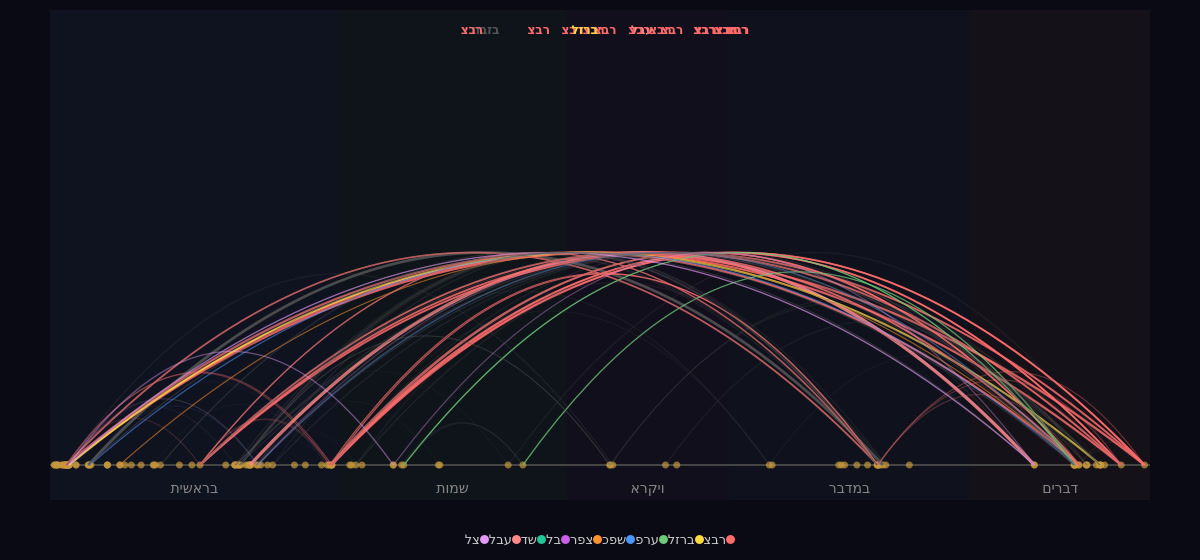
Eran Eliyahu Tobul Elul 5786
Sources
Scripture
- The Five Books of Moses
- The Book of Joshua
Sages and Commentators
- Babylonian Talmud, Berakhot 40a; Sanhedrin 70a — The Tree of Knowledge: vine/wheat/fig
- Babylonian Talmud, Sanhedrin 37b — "From the day the earth opened her mouth"
- Mishnah Avot 5:6 — Ten things created at twilight on the eve of the Sabbath
- Rashi on Genesis 2:9, 4:1, Numbers 19:2
- Or HaChaim on Numbers 16:30
- Zohar, Bereshit 36b — Reincarnation of Cain
- The Arizal, Sha'ar HaGilgulim, Introduction 36 — Cain → the Priesthood
Science
- Kobayashi, S. et al. (2004). "Retrotransposon-induced mutations in grape skin color." Science 304:982.
- Walsh, A.M. et al. (2013). "Widespread horizontal transfer of retrotransposons." PNAS 110:1012–1016.
- Ivancevic, A.M. et al. (2018). "Horizontal transfer of BovB and L1 retrotransposons." Genome Biology 19:85.
Primary Work
- Tobul, E.E. (2026). The Road and the Place: Directed Morphology in the Torah. boundbydesign.org
---
What Is Measured in the Main Book
The book The Road and the Place (Tobul, 2026) presents a quantitative analysis of biblical Hebrew morphology. The principal findings:
- 22 letters = 12 elemental + 4 AMTN (spirit) + 3 YHW (separation) + 3 BKL (relation). A complete system.
- 99.87% of morphology is governed by 10 control letters (p ≤ 0.0003).
- 87.8% root-meaning prediction from letter composition (5-fold CV, 98,122 pairs).
- 92.1% with vowel pointing — the 4.3% gap = the information content of the Oral Tradition.
- Z = 150.49 in a shuffle test — deviation from randomness that cannot be explained statistically.
- BovB/L1 equilibrium — only in sacrificial animals (sheep 1.00, bull 0.97, goat 0.97).
What this essay does is read the literary picture behind the numbers. The numbers are in the book. The picture is here.
Scientific Appendix: The Donkey in the Genome — Exploratory Research Notebook
The animal that the Torah pairs with the foreskin, with crouching, and with the sin-offering — is also the animal that shares with humans prominent anatomical features in reproductive regions. Three preliminary observations were examined: (1) BovB remnants shared by human and equines at similarly low fragment counts; (2) a double prepuce structure unique to equines; (3) extreme depletion of mobile elements in the HOXA13 region. The SRD5A2 investigation (8 versions) ended in an explicit negative result — no donkey-specific finding in coding.
This appendix is an exploratory research notebook and does not carry the central thesis of the essay. Science does not prove the midrash. The midrash does not depend on science.
→ Full notebook: The Donkey in the Genome
Appendix: Amtaniyahu — Morphological Families Test (Final)
The Structure of the Language: 22 = 7 + 7 + 3 + 5
The 22 letters of Hebrew divide into three functional groups:
| Group | Letters | Function | Example (root שב) |
|---|---|---|---|
| Amtaniyahu (7) | א, מ, ת, נ, י, ה, ו | Prefixes — open action | אשב, מושב, תשב, נשב, ישב, השיב, וישב |
| Kamtaniyahu (7) | כ, מ, ת, נ, י, ה, ו | Suffixes — close with relation | שבת, שבכ, שבנו, שבה, שבו, שבמ, שבי |
| BKL (3) | ב, כ, ל | Object relation | בבית, כבית, לבית |
| Foundation (12) | ג, ד, ז, ח, ט, ס, ע, פ, צ, ק, ר, ש | The root itself | ש, ב (= שב) |
Amtaniyahu and Kamtaniyahu share 6 letters. The only difference: א (prefix) ↔ כ (suffix). Aleph rules the opening, kaf rules the closing. And when kaf moves from BKL to the suffixes — what remains is ב and ל.
Bal. The same root that runs through the Torah: Hevel (Abel), Bavel (Babel), balal (to confuse), mabbul (the Flood), solet belulah (fine flour mixed). Bal = what remains when the system is complete. The remainder. The firstness that broke — and the repair that restores it.
The Test: Blind Judgment on the Entire Universe
To test whether amtaniyahu genuinely reveals morphological families — and not just random co-occurrences — a blind test was constructed:
Protocol (frozen before running):
- Frozen dictionary: 1,939 mandatory roots, each with an author-assigned basis root (yesod) — open file
- Target pairs (253): All pairs in the Torah where two different mandatory roots share the same basis root and appear in the same verse. Each root pair sampled once. 253 = the entire universe. No selection.
- Control pairs (253): Two mandatory roots from the same verse that do not share a basis root. Randomly sampled.
- Blind judgment: Two independent judges (Claude Sonnet) received the verse in Hebrew and the two roots — with no knowledge of the letter-set, the yesod, or the group assignment
- Question: "Does the verse express a specific relationship between the two meanings?"
- Categories: EXPLICIT_RELATION, CLEAR_TEXTUAL_METAPHOR, LEXICAL_FAMILY_ONLY, SAME_SCENE_ONLY, NO_RELATION, UNCLEAR
- Positive = both judges marked EXPLICIT, METAPHOR, or LEXICAL_FAMILY
Results — Final Run
64% vs. 17% — p < 0.0000001
| Group | n | Positive | Rate |
|---|---|---|---|
| Target — same basis root | 253 | 162 | 64.0% |
| Control — different basis root | 253 | 42 | 16.6% |
253 = everything there is. Not a sample — the entire universe.
Category Breakdown
| Category | Target | Control |
|---|---|---|
| EXPLICIT_RELATION | 29% | 18% |
| LEXICAL_FAMILY_ONLY | 36% | 1.6% |
| SAME_SCENE_ONLY | 8% | 17% |
| NO_RELATION | 26% | 62% |
The distinguishing category: LEXICAL_FAMILY_ONLY — 36% in target vs. 1.6% in control. 22× the rate. The judge recognizes lexical kinship — mikdash↔kodesh, mishpat↔shafat, na'al↔al — even when there is no explicit relationship in the verse.
Per-Letter Contribution
| Letter | Pairs | Positive | Success % | Examples |
|---|---|---|---|---|
| מ | 85 | 67 | 79% | mikdash↔kodesh, mishpat↔shafat, mishkan↔shakhan |
| ו | 25 | 15 | 60% | yad↔vad, tze↔tzav |
| ת | 34 | 20 | 59% | eḥad↔aḥat, nuf↔tenufah |
| י | 75 | 39 | 52% | ayil↔el, yashar↔shar |
| א | 119 | 61 | 51% | akhal↔kol, asaf↔saf |
| נ | 57 | 27 | 47% | nefesh↔pash, nasa↔sa |
| ה | 38 | 12 | 32% | ha-ger↔ger |
Mem = the queen of building. 79% success. When mem is the letter removed, nearly four out of five pairs are recognized as connected. Mem builds objects (mikdash), places (midbar), instruments (mizbe'aḥ), actions (mishpat).
Mem — The Root of Generation
Why mem? Because mem is not just a prefix. It is the root of generation in Hebrew:
מ = mayim (water). mi (who/water). yam (sea). em (mother). imah (mother). Mem alone = water in the singular.
"Let the waters be gathered unto one place" (Genesis 1:9) — that one place, water in the singular, is mem.
And mem alone cannot stand — a root does not stand on one leg. So mem adds ה (he), the feminine side: mah (what). Mem + he = a question. A beginning. Waters seeking form.
And ד (dalet) = two sides. Union. A door — two posts that meet. When dalet unites with mem:
Dam (blood) = ד + מ = union + water = two sides joining in one fluid
Adam (man) = א + דם = first + blood = the firstness of union
Adamah (ground) = אדם + ה = the feminine of adam = the earth from which he was born
Mem → mi → mayim → em → dam → adam → adamah. One chain of generation. And therefore mem generates: m+kodesh = mikdash (holy place), m+shakhan = mishkan (dwelling place), m+shafat = mishpat (justice), m+zavaḥ = mizbe'aḥ (altar). Mem generates a place from an action.
Additional Test: Reading the Essay Before Judging
Does the essay persuade the judge, or does the finding stand on its own? The same 506 pairs were sent again — this time after the judge read the full essay (160,000 characters):
| TARGET | CONTROL | Gap | |
|---|---|---|---|
| Blind (no essay) | 64.0% | 16.6% | +47.4% |
| Learned (after essay) | 66.8% | 19.0% | +47.8% |
Essay effect: +2.8% on target, +2.4% on control. Differential: 0.4%. The essay does not inflate. Does not persuade. The finding stands on its own.
(→ The finding: Morphological Families | → Frozen dictionary)
Appendix: Seven-Letter Reduction — Reduction Signatures in the Torah
→ Full appendix (Hebrew): Seven-Letter Reduction
Seven seed words × seven letters of removal × two findings: the triple (gaf+av+skl, p=3.61×10⁻⁷) and the YHW wave (Elonei Mamre + fig and pomegranate, p≈0.005). Full details in the appendix.
Statistical Appendix: The Quadruple Density Test
What Was Measured
136 key verses from this essay were tested using two primary tests, one robustness check, and one exploratory analysis against the Torah's 5,846 verses. All permutation tests use a fixed seedable PRNG (mulberry32). Seed: 20260914 for 124 frozen; 20261050 for 136 current. p is computed as (higher+1)/(B+1).
Final Confirmatory Results — 100,000 Permutations
| Set | T1 (AMTNYHU strip) | T2 (consonantal-frame roots) | exceedances |
|---|---|---|---|
| 124 frozen | Z = 11.23 | Z = 23.81 | 0 / 100,000 |
| 136 current | Z = 10.61 | Z = 24.12 | 0 / 100,000 |
p_MC = (0+1)/(100,000+1) ≈ 10⁻⁵ (Phipson & Smyth, 2010). Not a single random group, out of 200,000 attempts, reached the observed score.
Four Methods — Secondary Analysis (1,000 permutations, 136 verses)
| # | Method | What it measures | Z | p |
|---|---|---|---|---|
| T1 | AMTN+YHV removal | Delete 7 control letters from every word. What remains — count. No lexicon or morphological analysis; frequencies from corpus. | 10.65 | <0.001 |
| T2 | Consonantal-frame roots | Pool of 1,665 consonantal-frame roots (Tobul, 2026). Score = distance / root frequency. | 24.23 | <0.001 |
| T3 | Lexical weighting (robustness of T2) | Consonantal-frame root + lexical rarity + meaning-group specificity. Correlated with T2 (r ≈ 0.93) — not independent. | 26.38 | <0.001 |
| T4† | Names (exploratory) | 79 names decomposed into sub-roots. Score by rarity of the full name. Names selected from the essay — exploratory, not confirmatory. | 26.68 | <10⁻³ |
T1 and T2 are the confirmatory tests. T3 = robustness check. T4† = exploratory.
Six Anthologies — Same Four Tests
| Anthology | Verses | T1 | T2 | T3 | T4 |
|---|---|---|---|---|---|
| Ebal/Shechem axis | 136 | +10.65 | +24.23 | +26.38 | +26.68† |
| Brit (Covenant) | 123 | +5.12 | +9.92 | +8.60 | — |
| Jerusalem/Temple | 93 | +3.62 | +2.66 | +2.53 | — |
| Joseph | 118 | −4.92 | −4.54 | −3.79 | — |
| Tabernacle | 118 | −3.53 | −3.09 | −2.30 | — |
| "The place that He will choose" | 110 | −3.72 | −4.17 | −3.52 | — |
The Ebal/Shechem axis is anomalous in all three validated methods. The Covenant anthology remains a positive control — positive in T1–T3, but at a significantly lower level in T2/T3. T4 is presented separately as an exploratory analysis and is not used for anthology comparison at this stage. Joseph, Tabernacle and "the place" — negative in all three. Not every Torah narrative converges. Only this axis.
Name Decomposition — Method T4
79 names of people and places from the essay were automatically decomposed into sub-roots:
- Adam → adm, ad, dm
- Ebal → eybal, ey, yb, bl, eyb, ybl
- Hamor → khmor, khm, mo, or, khmo, mor, khr (AMTN+YHV)
- Jericho → yrikho, yri, reakh, ykho, rkh
- Shechem → shkhm, shkh, khm
Decomposition rules: minimum pair, all contiguous subsequences, AMTN+YHV applied (if 2+ remain), changed names → the original (Abram, not Abraham).
T4 score = rarity of the full name (not the sub-root). Ebal (4 occurrences) → high score. Abraham (124 occurrences) → low score. This filters noise and strengthens the truly unique connections.
Interactive Visualization
→ Quadruple Density Test — interactive interface
Post-Audit Robustness Tests
As part of an adversarial computational audit (LLM-assisted), T2 was tested with three robustness checks not part of the original analysis:
-
Position-matched null (20-bin stratified): Random groups were sampled with the same geographic spread across the Torah as the target set. T2 on 124: Z ≈ 17.9 (0/5,000 exceedances). The effect is not driven solely by verse spread.
-
Dominant root ablation: The ten highest-contributing roots were derived algorithmically by T2 contribution: rbtz (25.1%), khmr (7.8%), atn (7.5%), ʿrp (7.3%), adm (6.9%), sd (4.2%), ʿybl (2.6%), dm (2.3%), khr (2.1%), arr (1.8%) — together 67.4%. Removing all ten simultaneously: T2 on 124, Z = 3.95, p = 0.0013 (12/10,000). The signal weakens but remains anomalous — a tight, powerful kernel of long-range connections, around which the broader midrashic weave is built. (See also leave-one-motif-out below — removing each root individually leaves Z ≥ 16.)
-
Cutoff sensitivity: T2 was tested with frequency thresholds of 25, 50, 100, 200, 500, 1000. Z ranged from 19.7 to 23.8; in all cases 0 exceedances out of 5,000. The threshold is not a "magic number."
100,000 Permutations
After fixing the code and locking the seeds (mulberry32 PRNG; 20260914 for 124, 20261050 for 136), 100,000 permutations were run on both verse sets — the 124 frozen and the 136 current:
| Set | T1 (AMTNYHU strip) | T2 (mandatory roots) | exceedances |
|---|---|---|---|
| 124 frozen | Z = 11.23 | Z = 23.81 | 0 / 100,000 |
| 136 current | Z = 10.61 | Z = 24.12 | 0 / 100,000 |
p = 0.00001 (the floor of 100,000 permutations). Not a single random group, out of 200,000 attempts, reached the observed score.
Leave-One-Book-Out
Does the signal depend on a single Torah book? Each book was removed in turn; T2 was recomputed on the remaining verses (2,000 permutations, fixed seed):
| Removed | Verses remaining | T2 |
|---|---|---|
| — (baseline) | 124 | 24.00 |
| Genesis | 54 | 10.61 |
| Exodus | 114 | 22.20 |
| Leviticus | 119 | 24.88 |
| Numbers | 107 | 18.17 |
| Deuteronomy | 102 | 11.01 |
The signal is not entirely dependent on any single book. Genesis and Deuteronomy contribute most (the story begins and ends there), but even without them: Z > 10. The fact that removing Leviticus raises Z does not prove Leviticus "contributes" — it proves Leviticus is not necessary. The signal does not depend on any single book.
Leave-One-Motif-Out
Does a single root explain everything? Each dominant root was removed in turn:
| Removed | Z (from 24.00) |
|---|---|
| rbtz (freq 8) | 16.01 |
| khmr (45) | 21.74 |
| atn (13) | 21.30 |
| ʿrp (7) | 21.61 |
| adm (162) | 21.84 |
| sd (110) | 22.15 |
| khmor (18) | 23.42 |
| khr (38) | 22.84 |
| hrg (35) | 23.30 |
| dm (36) | 22.96 |
No single root is necessary. rbtz ("to crouch/lie down") is the heaviest (Z drops by 8 points), but Z = 16 is still an extreme outlier. The signal rests on a network of motifs, not on any one root.
Book-Stratified Null
Does the uneven distribution of key verses across books (70 from Genesis, 22 from Deuteronomy, 5 from Leviticus) generate the anomaly? In 2,000 permutations sampling the same number of verses from each book as the key set:
T2 = 19.93, 0/2,000 exceedances (p ≈ 0.0005). The signal is not an artifact of book distribution.
Exploratory Scan on External Corpus
The tests above examine the verses the essay itself selected. The exploratory scan asks a different question: does the motif-weave appear in the Prophets corpus, which was not part of the Torah-based density tests?
Method. A kernel of 39 mandatory roots in 4 tiers was frozen — with NO place names (Eival, Shechem, Gerizim excluded). The kernel scans 30-verse windows (stride 5) across 3,660 verses of the Prophets (Judges–Kings, Sefaria corpus). Each window is ranked by root-density score.
Results:
- Judges 9:1–30 (Abimelech at Shechem): rank 6 out of 727 (top 0.8%)
- All 6 windows of Judges 9: average rank 40/727 (top 5.5%)
- All 6 within top 62/727 (top 8.5%)
The raw single-window rank (6/727) yields p ≈ 0.008. The six windows are overlapping and are not independent observations. The block-level p depends on the regional statistic and the scan structure; a reasonable estimate (from permutations that preserve overlapping blocks) yields p ≈ 0.02–0.04. This result is exploratory, not a formal blind prediction — the hypothesis (Judges 9 should rank high) was specified before scanning, but was not externally pre-registered with a hash/timestamp.
Judges 9 tells the story of Abimelech son of Jerubbaal — a self-appointed king who reigns over Shechem, chosen beside a planted terebinth (verse 6), and narrated through the only fable in the Bible (Jotham's fable, verses 7–15). The chapter was written centuries after Deuteronomy, yet the kernel of 39 roots — containing no place name — identifies it as among the densest passages (rank 6 of 727).
The Foundation Split: 12 Letters
The Control Alphabet (Tobul, 2026) defines 22 letters = 12 foundation + 10 control: - 7 spirit (AMTNYHU) — removed in standard T1 - 3 relation (BKL) — "b-" (in), "k-" (like), "l-" (to) = spatial and comparative relations
This split predates the essay — it was defined in the book itself. If T1 survives even when all 10 control letters are stripped (not just 7), the framework is not ad-hoc.
| Strip | Unique strings (<200) | Z (124) | Z (136) |
|---|---|---|---|
| 7 letters (AMTNYHU) | 1,446 | 11.03 | 10.38 |
| 10 letters (+ BKL) | 353 | 4.17 | 4.13 |
The signal survives (p < 0.003 in both cases) but weakens: Z drops from ~11 to ~4. This makes sense — B-K-L carry genuine meaning: "in Shechem" ≠ "to Shechem," "like a donkey" ≠ "in a donkey." Stripping them erases real content distinctions.
The implication: AMTNYHU letters are truly "transparent" — stripping them exposes a skeleton. But BKL are borderline: grammatically transparent, yet semantically loaded. Exactly as the book claims.
Independent Replication: Blind LLM Verse Selection (Pilot)
Does the signal depend on the essay author's specific verse choices? To test this, 8 semantic criteria were defined — no roots, no letter analysis, no knowledge of any test results — and two independent language models (LLMs) were asked to select Torah verses matching those criteria.
Criteria: (1) Earth that responds, (2) firstborn/firstfruit/offering, (3) donkey/she-donkey, (4) stone/pillar/witness, (5) sacred tree, (6) blood and covering, (7) refuge/exile/wandering, (8) Shechem-area events — only if also matching criteria 1–7.
Results:
| Set | Verses | T1 | T2 | exceedances |
|---|---|---|---|---|
| Essay (Tobul) | 136 | 10.65 | 24.23 | 0/100,000 |
| Independent model A | 243 | 4.68 | 8.70 | 0/2,000 |
| Independent model B | 252 | 5.98 | 9.84 | 0/2,000 |
| Consensus (both models) | 142 | 5.78 | 8.51 | 0/2,000 |
Overlap with essay: Only 22% of the essay's verses were also selected by the models. 78% of the essay's verses were not selected — yet the effect persists.
Implication: Two independent models, guided only by semantic criteria, chose substantially different sets — and both show extreme T2 anomaly (Z > 8) with zero exceedances. However: the eight semantic criteria were derived from the essay itself — they are not independent of the hypothesis. The bot selection shows that the semantic criteria produce dense anthologies; it is not independent confirmation of the thesis. It does show that the signal survives ablation, leave-one-out, and alternative selection — meaning it does not depend on the exact set of verses chosen.
Note: This is a pilot with language models, not a formal blinded experiment with human readers. A pre-registered experiment with three independent human readers (who have not seen the essay) is planned (protocol hash: a577cb03...).
→ Audit package for independent replication: code, data, results (ZIP)
The interface includes: four Z tabs, benchmarks table, empirical null distribution of random scores vs. observed score, heatmap of 136×136 verse connections, and verse search by root.