Appendix: Food for Thought
This appendix does not prove anything. It asks questions that the data, once seen, make difficult to un-ask.
Two Creations, Two Genomes
Genesis opens with two creation narratives. Scholars have argued for centuries about why. We offer no theological answer — only an observation that, once noticed, is hard to dismiss.
Week One (Genesis 1) uses exclusively the name אלהים (Elohim). God creates by command — "let there be" — and the verb is בָּרָא (bara, to originate). The creatures are defined by what they physically possess: עוֹף כָּנָף — "winged bird" (the wing as mechanical apparatus). The earth produces חַיְתוֹ אָרֶץ — "beasts of the earth" (matter-bound). And on Day 5, a category appears that will never be mentioned again: הַתַּנִּינִם הַגְּדֹלִים — "the great reptiles."
Week Two (Genesis 2) introduces a compound name absent from Week One: יהוה אלהים (YHWH Elohim). The verb shifts from בָּרָא to יָצַר (yatsar — to form, to shape with intent, the verb of the potter). The bird is renamed: no longer עוֹף כָּנָף (winged bird) but עוֹף הַשָּׁמַיִם (bird of the heavens) — defined not by its equipment but by its domain. The beast is renamed: no longer חַיְתוֹ אָרֶץ (beast of the earth) but חַיַּת הַשָּׂדֶה (beast of the field) — שָׂדֶה, cognate with שַׁדַּי, a bounded, governed domain.
And the great reptiles? They are gone. They receive no mention in Week Two.
Now consider the genomes:
| Regime | Name | Verb | Genome type | Example |
|---|---|---|---|---|
| Week One | אלהים only | בָּרָא (create) | TE chaos — no regulation | Alligator: 37.7% TE, 65 families |
| Week Two | יהוה אלהים | יָצַר (form) | Regulated — managed TEs | Chicken: 1.05 Gb, 12.8% TE |
The alligator — closest living relative of the great reptiles — carries 18% DNA transposons distributed across 65 distinct families. Genomic chaos in the technical sense: prolific, undirected, unmanaged. No BovB/L1 equilibrium. No KRAB-ZFP silencing cascade.
The chicken — a dinosaur's descendant — compressed its genome to half the mammalian average. The dinosaur's heir did not continue inflating. It returned to regulation.
The terminological shifts in Genesis are not stylistic preferences. They are systematic:
| Genesis 1 | Genesis 2 | Shift |
|---|---|---|
| עוֹף כָּנָף (winged bird) | עוֹף הַשָּׁמַיִם (bird of heavens) | Equipment → Domain |
| חַיְתוֹ אָרֶץ (beast of earth) | חַיַּת הַשָּׂדֶה (beast of field) | Raw matter → Governed field |
| בָּרָא (create) | יָצַר (form) | Originate → Shape with intent |
| אלהים alone | יהוה אלהים | Multiplication → Regulation |
| תַּנִּינִם present | תַּנִּינִם absent | Chaos included → Chaos excluded |
We do not claim this proves anything. We note only that the lexical structure of the two accounts maps, with unexpected precision, onto the difference between transposon-chaotic reptilian genomes and transposon-regulated avian and mammalian genomes.
Draw your own conclusions.
The Snake Knows Only One Name
When the serpent addresses Eve, it says: "אַף כִּי אָמַר אֱלֹהִים לֹא תֹאכְלוּ" — Did Elohim indeed say you shall not eat? (Genesis 3:1).
The serpent speaks only the name אלהים. It never utters יהוה. In the traditional commentarial literature, this is noted as evidence of the serpent's spiritual limitation.
Now recall: BovB content in snakes stands at approximately 0.01% — a vanishing remnant. The snake served as the original horizontal donor of BovB to mammalian genomes (Walsh et al. 2013). It gave everything and retained nothing. It operates in the אלהים-only regime: pure multiplication, pure transmission, without the internal regulatory architecture that characterizes the יהוה אלהים domain.
The snake neither possesses BovB/L1 equilibrium nor deploys KRAB-ZFP silencing. Genomically, it is a creature of Week One that persists into the present.
Its speech, restricted to a single divine name, encodes exactly this status.
Before Day Four, There Is No Clock
A frequently raised objection: how can the "days" of Genesis 1 accommodate the Mesozoic Era — 186 million years of reptilian dominance?
The text itself answers this. The sun, moon, and stars are not created until Day 4:
"יְהִי מְאֹרֹת בִּרְקִיעַ הַשָּׁמַיִם… לְאֹתֹת וּלְמוֹעֲדִים וּלְיָמִים וְשָׁנִים"
— Let there be luminaries in the firmament of the heavens … for signs, and for seasons, and for days, and for years (Genesis 1:14).
Prior to Day 4, there exists no solar metric by which a "day" can be defined. The text explicitly states that calendrical time — days, seasons, years — begins only with the appearance of the luminaries.
The "days" preceding Day 4 are not solar days. They are epochs of indeterminate duration operating under the אלהים regime, in which time as a measured quantity does not yet exist.
The great reptiles of Day 5 — the תַּנִּינִם הַגְּדֹלִים — inhabit this pre-calendrical expanse. The Mesozoic fits naturally, not by allegorizing the text but by reading it on its own terms: measurable time begins when the text says it begins.
The Human-Specific Switch
Across seven primate species, the data tell a simple story:
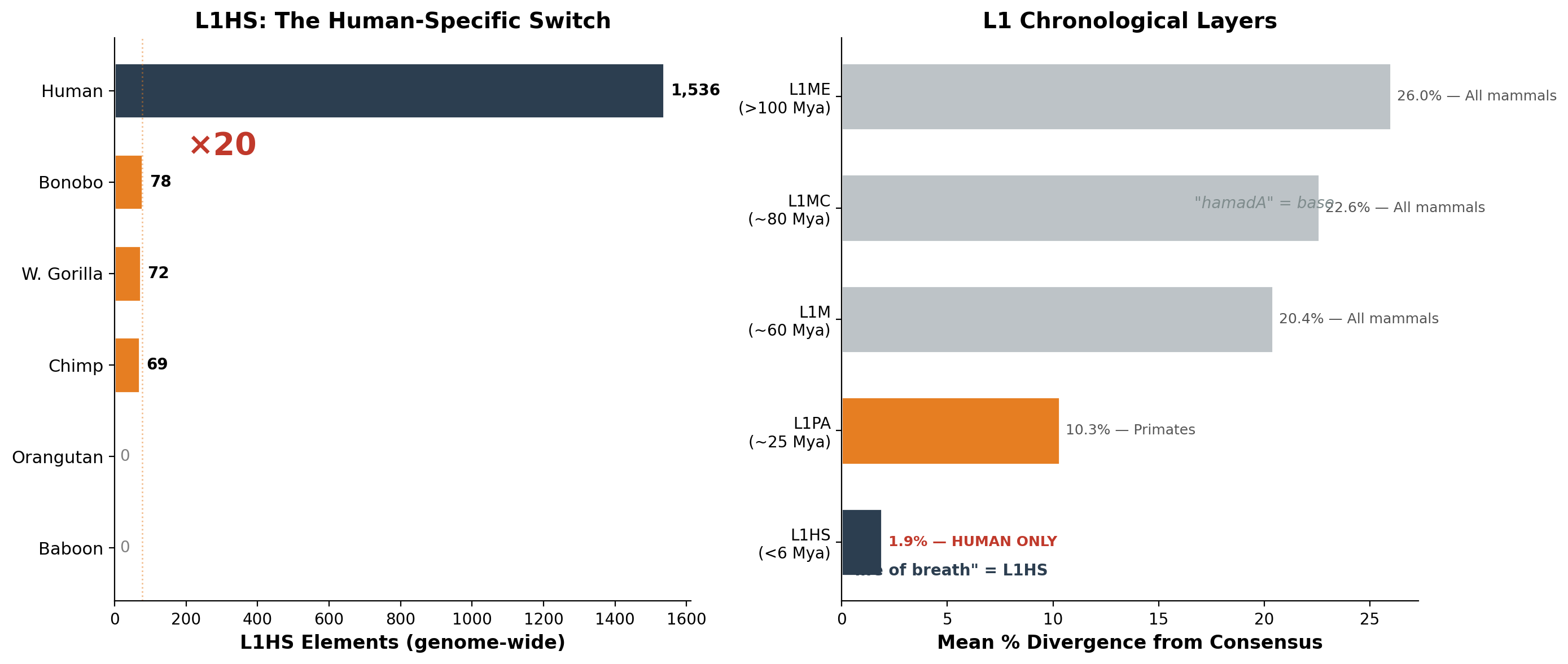
Left: L1HS elements genome-wide — human ×20 over the nearest primate. Right: L1 chronological layers — L1HS (<6 Mya) is human only.
| Species | L1HS Elements | Ratio to Human |
|---|---|---|
| Human | 1,536 | 1.00 |
| Bonobo | 78 | 0.05 |
| W. Gorilla | 72 | 0.05 |
| Chimpanzee | 69 | 0.04 |
| Orangutan | 0 | 0.00 |
| Baboon | 0 | 0.00 |
The genes are identical between species. FOXP2 (language), ASPM (brain size), KRTAP (hair/skin) — same TE density across all primates. The difference is one regulatory switch: L1HS on in humans, off or absent in everything else.
Neanderthals, with cranial capacity of 1,400–1,600 cc — equal to or exceeding modern humans — demonstrate that brain size is not the differentiating factor. But 96% of human L1HS regulatory sites are absent from Neanderthal genomes (Glinsky 2015). Of the 25 insertions exclusive to modern humans, there is significant enrichment at genes for neuron maturation, synapse formation, and undifferentiated neuron specification.
Hardware without software.
Each human neuron carries a unique L1-derived genomic variant, making the brain a landscape of ~86 billion regulatory experiments. The ape hippocampus, with L1HS remnants but no active transposition, lacks this diversity.
The species with the most active L1 lives the longest and thinks the deepest. The "damage" is the feature.
The Arrow of Descent
The standard narrative draws an arrow from ape to human: complexity increasing, capabilities accumulating, the human emerging at the top.
The data suggest a different reading.
The human genome carries the most active transposon (L1HS), the most elaborate regulatory machinery (KRAB-ZFP, piRNA, APOBEC3B), and the most diverse neural landscape. The ape genome carries the same genes but with the switch off. The Neanderthal sits between — larger brain, less software.
If you remove regulation, you do not get a simpler organism. You get a less capable one. The ape is not the human's ancestor in this reading — it is what happens when the regulatory switch is not turned on. The Neanderthal is what happens when it is partially turned on.
The Torah describes a sequence that moves not upward but downward:
- Adam — full regulatory capacity, direct communion, long lifespan (930 years)
- Post-Flood humanity — regulatory bottleneck (piRNA diversity collapse), lifespan drops 35.6×
- Nations — further regulatory divergence, linguistic separation
This is not a claim about evolutionary biology. It is an observation about the direction of the arrow. The genomic data are compatible with both readings — ascent through accumulated complexity, or descent through progressive deregulation. The text, for what it is worth, describes only one of these directions.
What This Appendix Does Not Claim
We do not claim that paleontology is mistaken. We do not claim that evolution did not occur. We do not claim that the days of Genesis are literal solar days or that they are not.
What we claim is simpler and more limited:
- The terminological shifts between Genesis 1 and Genesis 2 are systematic, not stylistic.
- These shifts map onto the difference between transposon-chaotic and transposon-regulated genomes.
- The pre-Day-4 absence of solar time is stated by the text itself.
- The human-specific L1HS switch has no known evolutionary explanation for why it activated in one species and not in its closest relatives.
- The direction of the arrow — ascent or descent — is a question the data cannot answer alone.
These are observations. They are not proofs. They are food for thought.
Think for yourself.