Chapter 29: Names, Descent, Census, and the Genome of Identity
29.1 Names as Architecture
Before Moses knows who he is, his name already knows.
The daughter of Pharaoh draws an infant from the water and calls him משה (Moshe) — "because I drew him from the water" (Exodus 2:10). The root מ-ש-ה — draw, move, depart — is woven through his entire life: the passive infant drawn out, the active prophet who does not depart from the Tent of Meeting (Exodus 33:11), the leader who will not cross over into the Land.
The name was given for one reason. It fulfills another. The root was there before either meaning was known.
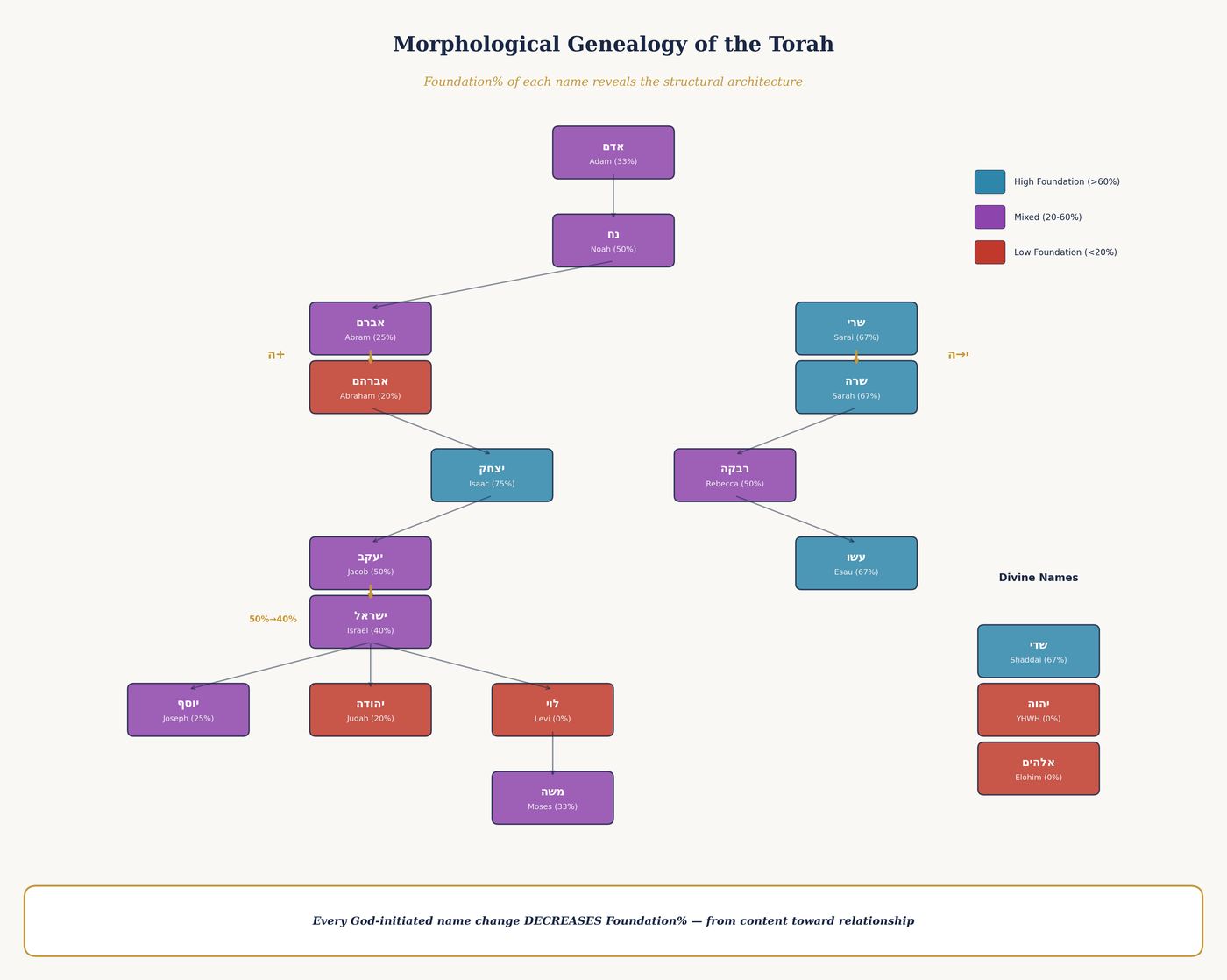
This is the rule, not the exception. Abraham is named before there are nations, yet his name contains the promise of multitudes. Isaac is named for laughter before the laughter is understood. Jacob is named "heel-grabber" at birth, and the root ע-ק-ב follows him through deception, struggle, and transformation until he becomes Israel.
In each case, the name is a morphological seed — a root that generates the narrative rather than being generated by it.
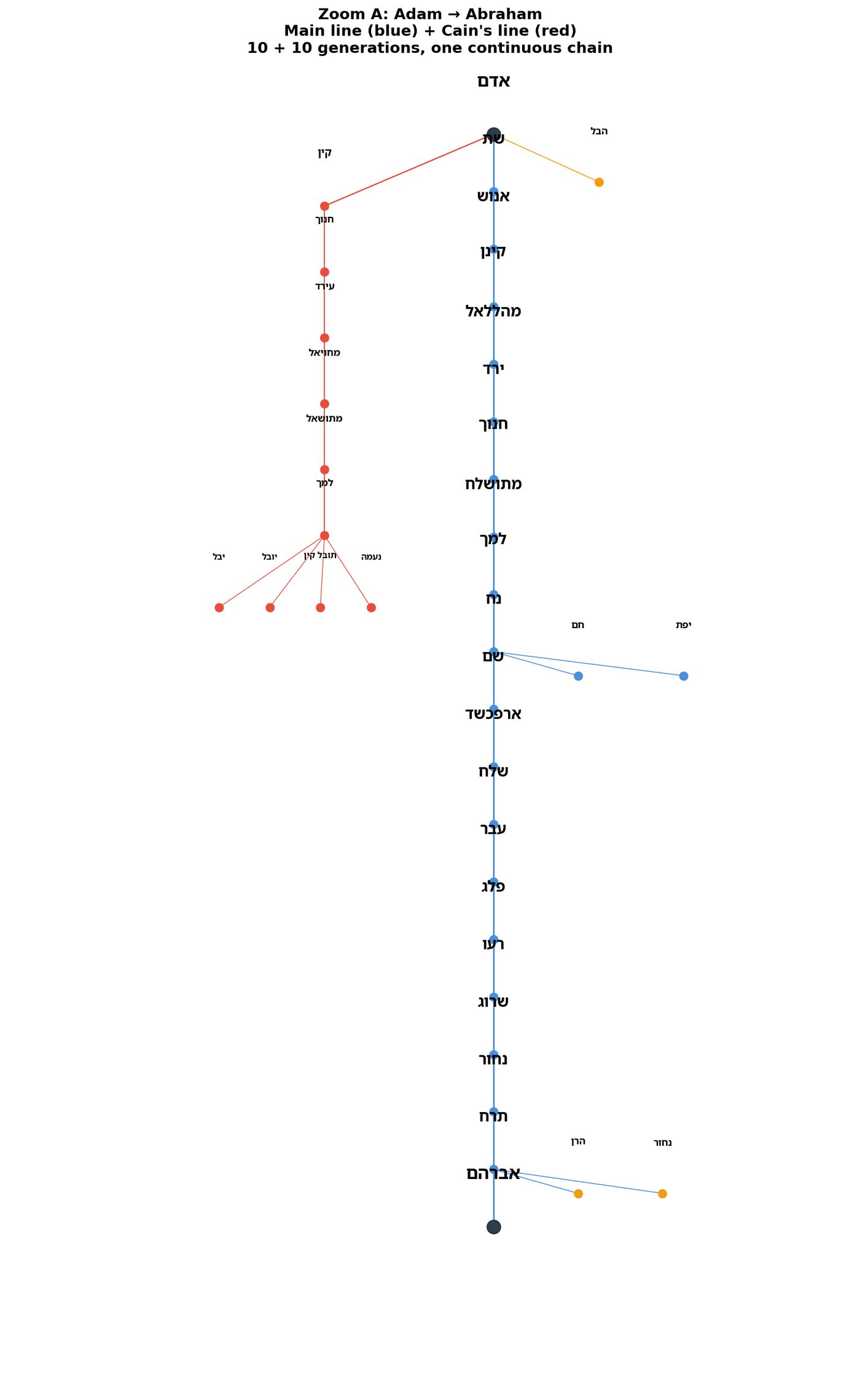
The Torah records genealogies exclusively through the male line: "by their families, by their fathers' houses" (לבית אבותם) — a formula that appears 18 times in the Book of Numbers alone. This patrilineal chain creates a continuous thread from Adam to the Twelve Tribes.
The chain terminates in twelve sons whose names span the entire Foundation% spectrum — from Levi at 0% (pure relationship, priesthood) to Gad at 100% (pure Foundation, military force). No tribe is complete alone. The system requires every member.
29.2 The Seventy: A Torah-Only Count
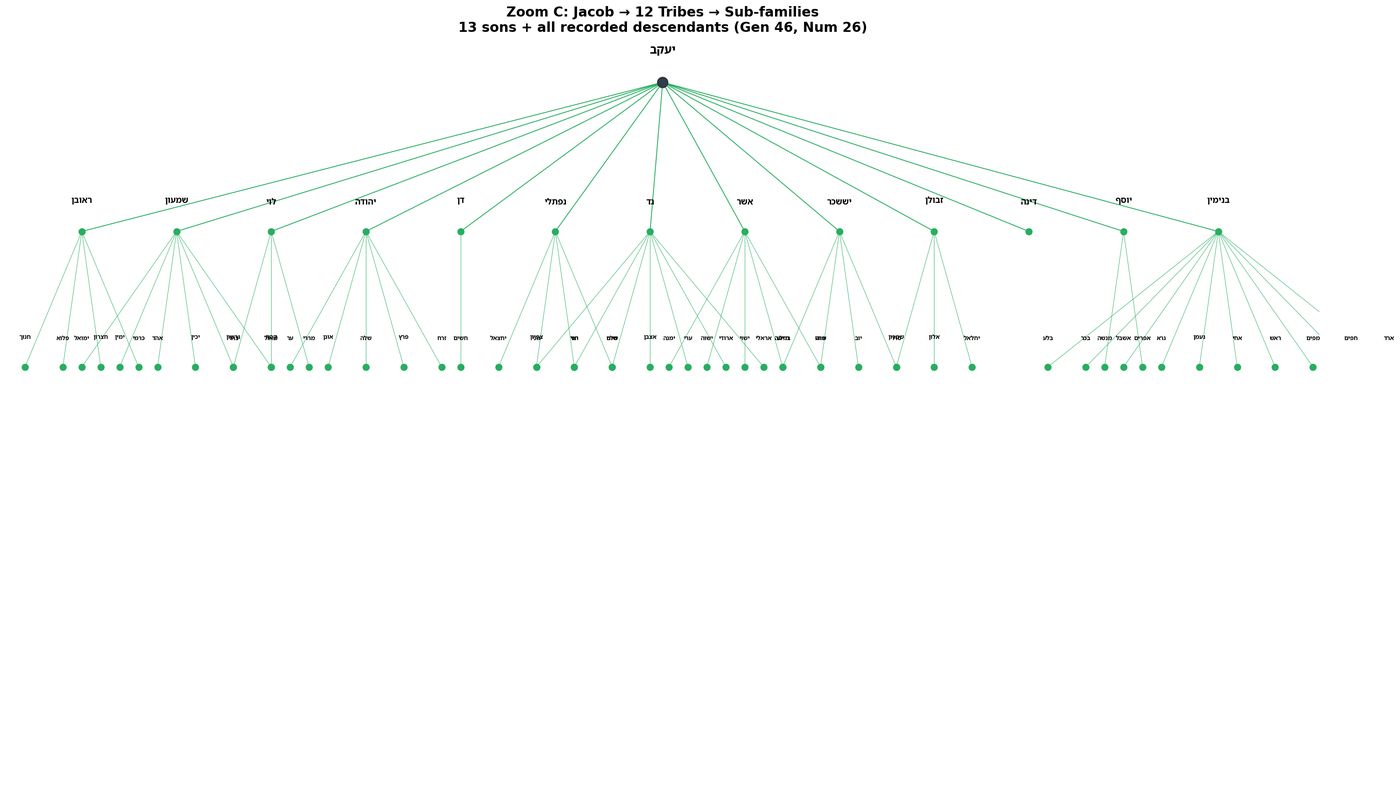
"All the souls coming to Jacob to Egypt, coming from his loins... seventy" (Genesis 46:26–27).
The traditional count of seventy souls has generated extensive rabbinic discussion, primarily because the names listed in Genesis 46 do not trivially sum to seventy. The Talmud (Bava Batra 123a) introduces Yocheved as born "between the walls" — during the entry to Egypt — to reach the count.
A direct reading of the text, without rabbinic addition, yields seventy exactly:
Counting principles:
- Er and Onan — counted. They are "coming from his loins" (יוצאי ירכו). They died in Canaan but belong to the count of Jacob's descendants.
- Shaul ben HaKna'anit — not counted. Identified by the text as son of a Canaanite woman — the only descendant so marked. Not purely of Jacob's seed.
- Dinah and Serach — counted. The Torah names them explicitly in the list.
- Yocheved — not counted. She does not appear in the list. "Between the walls" is Talmudic, not textual.
| Mother | Sons | Grandsons | Great-grandsons | Daughters | Total |
|---|---|---|---|---|---|
| Leah | 6 | 23 (incl. Er, Onan; excl. Shaul) | 2 | 1 (Dinah) | 33 |
| Zilpah | 2 | 11 | 2 | 1 (Serach) | 16 |
| Rachel | 2 | 12 | — | — | 14 |
| Bilhah | 2 | 5 | — | — | 7 |
| Total | 70 |
The count holds without external addition. The Torah's own list, read on its own terms, produces seventy exactly.
29.3 From 70 to 600,000: The Demographic Problem
At the Exodus, "about six hundred thousand men on foot, besides children" (Exodus 12:37). Immediately after: "and also a great mixed multitude (ערב רב) went up with them" (Exodus 12:38).
The Timeline
Three numbers appear in connection with the stay in Egypt: 430, 400, and 210 years. These are not contradictions — they measure from different starting points on a single timeline:
| Duration | From | To | Source |
|---|---|---|---|
| 430 years | Covenant between the Pieces (Abraham age 70) | Exodus | Exodus 12:40 |
| 400 years | Birth of Isaac = Expulsion of Ishmael (Abraham age 100) | Exodus | Genesis 15:13 |
| 210 years | Jacob enters Egypt (Abraham +290) | Exodus | Calculated |
The Four-Generation Proof
The Torah records the genealogy of Moses: Levi → Kehat → Amram → Moses. Four generations. Lifespans are given: Levi 137, Kehat 133, Amram 137, Moses 80 at the Exodus (Exodus 7:7). Korah follows the same pattern: Levi → Kehat → Yitzhar → Korah.
Four generations cannot produce 600,000 men from 70 souls under any realistic growth model. With 6 children per family across 4 generations starting from 35 couples: approximately 2,800 men. Even with 12 children per family: approximately 45,000. The gap to 600,000 is unbridgeable without an external population source.
Ishmael: The First Seed in a Foreign Land
"Know surely that your seed will be a stranger in a land not their own... four hundred years" (Genesis 15:13).
Ishmael is Abraham's seed. He is the first of Abraham's descendants to dwell in a foreign land. Hagar is Egyptian (Genesis 16:1). She takes Ishmael a wife from Egypt (Genesis 21:21). He fathers twelve princes (Genesis 25:13–16) — parallel to the twelve tribes of Israel.
From Ishmael's expulsion (Abraham age 100) to the Exodus (Abraham +500) = 400 years. Twelve founding families with ~15 generations of growth produce a population vastly larger than 70 souls with 8 generations.
ערב רב (erev rav — great mixed multitude): ערב shares its root with ערבי (Arabian) and ערבוב (mixing). The "great mixing" that accompanied Israel out of Egypt was not a population of strangers. It was the descendants of Ishmael — Abraham's other seed — who had dwelt in and around Egypt for 400 years.
29.4 The Wilderness Censuses: Levi as Control Group
Numbers chapters 1 and 26 record two censuses of Israel in the wilderness, counting men aged twenty and above who could serve in the army. Numbers chapter 3 records a separate census of Levi — males from one month old.
Census Data
| Tribe | Census 1 (Num 1) | Census 2 (Num 26) | Change |
|---|---|---|---|
| Reuben | 46,500 | 43,730 | −6.0% |
| Simeon | 59,300 | 22,200 | −62.6% |
| Gad | 45,650 | 40,500 | −11.3% |
| Judah | 74,600 | 76,500 | +2.5% |
| Issachar | 54,400 | 64,300 | +18.2% |
| Zebulun | 57,400 | 60,500 | +5.4% |
| Ephraim | 40,500 | 32,500 | −19.8% |
| Manasseh | 32,200 | 52,700 | +63.7% |
| Benjamin | 35,400 | 45,600 | +28.8% |
| Dan | 62,700 | 64,400 | +2.7% |
| Asher | 41,500 | 53,400 | +28.7% |
| Naphtali | 53,400 | 45,400 | −15.0% |
| Total | 603,550 | 601,730 | −0.3% |
Levi — Separate
| Clan | Males from 1 month (Num 3) |
|---|---|
| Gershon | 7,500 |
| Kehat | 8,600 |
| Merari | 6,200 |
| Total | 22,300 |
Census 2 (Numbers 26:62): 23,000 (+3.1%).
The Anomaly
Levi is counted from one month old — a much lower threshold than the other tribes' twenty years. Yet Levi totals only 22,300 while the other tribes total 603,550 (from age twenty).
If we estimate that approximately 40% of males are above twenty (standard ancient demography), the total male population including children is ~1,500,000. Levi at 22,300 (all ages) represents 1.5% of the male population.
If twelve tribes were equal, each would represent 8.3%. Levi is ×5.6 smaller than expected.
29.5 Endogamy vs. Exogamy: Why Levi Is Small
The explanation lies in marriage patterns.
"Amram took Yocheved his aunt as his wife" (Exodus 6:20). Amram married within the family. The Levites practiced endogamy — marriage within the tribe.
The other tribes, in Egypt for 210 years surrounded by a large Ishmaelite and Egyptian population, married local women. The children were counted "by their fathers' houses" (לבית אבותם) — patrilineal. An Israelite man who married an Egyptian or Ishmaelite woman produced Israelite children by Torah law.
This creates two growth regimes:
| Regime | Tribe | Growth mechanism | Rate |
|---|---|---|---|
| Endogamous | Levi | Internal marriage only | Slow — limited partners |
| Exogamous | All others | Marriage into large local population | Fast — unlimited partners |
Mathematical validation: Levi starting from 4 couples, 8 generations, 6 children per family (endogamous) = ~26,000. This matches the Torah's 22,300. The other tribes starting from 3 couples per tribe, 8 generations, 8 children per family (exogamous with local women) = ~55,000 per tribe average. This matches the Torah's ~55,000 average (603,550 / 11).
Levi is not small because it was punished or neglected. It is small because it maintained genetic isolation while everyone else mixed.
29.6 Simeon and Manasseh: The Same Mechanism
The second census reveals two extreme outliers:
Simeon collapses from 59,300 to 22,200 — a loss of 62.6%, the largest decline of any tribe. The trigger: Zimri son of Salu, "a prince of a fathers' house among the Simeonites" (Numbers 25:14), publicly took a Midianite woman during the Baal Peor incident. The plague that followed struck 24,000.
But the pattern begins earlier. In Genesis 46:10, among Simeon's sons we find "Shaul ben HaKna'anit" — the son of a Canaanite woman. Simeon is the only tribe with an identified foreign-mother son in the founding generation. The uncontrolled mixing that begins in Genesis culminates in Numbers.
Manasseh surges from 32,200 to 52,700 — a gain of 63.7%, the largest growth of any tribe. Manasseh is the son of Joseph and Asenath daughter of Poti-Phera (Genesis 41:45) — a recognized intermarriage. Joseph's marriage to an Egyptian woman is recorded without condemnation. The mixing is acknowledged, named, integrated.
The pattern: controlled mixing = growth. Uncontrolled mixing = collapse.
Simeon and Manasseh are almost exact mirrors: −62.6% vs. +63.7%. The mechanism is the same — exogamous marriage. The outcome depends entirely on whether the mixing is regulated or chaotic.
29.7 The Genome of Identity: BovB as Exogamy, L1 as Endogamy
The parallel between the genome and the demography is structural:
| Genome | Demography |
|---|---|
| BovB — horizontal transfer, from snake, exogenous | Exogamy — foreign wives, from outside, imported |
| L1 — vertical inheritance, endogenous, ancient | Endogamy — internal marriage, inherited, conserved |
| BovB/L1 ≈ 1.0 — altar animals only | Balanced mixing — Israel as a functioning whole |
Three Layers — In the Genome and In the Nation
| Layer | Genome | Nation |
|---|---|---|
| Altar / Balanced | BovB/L1 ≈ 1.0 (sheep, cow, goat) | Regulated tribes (Manasseh, Judah) |
| Kosher / Partial | BovB present but unbalanced (deer 0.69, giraffe 0.81) | Israel broadly — mixed but functional |
| Priesthood / Pure vertical | L1 only, no BovB (horse 0.00) | Levi — endogamous, serves the altar |
The priest (vertical/endogamous) offers the animal (balanced) on behalf of the nation (mixed).
This is not an analogy imposed on the data. It is the same architecture measured by different instruments:
- In the genome: RepeatMasker + BLAST measure BovB% and L1%
- In the Torah: Census numbers measure tribal sizes shaped by endogamy vs. exogamy
- In both: the ratio between horizontal and vertical determines function
Ishmael as the BovB of Abraham's Seed
| Ishmael | Israel |
|---|---|
| Same source (Abraham) | Same source (Abraham) |
| Through Hagar (Egyptian) — external channel | Through Sarah → Isaac → Jacob — internal channel |
| 12 princes (Genesis 25) | 12 tribes |
| Settled in Egypt/Paran — horizontal spread | Settled in Canaan → Egypt — vertical descent |
| = BovB: same DNA origin, horizontal transfer | = L1: same DNA origin, vertical inheritance |
Ishmael is the BovB of Abraham's seed. The same genetic material, transmitted through an external (horizontal) channel, amplified in a foreign environment, and reabsorbed into Israel as the "erev rav" — the great mixing.
In altar animals, BovB and L1 coexist at ratio 1.0. In Israel, Jacob's line (vertical) and Ishmael's descendants (horizontal) merged at the Exodus to form a unified nation. The erev rav are not foreign contaminants. They are the horizontal component of a dual-channel system — cousins, not strangers.
29.8 "Do Not Boil a Kid in Its Mother's Milk"
Three times the Torah commands: "You shall not boil a kid in its mother's milk" (Exodus 23:19, 34:26; Deuteronomy 14:21).
| Term | Channel | Meaning |
|---|---|---|
| Milk (חלב) | Vertical — from the mother, inheritance, nurture | L1 / endogamy |
| Meat (בשר/גדי) | Horizontal — the offspring's own flesh, external life | BovB / exogamy |
| Boiling | Unregulated mixing | Chaos — the Simeon pattern |
The prohibition is not against milk or meat separately. It is against combining the vertical channel (mother's milk = inheritance = L1) with the horizontal channel (kid's flesh = external life = BovB) without the regulation that the altar provides.
On the altar, BovB and L1 coexist at equilibrium. In the pot, they are mixed without structure. The altar is the regulated interface. The pot is unregulated combination.
כבש (lamb) = כבס (wash) = חלב (milk) = שכל (intellect) — all share the same letter structure (BBF/FBB = 33.3%). Washing is regulation. The lamb is the regulated form. Milk is the vertical channel. Intellect is what emerges when the channels are properly balanced.
The architecture of identity mirrors the architecture of the genome. Vertical and horizontal. Endogamy and exogamy. L1 and BovB. The priest, the offering, and the nation. The same structure, measured at different scales, in different media, across different millennia — and always, the ratio is what matters.