Chapter 10: Persistence, Scaling, and Long-Range Correlations
The Memory of a Text
Every text has a "memory" — a measurable tendency for the statistical properties at one point to predict the properties at a nearby point. In most texts, this memory is short. The style of one paragraph tells you something about the next paragraph, but very little about a paragraph ten pages later.
The Torah's mode system has a very different kind of memory.
Measuring Persistence
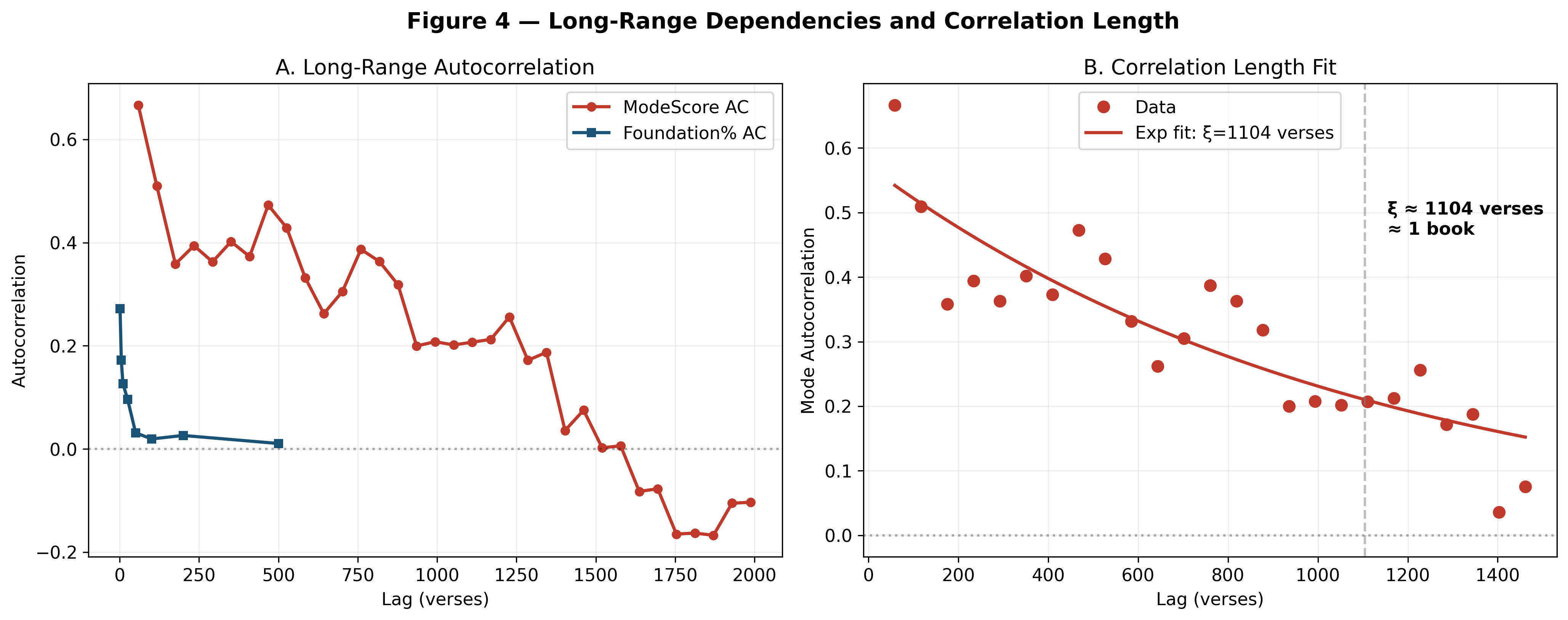
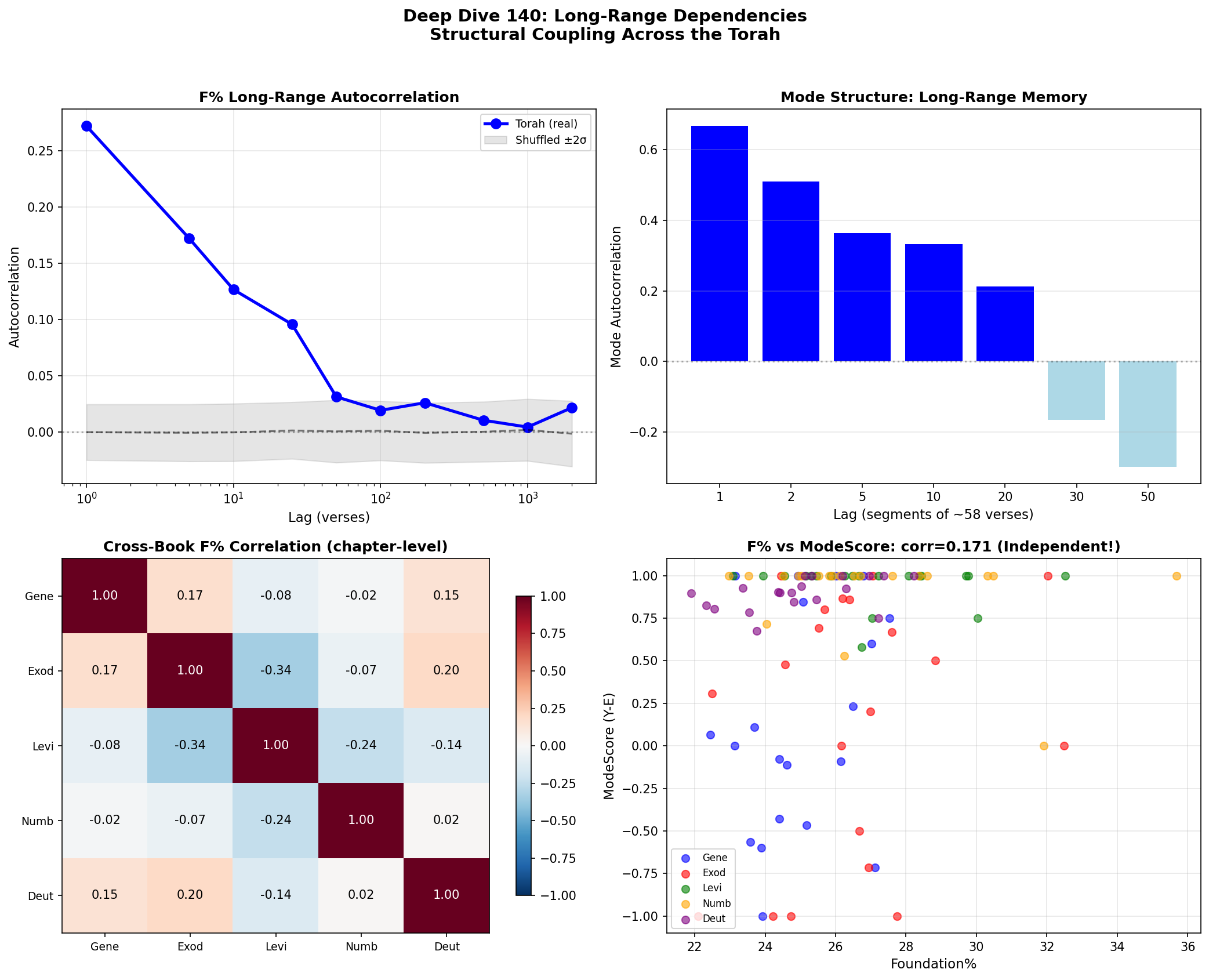
To measure how long the mode structure persists, we use a standard tool from time-series analysis: the autocorrelation function. We divided the Torah into 100 equal segments of approximately 58 verses each, computed the ModeScore for each segment, and measured how autocorrelation decays with increasing lag.
| Lag (segments) | Lag (verses) | Autocorrelation | Significance |
|---|---|---|---|
| 1 | ≈ 58 | 0.666 | Very strong — next segment highly predictable |
| 2 | ≈ 117 | 0.510 | Still strong |
| 5 | ≈ 293 | 0.363 | Nearly 300 verses and still correlated |
| 10 | ≈ 585 | 0.332 | 1/10 of Torah, still correlated |
| 20 | ≈ 1,170 | 0.212 | One-fifth of Torah — still positive |
| 30 | ≈ 1,755 | −0.165 | Turns negative — narrative arc effect |
| 50 | ≈ 2,923 | −0.297 | Half-Torah: strong anti-correlation |
Extraordinary initial memory. The autocorrelation of 0.666 at lag 1 means the mode state of any 58-verse segment is strongly correlated with the next segment. The text flows — it does not jump.
Long-range persistence. At lag 10 (≈ 580 verses — roughly the length of Leviticus), the autocorrelation is still 0.332.
Half-Torah anti-correlation. At lag 50, the autocorrelation becomes negative (−0.297). The first and second halves tend to be in opposite mode states — the signature of a large-scale directional structure.
The Correlation Length
Fitting an exponential decay model yields:
ξ ≈ 1,104 verses — approximately 0.9 books.
| System | Typical correlation length |
|---|---|
| Random text | 0 (no memory) |
| Typical novel | A few paragraphs |
| Academic paper | A few sections |
| Torah mode system | ~1,100 verses (~1 book) |
In complex systems physics, a correlation length of this magnitude places the Torah in the regime of long-range correlated systems — alongside DNA sequences, neural activity patterns, and physical systems near phase transitions.
Anti-Correlation: The Push and Pull of Names
The cross-correlation between יהוה density and אלהים density strengthens with scale:
| Window (verses) | Cross-Correlation |
|---|---|
| 10 | −0.093 |
| 50 | −0.134 |
| 200 | −0.237 |
| 800 | −0.582 |
Where one name increases, the other decreases. This is the hallmark of a genuine two-state system. For comparison, when divine-name labels are shuffled randomly, the anti-correlation vanishes and becomes strongly positive (+0.81). The Torah's anti-correlation is a property of the specific arrangement of names — not of language or vocabulary.
The Dual Scaling Law
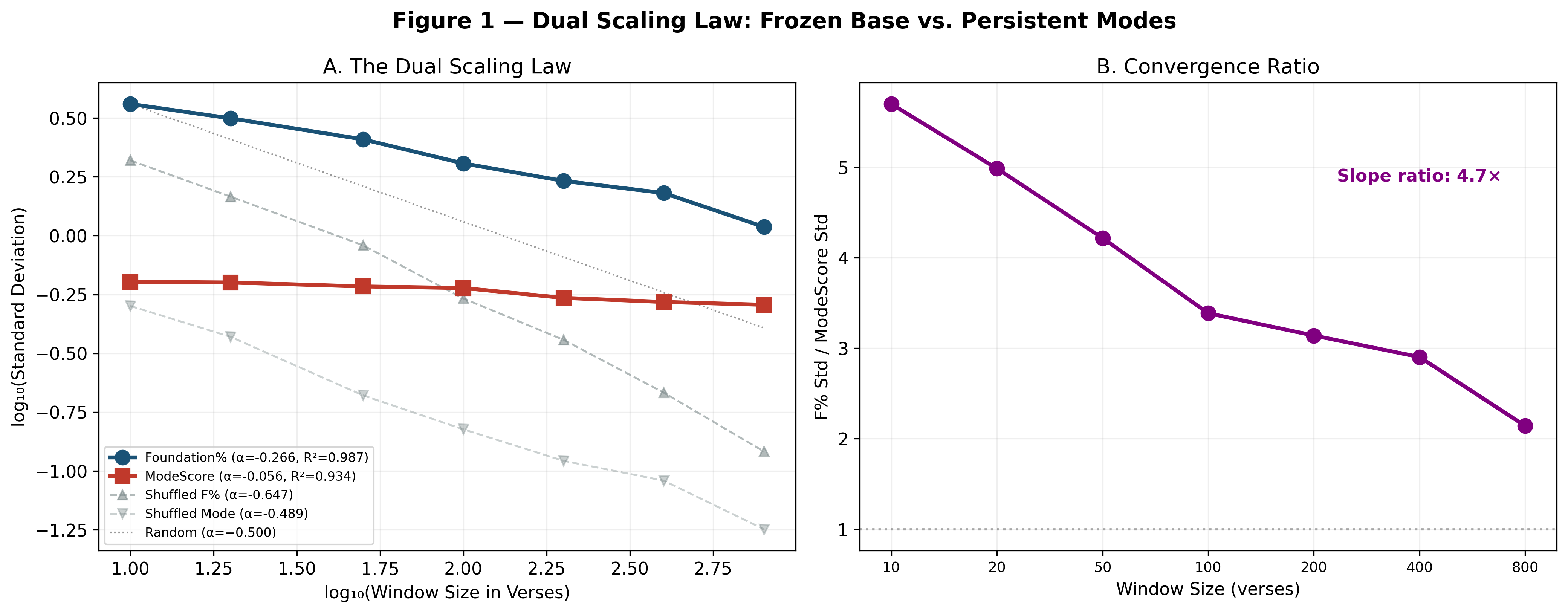
We measured Foundation% and ModeScore across seven window sizes (10–800 verses) and plotted variability against scale on a log-log plot.
Foundation% (the base layer):
- Scaling slope: α = −0.266, R² = 0.986
- Converges faster than random. The morphological base approaches its mean with strong order.
ModeScore (the mode layer):
- Scaling slope: α = −0.056, R² = 0.934
- Converges much slower than random. Nearly flat — the modes maintain variability at all scales.
The convergence ratio is 4.7× — the base "freezes" nearly five times faster than the modes.
What this means concretely: increase the window by a factor of 10, and ModeScore variability drops by only 12%. A random signal would drop 68%. The mode layer is an order of magnitude more persistent than chance.
Shuffled Torah: both slopes collapse to near −0.500 (random). The dual scaling law is entirely a property of the text's organization.
The dual scaling law was tested across 8 different configurations (varying window ranges and metric definitions). All ModeScore slopes fall between −0.144 and +0.037, mean −0.067 ± 0.054 — every value substantially shallower than random. The result is robust.
The Power Spectrum
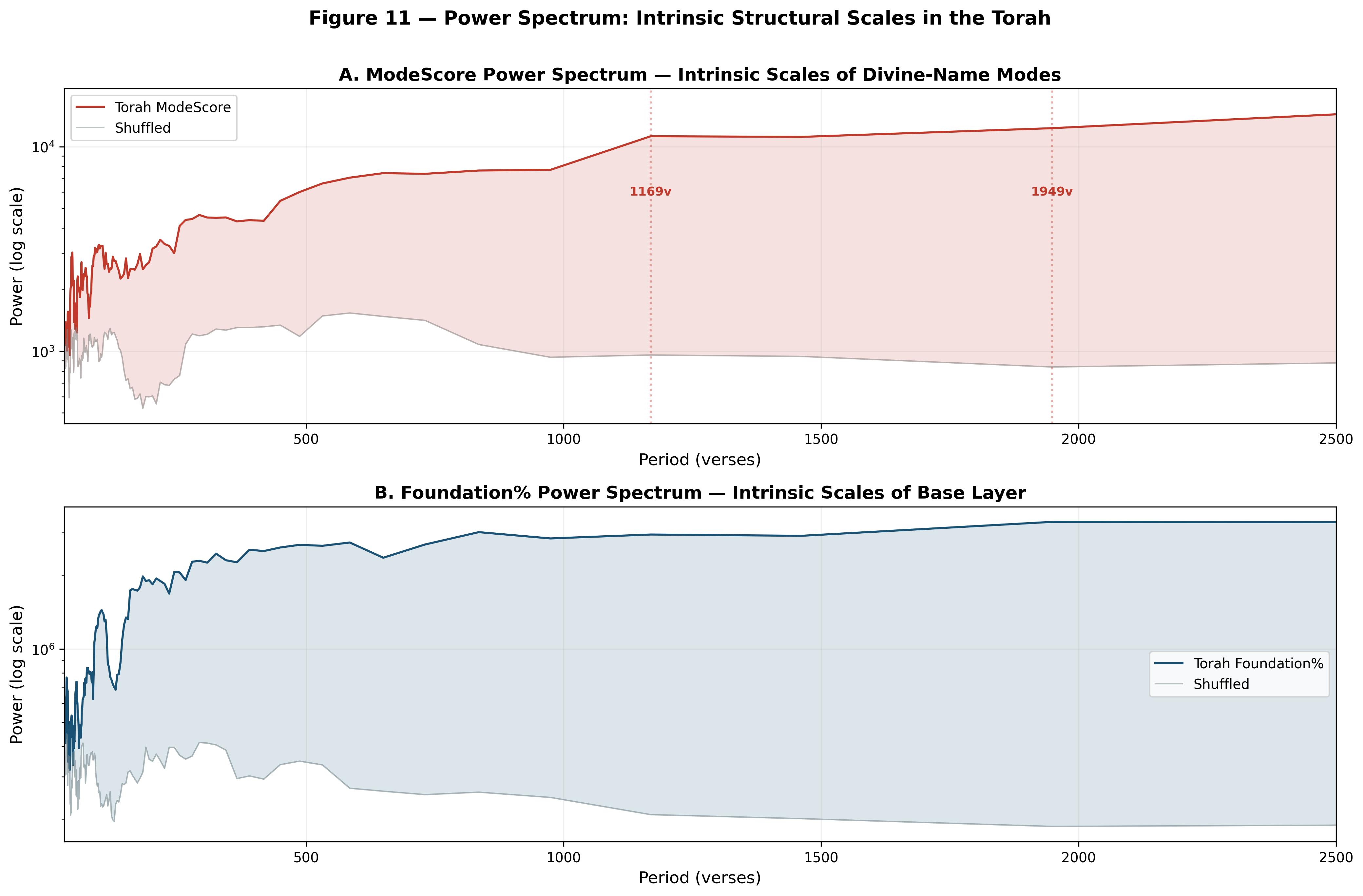
Fourier analysis provides independent confirmation. Dominant peaks appear at:
| Period (verses) | Correspondence |
|---|---|
| 254 | ~Parasha (weekly reading) |
| 450 | ~Sedra (narrative unit) |
| 1,169 | ~Mean book length (5,846/5) |
| 2,923 | ~Half-Torah |
The 1,169-verse peak corresponds almost exactly to the mean book length. The mode structure contains a natural periodicity at the book scale.
Foundation% Memory
For the base layer, verse-level autocorrelation against 200 shuffled controls:
| Lag (verses) | Real AC | Z-score |
|---|---|---|
| 1 | 0.272 | 21.95 |
| 5 | 0.172 | 13.63 |
| 10 | 0.127 | 9.93 |
| 25 | 0.096 | 7.50 |
| 50 | 0.031 | 2.21 |
| 200 | 0.026 | 2.01 |
Six of ten lags show significance (Z > 2), extending to lag 200. The base layer's structure reaches across multiple chapters. Shuffled texts: zero autocorrelation at every lag.
Cross-Book Structural Echoes
Interpolating each book's Foundation% to a common 50-point scale and computing cross-book correlations:
| Book pair | Correlation |
|---|---|
| Genesis ↔ Exodus | 0.165 |
| Genesis ↔ Deuteronomy | 0.147 |
| Exodus ↔ Deuteronomy | 0.203 |
| Exodus ↔ Leviticus | −0.340 |
| Leviticus ↔ Numbers | −0.236 |
The first and last books — separated by over 4,000 verses — are positively correlated. Narrative books correlate positively; Leviticus (legal register) correlates negatively with neighbors. In a patchwork text, cross-book correlations would follow no consistent pattern.
Two Independent Channels
The most important structural finding:
Foundation% ↔ ModeScore: Pearson r = 0.171
Barely different from zero. The Torah contains two separate structural fingerprints that are genuinely independent:
- A base-layer fingerprint (Foundation%) — moderate-range memory, fast convergence (α = −0.266)
- A mode-layer fingerprint (ModeScore) — long-range memory, extremely slow convergence (α = −0.056)
Word-length autocorrelation — a metric with zero dependence on divine names — confirms the base layer independently:
| Lag (verses) | Word-length AC | Shuffled |
|---|---|---|
| 1 | 0.175 | 0.015 |
| 5 | 0.096 | 0.012 |
| 10 | 0.049 | 0.005 |
The base layer is carried by the morphological properties of every word, not by divine names.
The Constraint
Any theory of Torah composition must account for both channels simultaneously. The two layers are independent — a theory that explains one does not explain the other.
A patchwork assembly from independent sources would produce neither. A single author with a consistent style might explain the base layer but not the dynamic modes. A deliberate editorial process could explain both — but only by maintaining extraordinary control over both the morphological composition and the divine-name distribution simultaneously, across 5,846 verses.
A frozen base that converges fast. Persistent modes that barely converge at all. Two independent channels. One text.
This is not the signature of a patchwork. It is the signature of a system.