Chapter 13: The Four Divine Names
A Note to the Reader: The chapters that follow depart from the purely statistical analysis of Parts I–IV. What follows is interpretive reflection — an exploration of possible resonances between the measured structural properties of the Torah and the semantic content of its most fundamental elements. These observations are offered not as scientific claims but as invitations to thought. The reader who prefers to remain within the domain of empirical analysis may regard Parts I–IV as the complete scientific argument. Part V is an additional, speculative layer — one that the data permit but do not require.
From Statistics to Meaning
Parts I through IV established the Torah's dual-layer architecture through purely quantitative analysis — scaling exponents, autocorrelation functions, boundary detection algorithms, and multi-dimensional corpus discrimination. No interpretation was imposed. No meaning was assumed. The numbers spoke for themselves.
But the Torah is not merely a statistical system. It is a text saturated with meaning — meaning that has sustained civilizations, inspired philosophies, and shaped the moral imagination of humanity for over three thousand years.
The structures we have measured are not abstract mathematical objects floating above the text. They are embedded in a language — and that language carries millennia of semantic depth. The question we now ask is: Does the measured architecture of the text resonate with the semantic content of its most fundamental elements?
The Four Names
Four principal divine names appear in the Hebrew Bible, each carrying its own constellation of theological meaning:
יהוה (YHWH) — The Tetragrammaton
The most sacred name in the Torah. Four letters: י-ה-ו-ה. So holy that Jewish tradition forbids pronouncing it as written — it is replaced in prayer by "Adonai" (my Lord) and in casual speech by "HaShem" (the Name).
Theologically, יהוה is associated with mercy, personal relationship, covenantal presence, and the intimate God who walks in the Garden, speaks to Abraham face to face, and leads Israel through the wilderness.
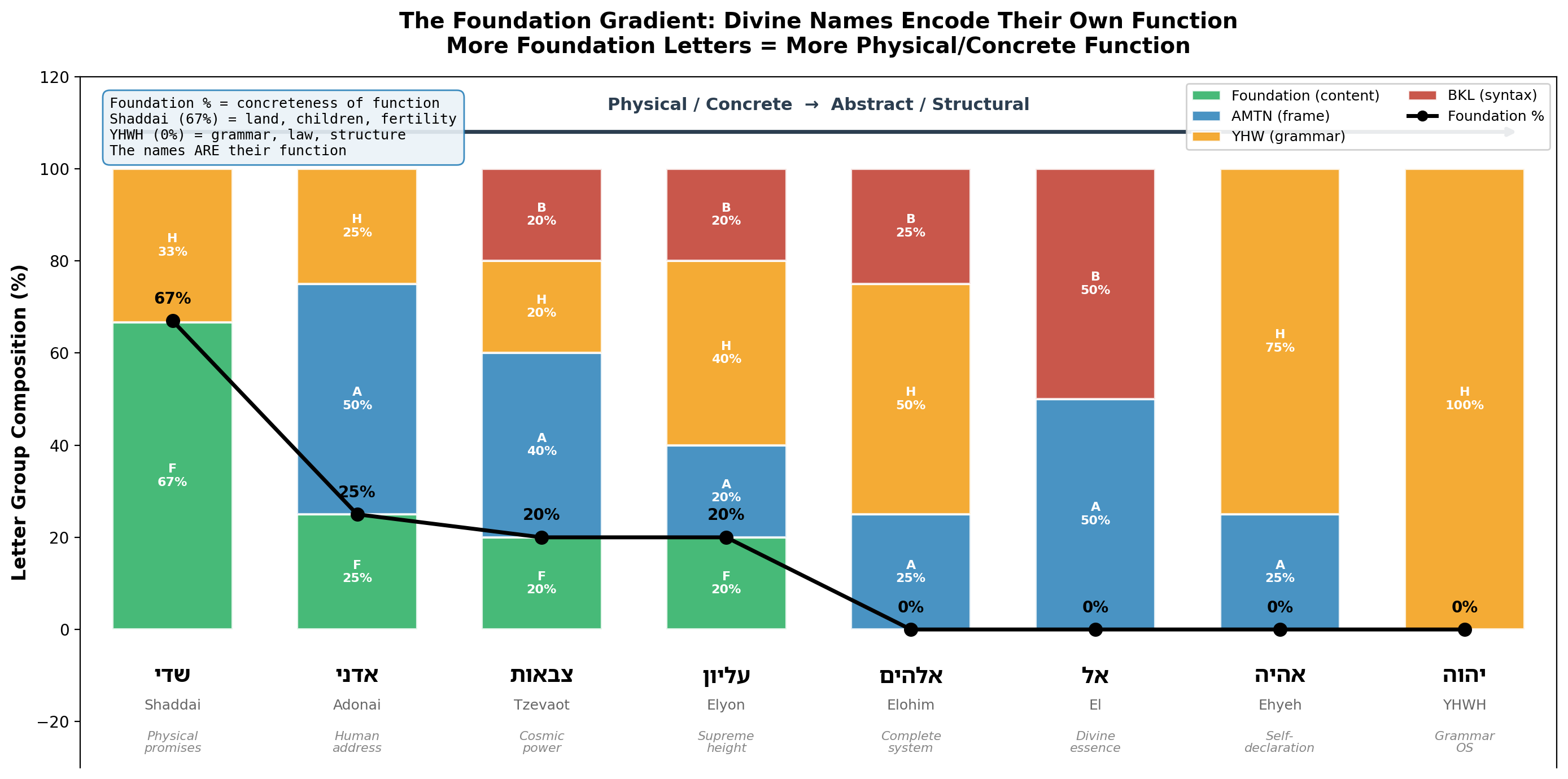
Morphological analysis: Every letter is a YHW letter. Foundation% = 0%. This is the purest possible expression of the grammar/existence group — pure relationship, pure mode, with zero content.
The name literally cannot be inflected with possessive suffixes. You cannot say "my YHWH" or "your YHWH" — the name resists grammatical modification. It is grammatically absolute.
By contrast, when God self-identifies as יהוה — "אני יהוה" ("I am YHWH," appearing 81 times) — both words contain zero Foundation letters. The self-identification formula is pure grammar: a mode declaration made entirely in the structural layer of the language.
אלהים (Elohim) — The Creator
Associated with judgment, creation, universal law, and the transcendent God who creates the world by speaking ("and God said..."), who sees and evaluates ("and God saw that it was good"), and who establishes the fundamental structures of reality.
Morphological analysis: Built entirely from Control letters — א(AMTN) + ל(BKL) + ה(YHW) + י(YHW) + ם(AMTN). Foundation% = 0%. All three Control subgroups are represented.
Unlike יהוה, this name can be inflected: אלהיך ("your God," 247×!), אלהיכם ("your God" plural, 85×), אלהי ("God of..." 60×), אלהינו ("our God," 30×). The suffixes all encode address direction and relationship.
Key insight: The grammar layer (יהוה) cannot be modified; the content-system layer (אלהים) can be. This mirrors the statistical finding: the mode layer is a fixed signal, while the base morphological system is flexible and context-dependent.
אהיה (Ehyeh) — "I Will Be"
The name revealed to Moses at the burning bush: "אהיה אשר אהיה" — "I Will Be What I Will Be" (Exodus 3:14). Associated with becoming, process, dynamic existence, and the unfolding of divine presence through time.
Morphological analysis: א(AMTN) + ה(YHW) + י(YHW) + ה(YHW). Foundation% = 0%. Like יהוה, built entirely from Control letters — but with a different composition: it begins with an AMTN letter (frame) rather than a YHW letter (existence).
Gematria: אהיה = 1+5+10+5 = 21. And 21² = 441 = אמת (emet, "truth"). The name of becoming, squared, equals truth. Existence-in-process, when completed, yields truth.
שדי (Shaddai) — The Foundation God
Often translated as "Almighty." The name of the patriarchal God — the God who appeared to Abraham, Isaac, and Jacob before the revelation of the Tetragrammaton.
Morphological analysis: ש(Foundation) + ד(Foundation) + י(YHW). Foundation% = 67% — the highest of any divine name, and the only divine name containing Foundation letters.
This structural uniqueness places שדי in a category entirely its own. While all other divine names exist in the grammatical/relational layer of the language, שדי reaches down into the morphological bedrock — the Foundation layer — the layer of content, substance, and root.
(A full exploration of El Shaddai follows in the next chapter.)
The Structural Map
When viewed through the morphological lens of this book, the four names appear to correspond to different structural layers:
| Name | Foundation% | Control Composition | Possible Structural Layer |
|---|---|---|---|
| שדי | 67% | F+F+YHW | Layer 1: Foundation — the bedrock |
| אלהים | 0% | AMTN+BKL+YHW | Layer 2: System — structure, creation, law |
| יהוה | 0% | Pure YHW | Layer 3: Mode — presence, relationship, covenant |
| אהיה | 0% | AMTN+YHW | Layer 4: Becoming — dynamic existence |
Each name occupies a different position in the architecture. Each is built from a different combination of letter groups. Each corresponds — suggestively, not provably — to a different layer of the textual system we have measured.
The Verb-Name Dictionary
The Torah assigns different verbs to different names, and this assignment is strikingly systematic:
| Verb | Meaning | Y:E ratio | Belongs to... |
|---|---|---|---|
| וידבר | spoke (formally/legislatively) | 97%:3% | יהוה (law) |
| ויאמר | said (generally) | 83%:17% | Shared, Y-dominant |
| ויברך | blessed | 40%:60% | אלהים (creation) |
| ויזכר | remembered | 0%:100% | אלהים only! |
| וירא | saw | 41%:59% | אלהים (perception) |
וידבר (formal legislative speech) is 97% יהוה — essentially only the law-mode name speaks formally. ויזכר (remembered) is 100% אלהים — only the creation-mode name remembers. ויברך (blessed) skews toward אלהים — blessing is a creative act.
The verbs are not randomly distributed. They map onto the functional distinction between the names: יהוה legislates, אלהים creates.
The Self-Describing System
Perhaps the most remarkable observation is that this system appears to be self-aware. The Torah describes its own name-architecture in Exodus 6:3:
"I appeared to Abraham, Isaac, and Jacob as El Shaddai, but by My name YHWH I was not known to them."
Read through the morphological lens: the text describes a transition from the Foundation-layer name (שדי, F%=67%) to the Mode-layer name (יהוה, F%=0%). From content to grammar. From substance to structure. From what God does to who God is.
This is exactly what the statistical data shows: Genesis = 55% אלהים (content/creation mode) → Leviticus = 100% יהוה (structure/law mode).
The text appears to reflect the same structural pattern detected statistically — and it does so in its own language, at the pivotal moment of name-revelation.
The next chapter explores the deepest of these names — שדי — and discovers that the resonance between structure and meaning runs deeper than we might have imagined.